Footwork on the Martial Side
Most people meet taiji as a slow solo exercise for health. The martial side of the art uses the same body rules under a different requirement: someone is trying to take your balance. This article reads that side — root, pivot, knee alignment, and the deliberate sacrifice of balance — from Dan Docherty’s T’ai Chi Ch’uan: The Martial Side, and asks what survives the trip to a tennis court.
The Martial Side
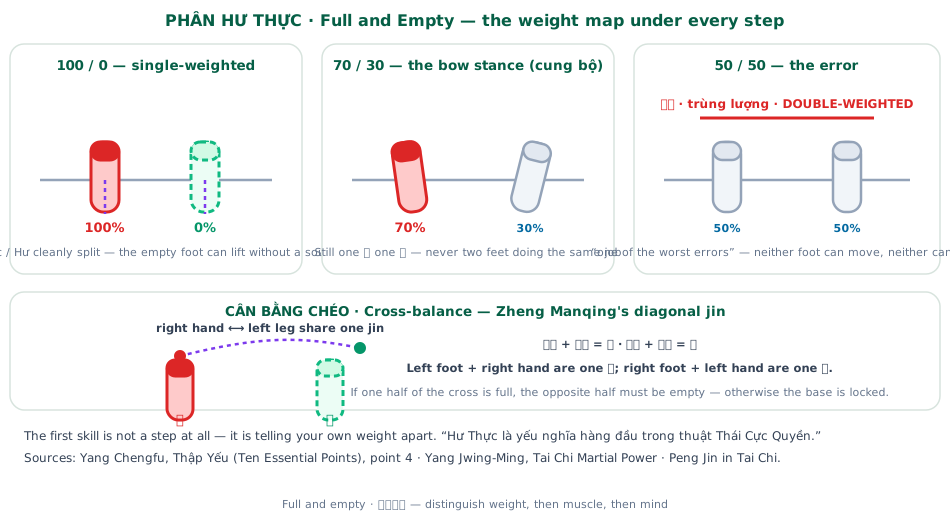
The martial side does not invent new footwork. It keeps every rule the solo form teaches — full and empty, relaxed waist, unbroken chain — and then adds a test: can you keep those rules while someone pulls on you? The Vietnamese tradition calls the basic standing practice trụ căn, literally “planting the root.” It is the same hư thực (full-and-empty) distinction of Yang Chengfu’s fourth point, tested under load.
What changes on the martial side is the consequence of error. In solo practice, standing 50/50 is a habit. Under a push, standing 50/50 is a fall — because if both feet are equally loaded, neither can move, and the double-weighting error (trùng lượng) that the classics call one of the worst faults becomes something an opponent can demonstrate to you.
Root and Pivot
Root is the property that lets a body receive force without being moved. It is produced by the same chain the Ten Essential Points describe — root in the foot, issue in the thigh, master in the waist — and the martial side adds a drill: have someone push, and notice that the failure is never in the shoulders. The diagnostic is always below, in the waist and the leg, exactly as the classic says.
The pivot is how root is preserved while direction changes. The body turns on one loaded foot rather than sliding on two, which keeps the full/empty split intact through the turn. This is the practical reason the tradition forbids the flat-footed square stance: a body that is balanced on both feet has nothing left to pivot on.
Knee and Alignment
The knee rule is the one the martial side states most often and in the most detail: the knee must track over the toes, in the direction the toes point, never collapsing inward or drifting past them. The peng jin literature (the expanded, supportive force that is the art’s signature) treats this as a structural requirement rather than a safety note — alignment is what lets force travel up the chain instead of leaking out at a bent joint.
This is the single most transferable line in the whole shelf. The knee-over-toe rule is standard modern tennis coaching and standard sports-medicine advice for knee injury prevention. The martial art arrived at the same rule from the opposite direction: it was protecting the force path, not the joint.
Sacrificing Balance
One instruction on the martial side looks like a contradiction: to strike effectively you must sometimes give up your balance deliberately. The entering step commits weight fully in one direction — more committed than balance would normally allow — because a strike needs the whole body behind it, and because the recovery is planned as part of the movement rather than left to chance.
The condition is that the sacrifice is chosen, not accidental. The practitioner knows which foot is full, knows where the weight is going, and has already decided how to recover. An unplanned loss of balance is ordinary clumsiness; a chosen one is the mechanics of a committed shot.
On the Tennis Court
Three transfers are direct.
1. Root is a test, not a feeling. The martial drill — get pushed and find the failure below the waist — has a court equivalent: when a player’s contact point collapses under a heavy ball, the fault is almost always that the feet stopped working before the arm did. Test it under load, not in shadow practice.
2. Pivot on one foot, never slide on two. Keeping the full/empty split through a turn is what makes a direction change quick. A player who pivots on a loaded foot is already moving; one who slides on two flat feet is rebalancing first.
3. Commit fully, then recover on purpose. The deliberate sacrifice is the open-stance forehand: the body commits into the shot in a way that would be poor balance in any other context. What makes it safe is that the recovery was part of the plan.
Source Books
Dan Docherty, Thái Cực Quyền: Bản Chất Thực Chiến (T’ai Chi Ch’uan: The Martial Side) — root under load, the double-weighting fault, and committed entry: dan_docherty_tai_chi_martial_side_vi
Cross-checked against Bằng Kình Trong Thái Cực Quyền (Peng Jin in Tai Chi) on structural alignment, and Yang Chengfu’s Thập Yếu on full-and-empty: peng_jin_in_tai_chi_vi · yang_chengfu_ten_essential_points_vi
All quotations translated from the Vietnamese readers of these editions. Diagrams are original work made for the TFL Footwork Research Project.
← Named Stepping Patterns - Paul Crompton's Five Steps | TFL Footwork Research Project | Beyond Taiji - Xingyi, Bagua and Chen Footwork →