The Common Thread: Tennis, Taiji and the Martial Arts
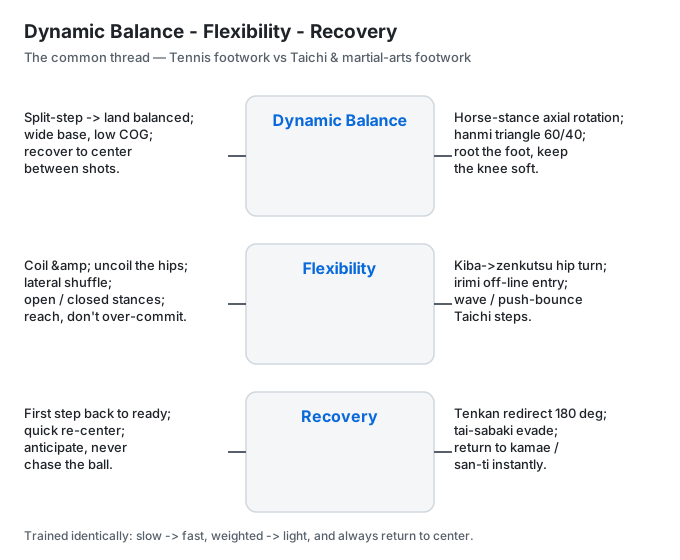
The TFL Footwork Research Project read thirteen martial-arts books - Taiji, Aikido, Xingyi, Bagua and Chen-style - and mapped their footwork onto the tennis court. Ten bilingual articles later, one line runs through all of them. This article states that line plainly: tennis footwork, Taiji footwork and Aikido footwork are the same discipline seen from three doors. The shared discipline has three names - dynamic balance, flexibility, and recovery.
Three Principles, One Thread
Every footwork problem on a tennis court is a failure of one of three things. A player is off-balance, stiff through the hips, or late recovering. The martial arts name the same three failures with their own vocabulary, but the body mechanics are identical:
- Dynamic balance - a base that stays stable while it moves. Not a still stand, but a moving equilibrium.
- Flexibility - the hips and waist rotate and coil so the step is powered from the centre, not the limbs.
- Recovery - the step that ends is already the step that begins. Position is never held; it is continuously returned to.
1. Dynamic Balance
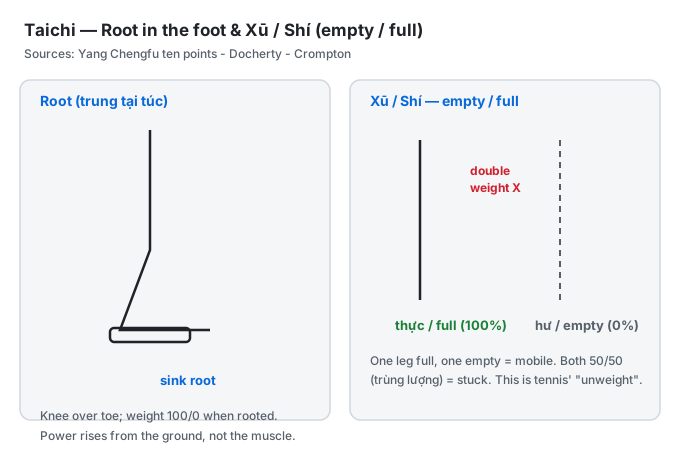
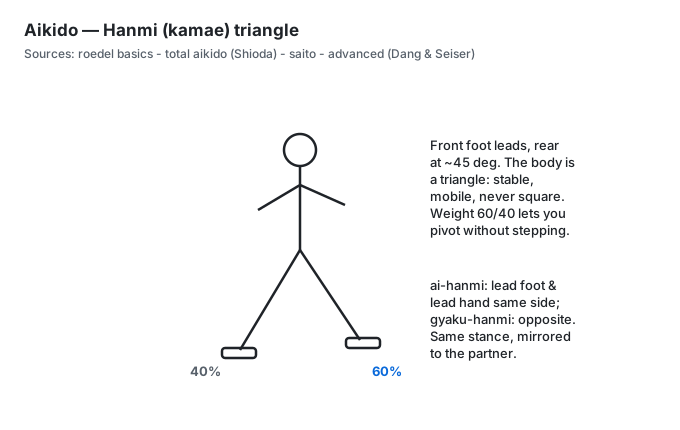
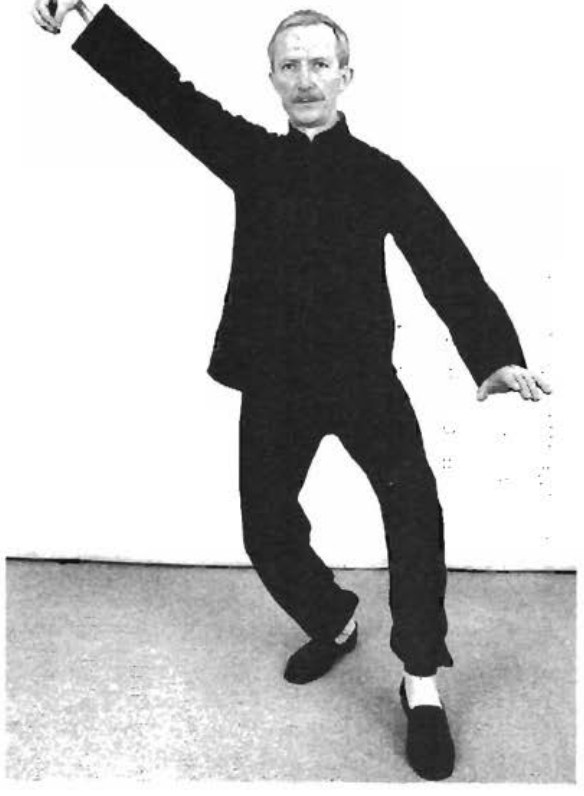
Tennis asks for an athletic stance: knees bent, weight centred, centre of gravity low, ready to move in any direction. The coach's "stay balanced" is a moving target - balance is something you keep, not something you hold. Taiji calls the same thing the root in the foot and the distinction between full and empty (xu and shi): at every instant one foot carries the root while the other stays alive and free to move. Aikido builds the same base as a triangular hanmi stance, the body turned off the line so the support triangle is narrow, grounded and ready to pivot. Three languages, one picture: a low, centred, moving base.
2. Flexibility (and the Waist's Rotation)
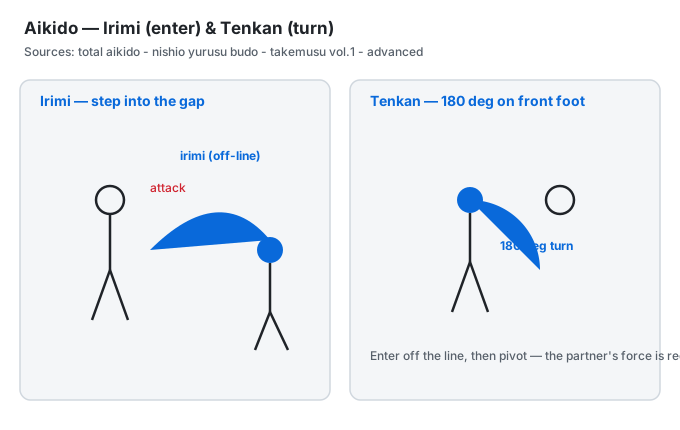
Power on court comes from the ground, up through a rotating hip, not from the arm. The "power wave" is a hip-and-waist rotation that the feet set up and the step loads. Taiji puts the waist first in its chain of force - "the waist is the master" - and teaches stepping as an internal coil that issues force (fa jin) from the foot. Aikido's irimi (enter) and tenkan (turn) are the same rotation made into a two-phase footwork: step off the line, then turn the waist to redirect. Flexibility here is not stretching; it is the rotational freedom of the centre.
3. Recovery - the Continuous Return
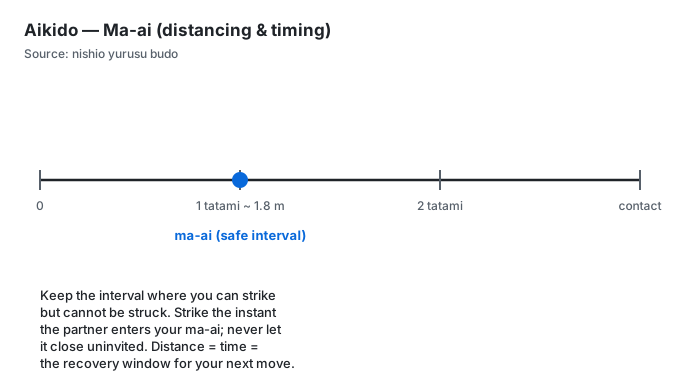
The split step ends and the next step has already started. A player who "sets" between shots loses the ground reaction force that recovery preserves. Taiji forbids the double-weighted standstill - weight must always be live on one foot - and Aikido's ma-ai is the live distance that decides when to step and when to wait. Recovery is the discipline of never arriving; every landing is a launch.
From the Books: Original Footwork Mechanics
A direct cross-reference with the original martial arts literature on the TaichiKB Library clarifies the shared biomechanical principles that unite traditional martial footwork and modern tennis movement:
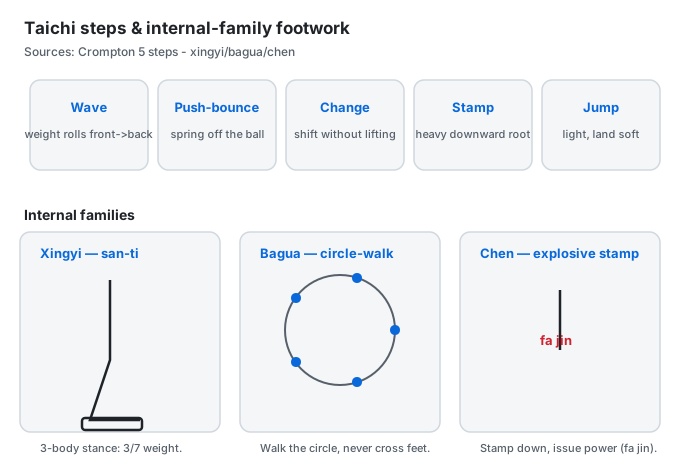
- Full/Empty Weight Distribution and Five Combat Stepping Patterns (Taijiquan): Point four of Yang Chengfu's Ten Essential Points establishes distinguishing Full (Shi) and Empty (Xu) as the primary footwork lesson — one foot loaded ("Full") and rooted into the ground, while the other ("Empty") remains light and agile to redirect instantly. The most fatal mistake is "Double-Weighting" (50/50), which locks both legs and destroys explosive responsiveness. Paul Crompton (Tai Chi Combat) systematizes five combat steps: the wave step rolling weight from the heel; the push-bounce step compressing and releasing elastic recoil; the change step transferring weight smoothly; the stamp step anchoring the root to discharge force; and the jump step for light, agile landings.
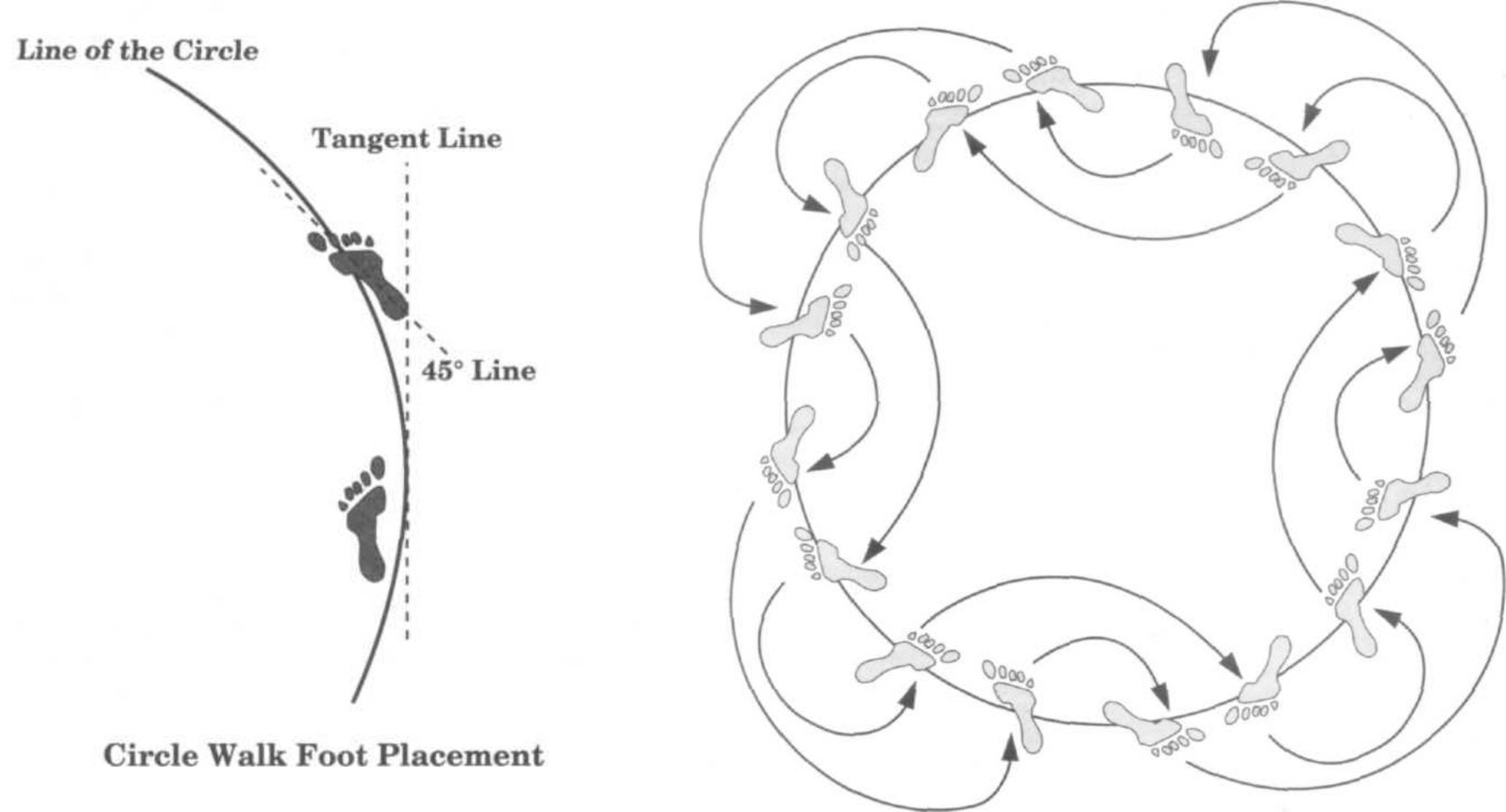
- Circular Footwork & K'ou Pu / Pai Pu Mechanics (Baguazhang): In Fundamentals of Pa Kua Chang (Vol. 1, Ch. 3) by Master Park Bok Nam & Dan Miller, the entire system revolves around circle walking (Zǒu Quān) around an opponent's center. The inner foot always tracks along the circle's tangent line, while the outer foot angles 45° inward to seamlessly navigate the curvature without breaking structural body connection. For instantaneous direction changes, Baguazhang deploys two pivotal stepping mechanisms: K'ou Pu (Hook Step) — turning the toes inward 45° to 90° to lock the hip (kua), arrest linear momentum, and pivot 180°; and Pai Pu (Swing Step) — flaring the toes outward to broaden the base and redirect along a new tangent. This exact dynamic underpins circular recovery patterns and sharp V-cuts on the tennis court.
- San Ti Shi 3/7 Weight Distribution (Xingyiquan): In Xing Yi Nei Gong (Dan Miller & Tim Cartmell), the foundational San Ti Shi stance instills a strict 3/7 weight distribution (70% on the rear foot, 30% on the lead foot). The deep knee flexion of the rear leg acts like a coiled hydraulic spring, primed to unleash explosive linear propulsion — the direct mechanical parallel of the first-step push-off when exploding forward to chase a short ball.
- Hanmi Triangular Base & Irimi–Tenkan Mechanics (Aikido): In the teachings of Gozo Shioda (Total Aikido), Morihiro Saito, and Bodo Roedel (Aikido — The Basics), the ready stance (Kamae) establishes a 60°–90° triangular Hanmi footprint with a 60/40 weight split, keeping the rear heel firmly grounded. The fundamental twin dynamics of Irimi (entering directly into open space) and Tenkan (pivoting 180° around the lead foot) combine into Tai Sabaki — allowing one to absorb, redirect, and harmonize with incoming momentum without harsh braking. Simultaneously, Ma-ai (active spatial distance) dictates the exact timing for initiating split-steps and tracking ball trajectories.
Tennis Without Talent: Stance and Balance
The site Tennis Without Talent - Stance and Balance describe the same three principles in pure tennis language. Reading them against the martial arts shows how little separates a tennis ready position from a Taiji or Aikido base.
| Tennis Without Talent | Taiji | Aikido |
|---|---|---|
| Stance: knees bent, low centre, ready to move any direction (dynamic balance) | Root in the foot; full/empty weight so one foot is always alive | Hanmi triangular base, body off the line |
| Balance as a "power wave" - ground to hip to hand (flexibility) | Waist is the master; fa jin issues from the foot | Irimi enter + tenkan turn: rotation into footwork |
| Balance kept by continuous adjustment, never a held pose (recovery) | Never double-weight; weight always live | Ma-ai: the live distance that times the step |
The match is exact. "Dynamic balance" is the Taiji root and the Aikido hanmi. The "power wave" is the Taiji waist-master and the Aikido tenkan. "Continuous adjustment" is the Taiji ban on double-weighting and the Aikido ma-ai. The tennis coach and the martial master are describing one body.
Takeaways for the Court
- Build a low, centred, moving base - the split step is your hanmi.
- Power the step from the hip turn, not the reach - your waist is the master.
- Never arrive; recover into the next step - keep weight live, the way Taiji bans double-weighting and Aikido keeps ma-ai.
Source Books
The thirteen source books (Taiji, Aikido, Xingyi, Bagua, Chen) are read in the taichinow bilingual library. The ten TFL articles each take one book or theme and translate its footwork into tennis. Diagrams and plates on this page are original work made for the TFL Footwork Research Project, with source scans credited to taichinow.github.io.
TFL Footwork Research Project | The Root in the Foot - Yang Chengfu's Ten Essential Points →
The Split Step: Load, Unload, Redirect - the three jobs of the smallest footwork move →