Ma-ai and De-ai
Aikido has two separate words for the two halves of what tennis calls court positioning. Ma-ai is the distance between you and the opponent. De-ai is the moment at which you meet. The first is geometry and the second is time, and both of them are settled by the feet rather than the hands. This article takes them in that order and then puts them back together.
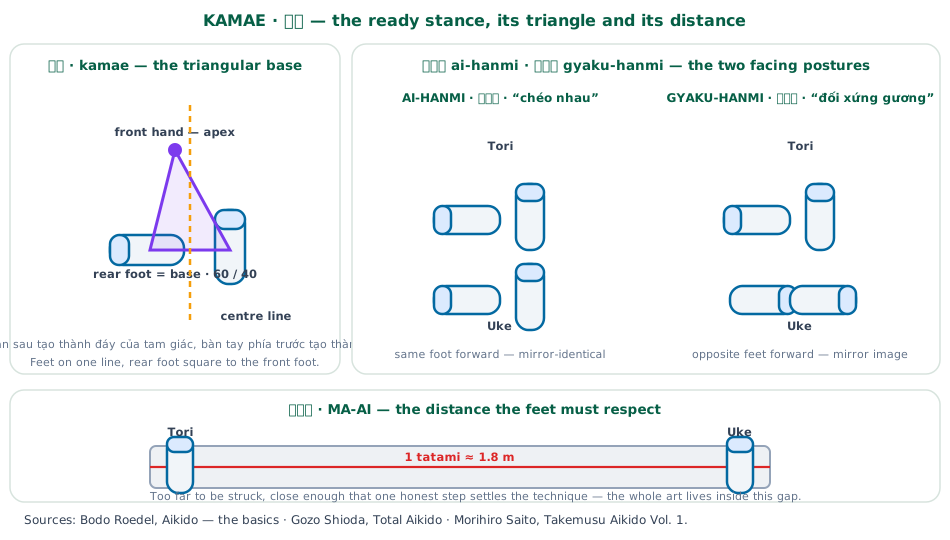
Two Words, One Problem
English collapses the pair into the single idea of “distance,” and loses something in doing so. Keeping them apart forces a question: is the problem that you are standing in the wrong place, or that you arrived at the wrong moment? Those have different fixes, and confusing them is a common reason practice stalls.
A student who is always too close is told to move; a student who is always late is told to move sooner. Only one of those is a ma-ai problem.
Ma-ai: The Distance
Ma-ai is literally the interval (ma) of mutual position (ai). It is the gap at which the encounter takes place, and it is treated in the sources as something you choose and hold rather than something that happens to you.
The critical property is that ma-ai is measured in steps, not in metres. The practical question is never “how far is he” but “how many of my steps is he.” That is why footwork and distance are the same subject in this tradition: change the length of your step and you have changed your ma-ai without either party moving.
One Tatami
Shioda gives the scale concretely. Training distance is discussed in tatami, and one tatami mat is about one point eight metres long — roughly a body length plus a stride. The useful consequence is that ma-ai has a unit, and the unit is close to the distance a single committed step covers.
So the working distances are small integers: one step, two steps. There is no distance in aikido that requires five steps to cross, because a crossing that long is not a crossing, it is a chase. Anything beyond about two steps is outside the engagement and has to be re-established before technique is possible.
De-ai: The Timing
De-ai is the meeting — the instant the two intentions arrive at the same place. Where ma-ai is where, de-ai is when.
The footwork consequence is that de-ai cannot be corrected by repositioning. If you are in the right place at the wrong moment, stepping somewhere else does not help; what is needed is to begin the step earlier, or to make the step shorter so it completes sooner. The sources treat this as a reason to keep steps small: a small step finishes quickly, which widens the window in which de-ai can be right.
This is the point where the two halves rejoin. Because ma-ai is counted in steps and de-ai is governed by how fast a step completes, the single variable underneath both is step length. Shorter steps give finer control of distance and quicker completion of timing. That is the whole argument for the small step, and both halves of the pair point at it.
On the Tennis Court
1. Separate the two diagnoses. When a player is beaten by a ball, ask whether the positioning was wrong or the initiation was late. Those are different drills, and mixing them is why players practise hard at the wrong one.
2. Count distance in steps. Measuring court position in your own steps rather than in metres makes the number small and actionable. Being “one step short” is a fixable statement; being “half a metre short” is not.
3. Shorten the step to buy time. Because a small step completes sooner, shortening the recovery step buys timing without any loss of positioning. This is the most direct transfer from de-ai to tennis footwork.
Source Books
Gozo Shioda, Total Aikido — ma-ai discussed in tatami, one mat about 1.8 m, and the sixty-forty weight split that makes the step available: aikido_total_aikido_vi
Bodo Roedel, Aikido — Những Điều Cơ Bản (Aikido — the basics) — kamae, the ready posture from which distance is judged: aikido_roedel_basics_vi
Cross-checked against Advanced Aikido (Phong Thong Dang & Lynn Seiser) on distance and entry: aikido_advanced_vi
All quotations translated from the Vietnamese readers of these editions. Diagrams are original work made for the TFL Footwork Research Project.
← Tai Sabaki - The Path the Hips Take | TFL Footwork Research Project | Weapons Footwork - What the Sword and the Staff Teach the Feet →