Irimi and Tenkan
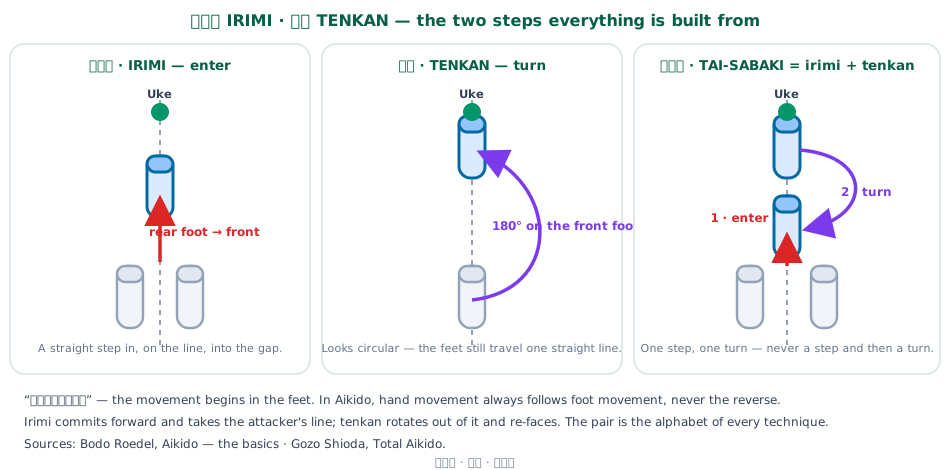
The whole of aikido footwork reduces to two movements. Irimi steps straight in. Tenkan turns and steps out. Every technique on the shelf is assembled from those two, and the sources are explicit that this is the entire vocabulary. This article reads each one and then the thing that makes them difficult: tenkan looks circular, but the feet do not travel in a circle.
Two Movements
Roedel states the reduction plainly: aikido has entering (irimi) and turning (tenkan), and the combined body movement that results is called tai-sabaki. Everything else — the long lists of techniques, the weapons forms, the variations — is a rearrangement of those two.
That claim is worth taking seriously as a design principle. A system that can be reduced to two named movements is a system that can be drilled to fluency, because there are only two things to get wrong. Tennis has something similar in the split step and the first step; the aikido version is simply more honest about the fact that these two are the whole alphabet.
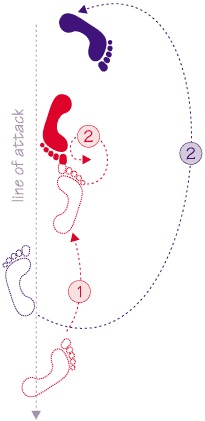
The classical step diagram for irimi–tenkan: enter along the line of attack, pivot on the lead foot, and finish facing out behind it. Diagram: Tobias Steinhoff, CC BY-SA 2.0, via Wikipedia: Tenkan.
Irimi: Entering
Irimi is the entering movement: a step straight forward along the line to the opponent, into the space beside or behind them rather than into their mass. The footwork is a single committed step, usually off the rear foot, with the body staying on the line. The point is not to overpower but to occupy — to arrive in the gap the opponent has left.
What makes irimi a footwork lesson rather than a tactic is its directness. There is no feint and no lateral travel. The body goes from A to B along the straightest available line, and if the timing is right the opponent’s attack passes through the space you have just left.
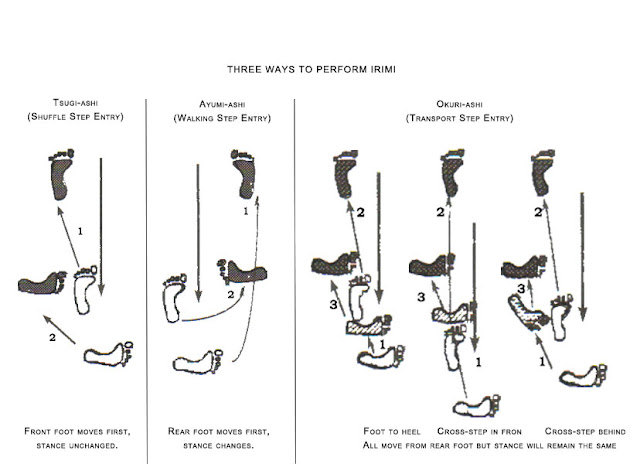
Three classical entries, each executed as one step: tsugi-ashi (shuffle — the front foot moves first, stance unchanged), ayumi-ashi (walking — the rear foot moves first, stance changes), and okuri-ashi (transport — foot-to-heel cross-step in front, all movement from the rear foot while the stance stays the same). Diagram: Katsujinken Dojo, “Basic Aikido Stance and Movements”.
Tenkan: Turning
Tenkan is the turning movement: a pivot, usually on the front foot, that turns the body roughly one hundred and eighty degrees and steps out to the side of the attack. It is the movement that turns a defence into an escape-and-redirect, and it is what most people picture when they picture aikido.
The footwork detail that matters is which foot turns. The pivot happens on the loaded foot — the one that is already full — which is exactly the rule taiji gives as “pivot on one foot, never slide on two.” Aikido arrived at the same instruction independently, which is the kind of convergence worth noticing.
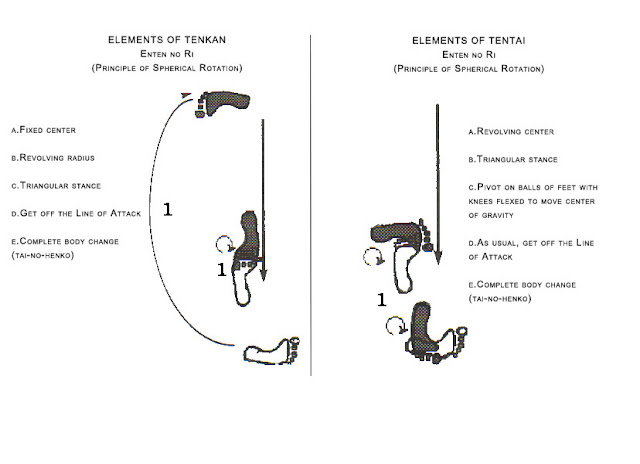
Tenkan (fixed centre, revolving radius) against tentai (revolving centre): both pivot on the balls of the feet with knees flexed to move the centre of gravity and complete the body change — enten no ri, the principle of spherical rotation. Diagram: Katsujinken Dojo, “Basic Aikido Stance and Movements”.
Why Tenkan Looks Circular
This is the single most useful idea on the whole shelf, and it is the one beginners get wrong most often. Tenkan looks circular: the body sweeps around, the partner is led in an arc, and observers describe a circle. But the feet do not travel in a circle. The turning foot pivots in place, and the stepping foot travels along a straight line.
Why it matters: a player who tries to move their feet along the arc they can see will travel too far, arrive late, and lose the base. A player who understands that one foot pivots and the other steps straight will make the same movement in half the distance. The circle is what the body traces; the feet do something much cheaper.
On the Tennis Court
1. Two movements, drilled to fluency. The reduction itself is the lesson. A player practising only “enter straight” and “turn out” has a complete vocabulary for dealing with a ball that is short or wide.
2. Enter into the gap, not into the ball. Irimi occupies space rather than meeting force head-on. On court that is the difference between reaching for a ball and moving to where the ball will be.
3. Pivot, do not arc. The tenkan correction — one foot pivots, the other steps straight — is the most transferable footwork idea in aikido. Players who arc their feet around a ball are travelling further than they need to and arriving with nothing left.
Source Books
Bodo Roedel, Aikido — Những Điều Cơ Bản (Aikido — the basics) — irimi and tenkan as the complete vocabulary, and tai-sabaki as their combination: aikido_roedel_basics_vi
Cross-checked against Advanced Aikido (Phong Thong Dang & Lynn Seiser) and Nishio’s Aikido — Võ Đạo Của Sự Chấp Nhận on entering and turning: aikido_advanced_vi · aikido_nishio_yurusu_budo_vi
All quotations translated from the Vietnamese readers of these editions. Diagrams are original work made for the TFL Footwork Research Project.
Figure credits: the irimi and tenkan–tentai step diagrams are reproduced from Katsujinken Dojo, “Basic Aikido Stance and Movements” (2012). The irimi–tenkan step diagram is by Tobias Steinhoff, CC BY-SA 2.0, via Wikipedia: Tenkan.
← Kamae and Hanmi - Aikido's Ready Posture | TFL Footwork Research Project | Tai Sabaki - The Path the Hips Take →