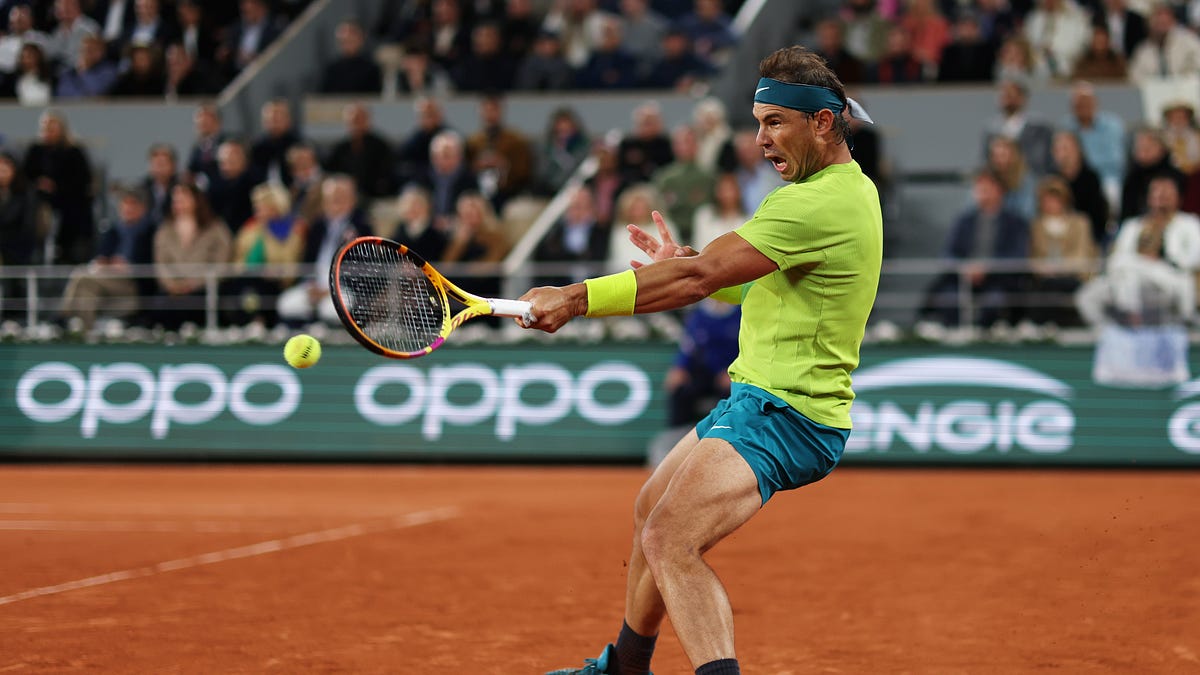
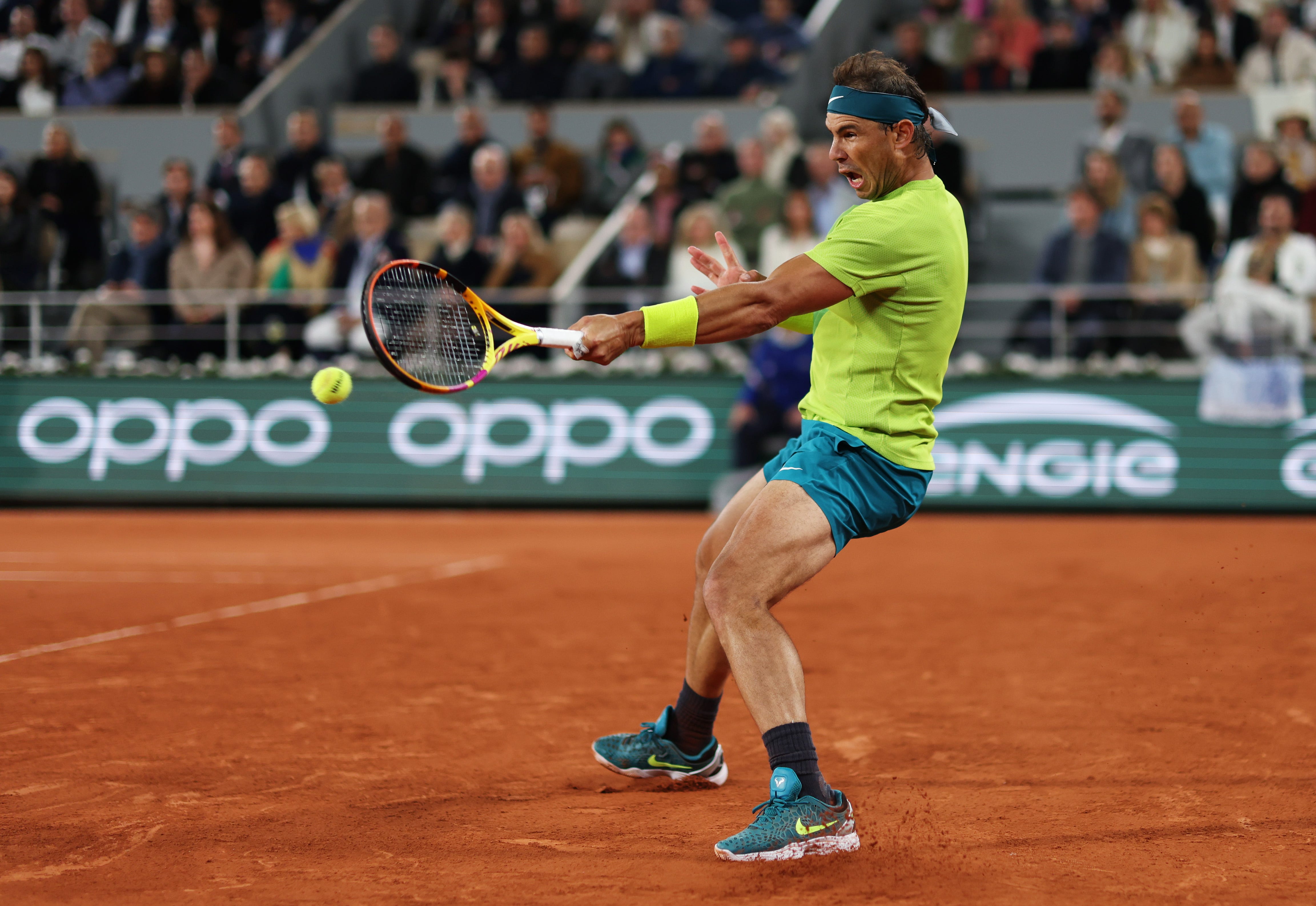
Nadal d Djokovic: 6-2, 4-6, 6-2, 7-6(4)
An interesting match. Not one of their absolute best contests, but interesting nonetheless and it featured patches of tennis, in terms of raw competitive level, which still outstrip most other sights in the men’s game right now. Considering the stakes at play it felt bizarre that this meeting was only a quarter final.
I think the easiest way to frame this match is that a better (healthier?) Nadal than last year showed up, and a less battle hardened Djokovic showed up this year compared to last year. There were both tactical and physical differences to last year’s semi final. But over the course of four sets last night, in its simplest form, this clay rivalry reverted to mean.
In the preview analysis to this match I wrote a lot about Nadal’s ability to play forehands on his terms, and about the ways in which both players try to limit the other from playing those forehands. In last year’s semi final, when Djokovic won, Nadal played more backhand groundstrokes than forehands, the first time that had ever happened in their clay rivalry.
But last night things changed:
Nadal forehand groundstrokes: 337
Nadal backhand groundstrokes: 266
If you break down Nadal’s groundstroke % by set:
Set 1: 62% forehands (set won)
Set 2: 51% forehands (set lost)
Set 3: 61% forehands (set won)
Set 4: 54% forehands (set won)
This is far from a perfect metric but considering set four was decided by a tiebreak and Nadal came from a break down, it actually tracks who was winning and losing the match pretty well. The second half of set 4, from the game where Nadal broke back at 3-5* onwards, actually featured Nadal back over 60% forehands again. So essentially Nadal was winning the match while hitting 60% or more of his groundstrokes as forehands.
This isn’t too surprising. I’ve written plenty about this rivalry on clay largely hinging on whether Nadal can impose his forehand on the match. But why did this happen this year where it didn’t last year?
Last year Djokovic had significant joy dragging Nadal out into plenty of extended rallies, often by returning deep and then targeting the Nadal backhand to blunt Nadal’s ability to play aggressive forehands early in the point. Djokovic dominated Nadal in that 5-8 shot rally length last year (53 to 39). Yesterday however, Nadal managed to narrowly keep most of the points under 5 shots across the sets he won, while then also finding his largest edge (17 more points won than Djokovic) in the longer points in those sets (sets 1,3,4):

Djokovic found ways to push points longer in set 2 (62% of points in that 2nd set were 5 shots or more), especially with Nadal serving, and to make Nadal play more backhands in those rallies. In sets 1, 3, and 4, for the most part Nadal managed to play more short points on his own serve, on the back of good serving and good serve+1 forehands, and then get into rallies on Djokovic’s serve and win a solid chunk of the baseline rally points.
So how and why did this happen?
In the pre-match analysis I wrote about what has to happen to enable both players to hit the forehand patterns they both like. While this matchup is often a lot about their forehands, there are plenty of things that have to happen, including off their backhands, to enable those forehands.
Nadal does have counters to Djokovic' initiating those rallies into his backhand however. Historically Nadal has mixed in deep & high backhands down the line (harder for Djokovic to attack), low pace slices down the line (easier for Djokovic to hit cross court into Nadal’s forehand rather than back down the line into the backhand), and powerful backhand drives cross court to try and create opportunities to hit his forehand.
And also about how Nadal’s forehand down the line can work for and against him:
There’s also quite a fine line in this matchup between Nadal’s forehand down the line being impossible for Djokovic to deal with (RG 2012,2013, 2014, 2020) and it being a liability that actually opens up space for Djokovic to hit cross court into Nadal’s backhand again (RG 2021). Much will depend on that shot once again.
First off, the backhands.
In last years semi final, two things happened. Firstly Djokovic was really, really good and disciplined about targeting the Nadal backhand until he had the right ball or court space to attack. And secondly Nadal usually tried to trade cross court from his backhand corner back into Djokovic’s forehand. You can see this here:

But two things happened in yesterday’s match between the two. Firstly I think Djokovic was a little less disciplined or maybe just couldn’t execute to the same degree to target Nadal’s backhand, and Nadal was extremely disciplined himself about keeping the ball away from Djokovic’s forehand unless he had an opportunity to go on the offensive:


The above are two examples of Nadal’s defensive counters to Djokovic’s cross court forehands/serves into his backhand. The slice down the line (first GIF) is a good option because it gives Djokovic no pace to work with and is easier for Novak to hit cross court back into Nadal’s forehand strength (which then puts more pressure on that shot because it has to be good enough to avoid Nadal attacking it). And the loopy ball down the line (second GIF) is a good option because it forces Djokovic to take the ball quite high and still doesn’t offer a lot of pace for Novak to work with. Both options, most importantly, also prevent Djokovic being aggressive with his forehand. These counters can still backfire for Nadal if they’re not well placed, deep or high enough, but generally speaking Nadal managed the balance of what shots to hit from that backhand corner, and when to attack Djokovic’s forehand corner, masterfully throughout the match. Nadal pulled the trigger up the line with his forehand far more aggressively and more often yesterday than he did last year:
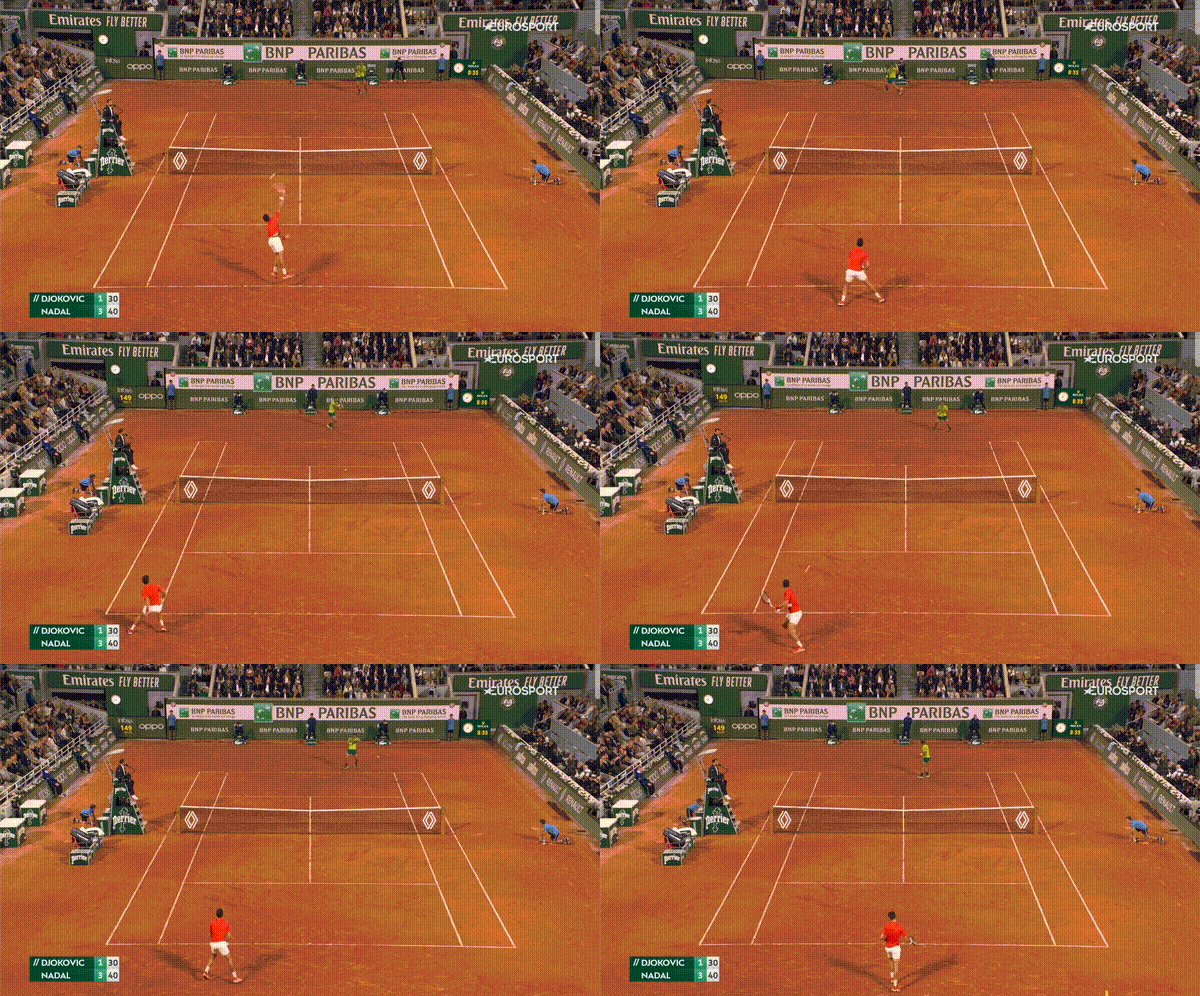
Nadal changed direction down the line far more often, off both wings, earlier in the point than he did last year. This allowed Djokovic much less comfort from the baseline and kept him guessing RE his positioning. There’s this sort of cascading series of events when Nadal is hitting his forehand down the line well, where Novak can be less comfortable in his backhand corner, and is then in turn also unable to be as offensive with his backhand, unsettled positionally by the Nadal threat down the line. When I talk about there being lots of subtle layers of implied strategy to this matchup, this is part of what I mean.
Fightback
This doesn’t mean Djokovic didn’t manage to find openings though. A nearly 20(!) minute game at 3*-2 in the second set, with Nadal serving, felt like a significant turning point in Djokovic’s favour, in large part because he managed to find Nadal’s backhand and set up offence the way he had last year. Djokovic returned superbly for most of set 2, and also served well, hurting the number of comfortable forehands Nadal got to play:


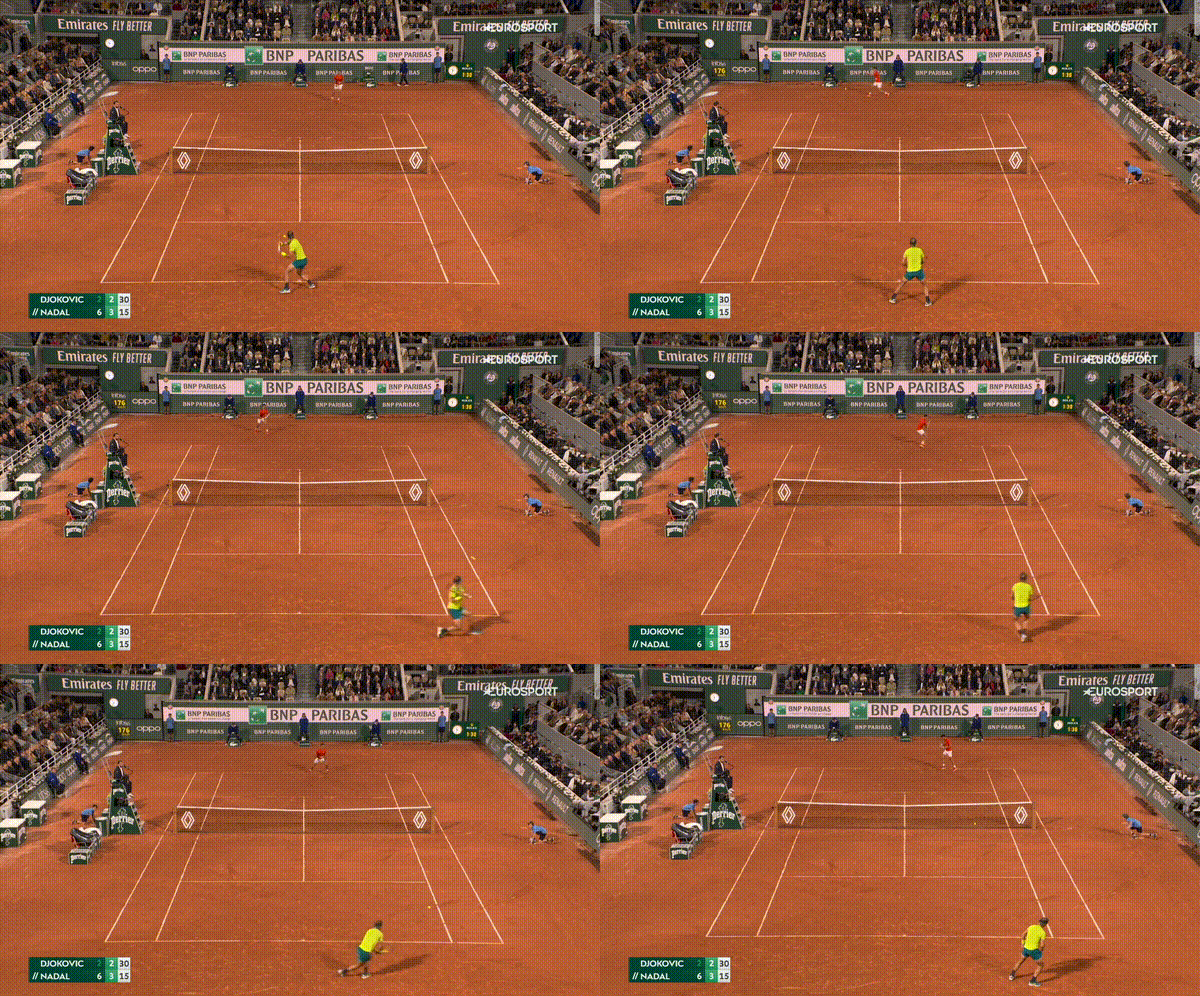
Those three points represented exactly the way Djokovic wanted to play this match. Excellent returning and serving, along with winning a physical set 2 battle against Rafa, enabled much of those desired patterns.
4th
A combination of a poor service game from Djokovic and a good return game from Nadal, with Djokovic serving for the 4th set at 5*-3, put us back on serve. But two things surprised me as the 4th set wore on. Firstly, Nadal looked the physically stronger of the two. To my eyes Djokovic had some physical lulls in the 4th set (and the 3rd set) that just weren’t there last year. And secondly Djokovic wasn’t quite as disciplined with his baseline strategy at the tail-end of set 4, the first two points of Nadal’s 5*-6 service game in particular:

And something similar happened again on the very next point:
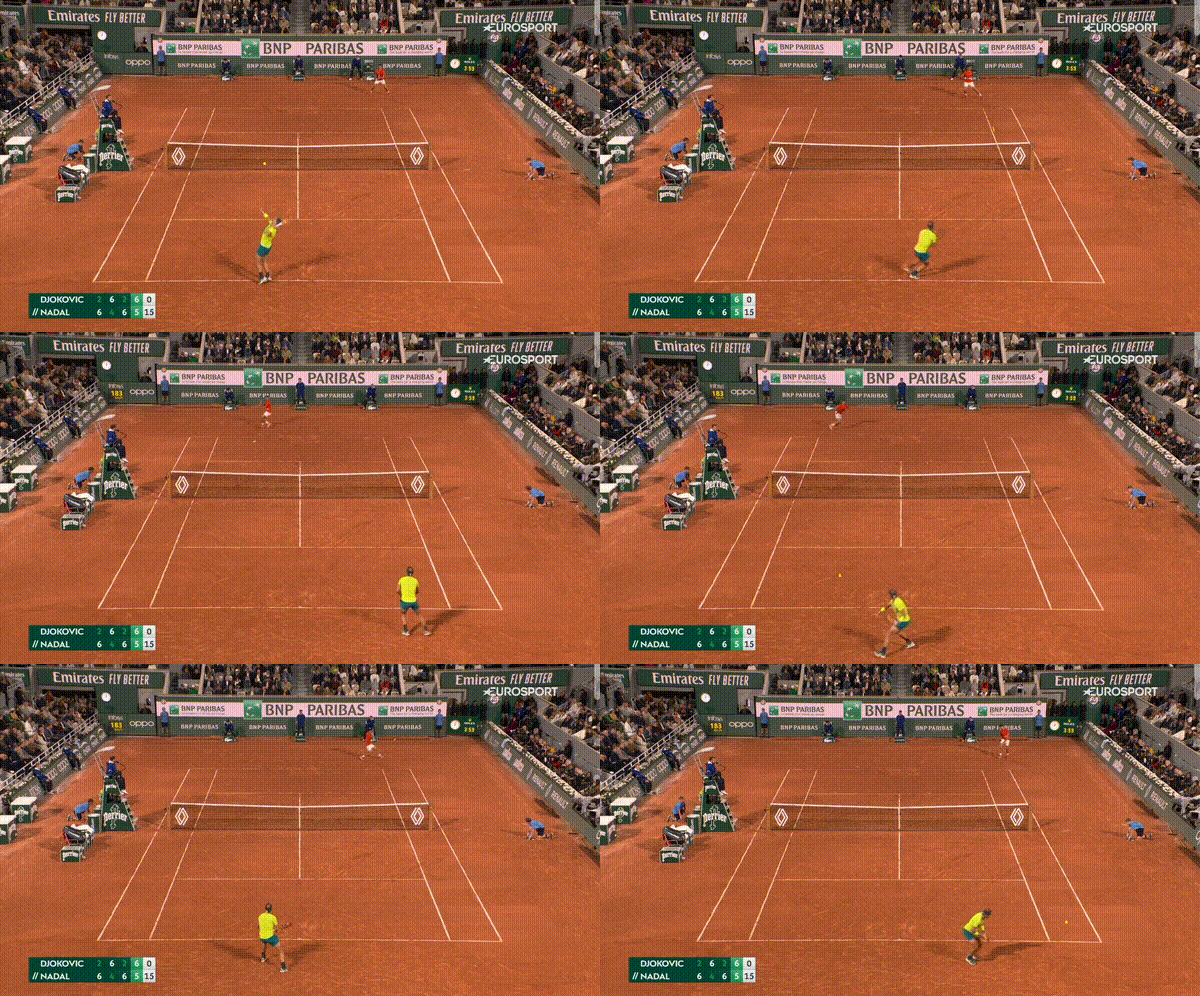
Both the above two points are a bit picky, because there are situations where it is correct to attack the Nadal forehand rather than backhand. And Nadal may have been able to deal with cross court forehands instead if Djokovic had hit them. But considering matchup history I’m surprised both of these forehands went down the line, eventually being punished by the Nadal forehand. And it wasn’t like this was a game where Novak could check out, Nadal was serving to stay in the set.
Djokovic ultimately played quite a soft 4th set tiebreak, committing four unforced errors, while Nadal continued to return well and play clever tennis from the baseline. And that was that.
2nd serve
Last year Djokovic managed to put a huge dent in Nadal’s 2nd serve performance.
2nd serve points won, 2021 Semi Final:
Nadal: 40%
Djokovic: 50%
2nd serve points won yesterday:
Nadal: 60%
Djokovic: 42%
Nadal was more aggressive on his 2nd serve returns last night compared to last year, finding good depth and being able to set up return 1-2 punches relatively often when it mattered:
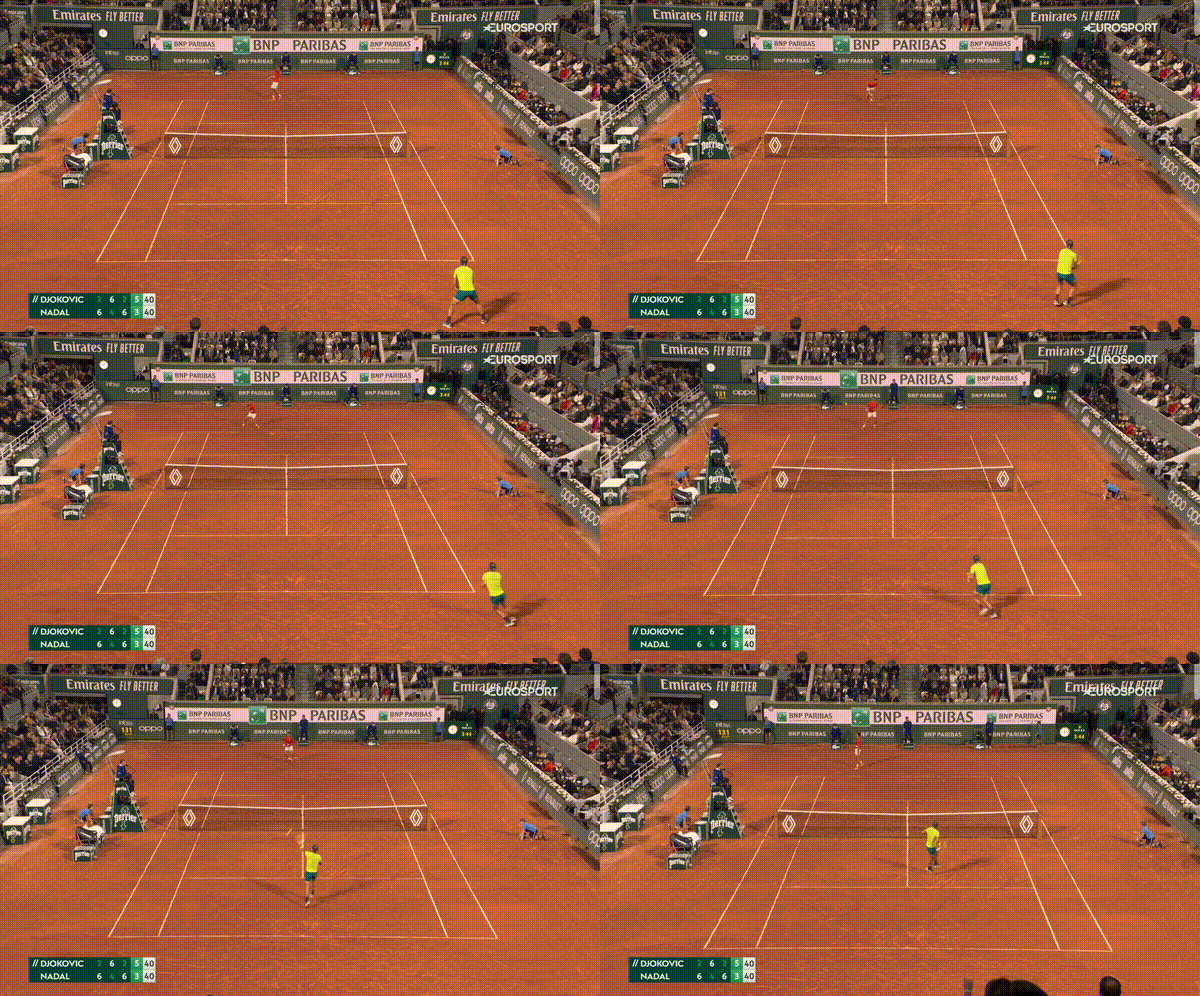
Nadal’s first serve placement spread and speed was pretty much identical across the 2021 and 2022 matches. But his 2nd serve speed got a 5mph bump last night relative to last year (95mph/154kph compared to 90mph/146kph last year). Djokovic returned superbly well for large parts of the 2nd and 4th sets, but Nadal also managed to land some quite aggressively placed 2nd serves when he needed to. This is in line with Nadal’s recent beefing up of his 2nd serve (his average in Australia was even higher @101mph). This further helped Nadal set up the kinds of point patterns he likes on serve.
Djokovic’s 2nd serve was also slightly faster year to year (85mph avg up from 82mph in 2021), but that was still 10mph (16kph) slower on avg than Nadal’s 2nd serve and opened up more opportunity for Nadal to attack. A side note on this, I’m actually pretty surprised that Djokovic’s 2nd serve speed seems to have come down in the last year or so compared to some of his 2019 and 2020 numbers, but will check back at the end of the year.
Mean
I think there were two simple keys to the match last night. The first is that the physical edge that Djokovic had last year, where Nadal faded fast in the 4th set struggling with his foot, was gone. Last night Nadal was the physically stronger player in set 4 with Djokovic possibly feeling the rust of not having played the best of five set format in nearly 9 months (US Open last year). The second is that Nadal managed when to hit into his opponent’s backhand and forehand pretty much perfectly, and Djokovic didn’t, with some assists and hindrance from their respective serve performances.
I think last nights match is also a great indication of how difficult it is to do what Djokovic did last year. Novak played an excellent second set last night, forcing the points into precisely the strenuous domain which he needs to in order to make Nadal uncomfortable on that court. But doing so seemed to sap Djokovic’s energy bar to the point where he faded to start the next (3rd) set. Maintaining that level and execution of strategy clearly requires a sort of physical overdrive that is not easy to sustain or recover from.
Nadal, to his immense credit, did adapt to what happened last year, even if having fewer physical issues seemed to be the biggest factor in his ability to execute his game plan. Rafa has only hit more winners than Djokovic in three of their Roland Garros matches. Two of those matches have come in the past three years, as his movement has somewhat diminished relative to his younger days: the 2020 final and last night’s quarter final. Nadal knows that offence is his key against Djokovic on clay, but the way he enabled that offence last night, via changing direction early in the points (especially the forehand up the line), knowing when to stay away from Djokovic’s forehand, and serving and returning effectively, was pretty special. Novak pulled off a bit of a miracle last year when depriving Nadal of his strengths on a clay court. But as so many players have discovered over the years, keeping Rafa’s forehand shackled on the red stuff is arguably the hardest task in tennis.
Nadal gets revenge for last year and Rafole’s clay rivalry reverts to the mean.
— MW

I’ll see paid subscribers on Sunday for final analysis.
The Racquet goes out twice a week, a (free) piece every Thursday/Friday and a (paid) analysis piece every Sunday. You can subscribe here (first week free):
Know someone who would like The Racquet? Give them a gift subscription:

Top: Clive Brunskill/Getty, Bottom: Andy Cheung/Getty
Most recent:
