🏠 Home › Fundamentals › Classic Lessons › Disguise
Building A World Class One-Handed Backhand: Disguise
Comprehensive unified tennis knowledge base — Fundamentals, Stroke Analysis, Reference Library, and more
Building A World Class One-Handed Backhand: Disguise
In the last two articles we have looked at the preparation (Click Here) and the forward swing (Click Here) in building a world class one-hander. But my goal in teaching the one handed backhand is not just to build a technical foundation.
My goal is to build a technical foundation that simultaneously creates disguise. Disguise is essential to creating a real weapon, a superior shot that cannot be easily read.
So let's review the one-handed stroke we have built from a different perspective. Let's see how the same technical elements that create world class ball striking create disguise.
What is it like to try to read a world class one-handed backhand from court level?
Let's illustrate this combination of shot making and deception by looking at what it's like to be at court level on the other side of the net from one of the greatest one-handers in tennis history, Roger Federer. See for yourself if you can read what he is doing with his racket and how this relates to shot location.
Deep Turn
The first component to look at is the deep shoulder coil. As we saw in the previous articles, this coil is essential to utilizing the core explosively in the shot.
The back turned to the opponent in the deep coil hides the racquet work.
But look how the same move disguises the shot. The deep turn of the body up to 150 degrees or more shows part or most of the back to the opponent. With this turn, the back naturally hides the racquet work in the backswing and the start of the forward swing.
If the player's shoulders are not turned this far and are closer to perpendicular to the net at around 90 degrees--as is often advised by coaches-- the power potential is less. But perhaps more importantly, the potential to disguise the shot is reduced or eliminated. The thin profile of the perpendicular shoulder preparation will not hide the racquet work and the player's intention.
In my system, the backswing and racquet work take place directly behind the coiled body. This blocks the sightline of the opponent during the critical phase of the swing.
If the player does not get that big, 150-degree shoulder coil, the racquet work will peak out on the right side of the body--the left side from the opponent's viewpoint. At the highest level, where so little separates the good from the great, this “tell,” like in poker, can be a major disadvantage.
Hip and Shoulder Position
Look at the angle of the hitting shoulder--can you read the location of Roger's shot?
The second element in creating disguise is the hip and shoulder position at contact.
Players can reveal the intention of their shots by opening their hips and shoulders too soon, typically giving away a crosscourt play. Or hold them sideways longer going down the line. I like to teach players to keep their hips the same on both crosscourt and down the line shots and to use the hand and wrist to control the direction of the ball.
I want players who can, with the same exact hip preparation and hip position at contact, hit the down the line and also hit a crosscourt angle. Too often, players learn to direct the ball with their hip and shoulders rather than with the wrist, hand, and racquet face angle.
Often I see players coil less in the preparation for a crosscourt shot, or start the uncoiling of the hip earlier. These subtle differences in the swing can where the shot is heading.
Head Position
In the last article, we saw the critical importance of keeping the head still at contact. Balance, body rotation, shot line--are all related to head position. No one demonstrates the effectiveness of this element better than Roger Federer.
Roger's amazing head position gives no indication of shot direction.
Keeping the head still is critical to disguise. Just as a player's hips and shoulders can telegraph a shot, the head can look up and the eyes can look in the direction of the intended shot.
This is a very common tactical problem, as well as a basic biomechanical issue. Moving the head disrupts the stroke production, but looking up too soon also gives away the intention and direction of the shot.
Racket Angle
The racquet face angle during the backswing is another factor players must control in creating disguise. If the racquet face angle changes too much from shot to shot, this can signal the shot intention.
For example, many players close the racquet face much more on the backswing for heavy spin shots. This makes the shot easily readable by the opponent. Players should be careful not to turn the wrists and racquet face on the preparation for different types of shots.
Look at the consistency of the racket face angle as Roger begins the forward swing.
Well-trained players have less variance in racquet face angle. As we saw in the previous article, this should be between 0 and a maximum of about 10 to 20 degrees no matter what the shot. The shot should surprise not telegraph.
Players must be able to have flexible wrists in order to control shots that, for whatever reason, they have caught late. Late contact is an easier adjustment on the two-hander.
But regardless of whether a player has a two-handed shot or one-handed shot, he must learn to use the wrists properly at the contact, especially at the last minute when catching the ball late.
This wrist control dovetails with the importance of keeping the hips and shoulders in line. They work in concert to control the ball with minimal telegraphing.
Players should be able to direct the ball with the wrist and racquet face angle rather than their hips and shoulders. Players with a stiff wrist on the one-handed backhand need to swing their hips open to hit the ball crosscourt.
Advanced Backswings
Roger's backswing, with the racket face slightly open, is the same on the slice and the drive.
A final advanced element in backhand disguise is the racket face angle in the preparation. Players like Federer or Tommy Haas actually open the racquet face slightly in the backswing--no matter what spin they are preparing to hit. I call this the racquet to the ear preparation.
This positioning prevents the opponent from reading topspin or slice. If the racket face is radically different in this phase then the other disguise elements are not as effective. Together however, the elements in my system help any one-hander create the best of both worlds. Superior shot making and world class disguise.
So that's it for the relationship between technique and disguise! Now let's move into my unique series of training drills for court movement, defending, taking the ball early, and building racket speed. Stay tuned!
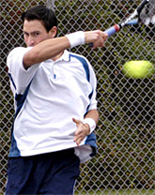
Chris Lewit, former #1 for Cornell and Pro Circuit player, has coached numerous top 10 nationally ranked juniors and is a leading coach, educator, and author. He has written two best-selling books, The Secrets of Spanish Tennis and The Tennis Technique Bible.
Chris runs a popular high performance summer tennis camp in the beautiful mountains of Vermont and coaches players world-wide through his virtual school, CLTA Online (CLTA.teachable.com).
Chris also produces a weekly high performance tennis video talk show and podcast, The Prodigy Maker Show, which is available on Apple Podcasts and all other podcasting directories. All shows can be accessed at ProdigyMaker.com.
Check out Chris's blog, also at ProdigyMaker.com for free articles on high performance junior development and Spanish training. Learn about his camp at ChrisLewit.com or visit the online academy at CLTA.teachable.com
Source: tennisplayer.net archive — Disguise.docx (John Yandell teaching library, 2002-2022). Extracted and rendered as HTML for Tennis Future Lab.