by Doug Eng EdD PhD, MTPS and Bharathan Sundar
TESTING UNILATERAL POWER
Measurement of initial leg power can be correlated to leg strength. Hewit et al. (2012) tested single leg countermovement (SLCM) jumps vertically (SLCM-V), horizontally (SLCM-H), laterally (SLCM-L) with either legs. The largest leg discrepancies were SLCM-L. Lockie et al. (2014) found some correlation between lateral power and COD but lateral jumps were not the strongest predictors of the COD test. Young et al. (2002) found that COD was related to the outside reactive leg strength. For example, athletes averaging 24% stronger in the right leg were 4% faster moving to the left; moving to the right was not correlated with leg strength. Lateral movement due to unilateral leg strength was not considered a factor unless there was a significant strength difference between legs. In addition, Young et al. suggested reactive leg strength was a greater factor than concentric leg strength. It was suggested that technique and perceptual factors also affect lateral speed. Both studies (Lockie et al., 2014; Young et al., 2002) look at linear speed with 20-60° as the range of COD which represents more traditional cutting in team sports. A test for 3 m COD and acceleration (CODAT) was devised using 45˚ and 90˚ COD (Lockie et al., 2013).
As opposed to many field sports, tennis involves significant movement back to the origin which implicates many 180° CODs. Therefore, unilateral leg reactive strength might be a greater factor in tennis. Hoppe et al. (2014) indicated high acceleration and deceleration with 180˚ COD was a major characteristic of tennis movement. Habibi et al. (2010) found single leg hop power was correlated with 10 m sprints. It was found that a triple single leg hop was even a better predictor for 10 m sprint times. That suggests reactive strength in landing with rapid muscle contraction and stored elastic energy is critical. In addition, the explosiveness movement from a previous jump, hop or bound is more critical for acceleration than from a standing position.
In tennis, lateral speed is initially generated after an athlete makes a modest vertical jump or split-step with a resultant lateral bound. Although Lockie et al. (2014) suggested lateral jumps were not the strongest predictors of 20-60˚ COD ability, 180˚ COD were not investigated. Therefore, lateral jumps may still remain a predictive test for tennis. By definition, a hop is when the take-off and touchdown is done off the same leg and the distance covered is relatively small. A jump is either one- or two-legged but the distance is relatively greater. A bound is when the take-off leg and touchdown leg are opposite legs. With that in mind, single leg lateral bounds for both legs can show promise for improving contralateral force production.
The well-known Pro Agility Test and 3 Cone Drill has been shown to be correlated to 10 m sprinting (Mann et al., 2016). Both can be useful for tennis testing since they utilize 180˚ COD and acceleration/deceleration. In addition, as Young et al. (2002) and Habibi et al. (2010) suggested, reactive unilateral leg strength can be important. Figure 1 shows a simple single leg lateral jump (SLLJ) in which a countermovement is allowed and the takeoff and touchdown leg are the same. Measurements should be on the outside edge of the foot or shoe (green line). Lateral bounds in both directions should be executed and measure from a best of three bounds.
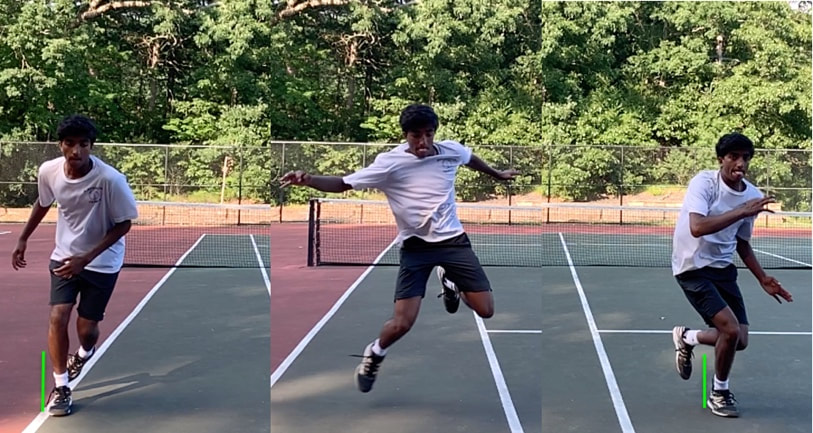
Figure 2. Single leg lateral jump (SLLJ) test with countermovement. Note the same leg (right leg in this example) is both the takeoff and touchdown leg.
EXERCISES
Wall Drives and Runs
Wall drives and runs are shown in Figures 3 and 4. In the crossover wall drive (Figure 3), the athlete crouches and leans with the inside shin angled towards the wall. A cross-over step is taken with the outside leg. The athlete can repeat in sets of 10 and then switch direction and legs. The lateral wall run is shown in Figure 4 has the athlete more upright. This exercise can be done with different number of steps: a) 1 step - lifting only the inside leg, b) 2 step, c) multiple step. A coach or another athlete can call the number of steps, e.g., “three,” or “four.”
Lateral Wall Drills
The single leg lateral jump test is often used as a repeated bounding exercise alternating legs (aka “alley hops”). Another set of simple movement exercises are wall drives and runs. Many athletes have trained with forward wall drives where the athlete faces a wall and leans forward at 45˚ with hands outstretched supporting the body against the wall. For tennis, lateral wall drives and runs are specifically applicable. Lateral wall drills allow the athlete to shift the center of gravity applying horizontal lateral force, while maintaining balance using a wall or fence.
The simplest drill is the lateral wall hold using either leg (Figure 3) which is also good for core and hips strength. The athlete leans sideways into a wall (fence is more difficult). The athlete lifts either leg with the knee up to the hips and maintains the leaning position for a few seconds and then may switch the legs and hold that position with the knee up for a few seconds. The athlete repeats leaning the other side. Once the athlete is comfortable with the positions, the athlete can do a second drill: lateral wall runs with sets of 2-6 rapid alternating steps. Repeat for a set of 6-8. Then the athlete does another set on the other side.
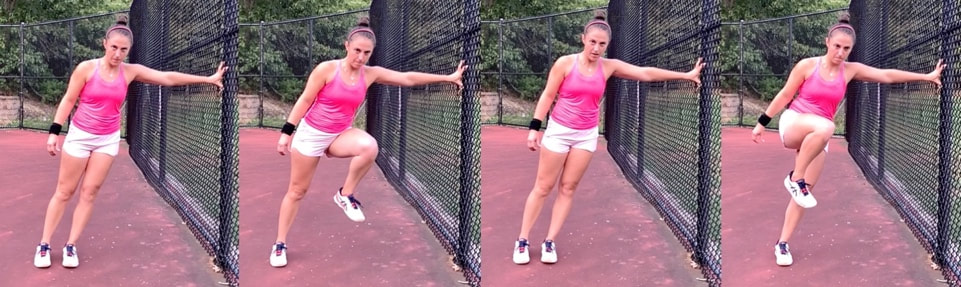
Figure 3. Lateral wall hold and alternating strides. Athlete holds positions for a few seconds. Athlete can also do quickly as a lateral run.
The second wall drill (Figure 4) is the load and crossover hold which brings the outside leg across and up. Athlete should start low with the outside leg at an angle and ready to push off. Both arms can be placed on the wall or fence and movement is more powerful and angled.
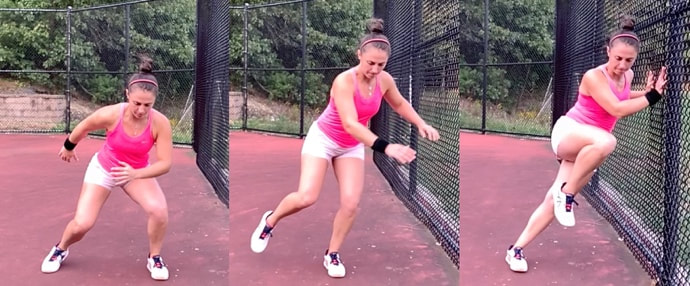
Figure 4. Load and crossover hold.
In Figure 5, the crossover load and lift applies greater force. Figure 5 shows loading off the outside leg. Balance is maintained only using one leg and the wall. Either inside or outside leg may be used in loading. Drive upwards and bring the knee above the hips.
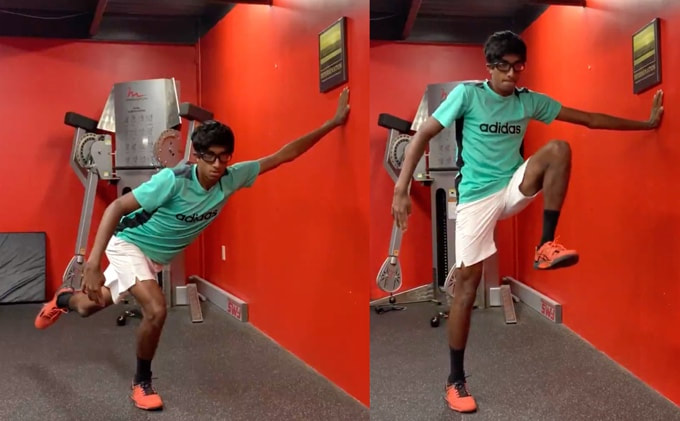
Figure 5. Load and crossover hold.
Hops + Bounds + Sprints
Most split-steps in tennis involve a vertical component with landing first on the leg farther away from the intended direction and the other leg taking a lateral step with the toe pointing toward the intended direction. For training, the following exercises are useful:
Figure 6. Vertical single leg hop + lateral bound

Figure 7. Lateral single leg hop + lateral bound

Figure 8. Vertical single leg hop + lateral bound + short sprint opposite direction
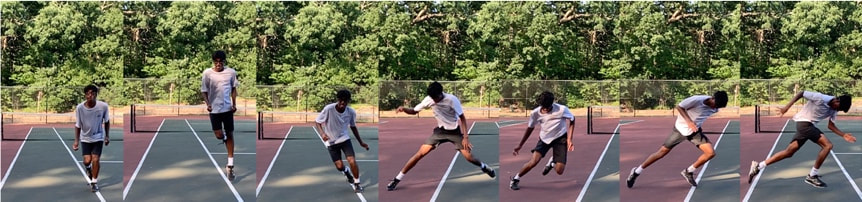
Figure 9. Lateral single leg hop + lateral bound + short sprint opposite direction
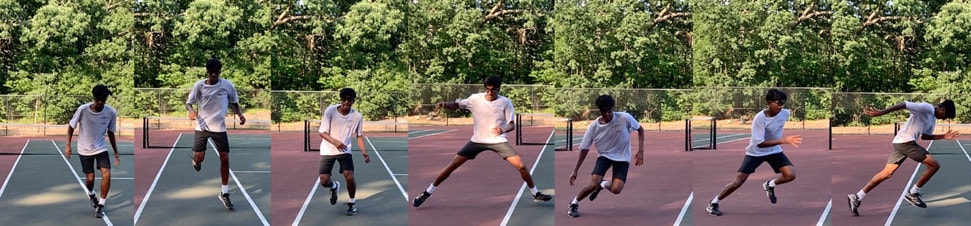
In these exercises, the single leg hops mimics the initial split-step landing but develops GRF for the lateral bound. An important concept is developing appropriate leg stiffness with short ground contact time (GCT) (Ferris et al., 1999; Morin et al., 2007). It is important to note both leg stiffness and GCT affecting split-steps and the initial takeoff and touchdown steps may change on clay courts (Ferris et al., 1999). In the drill, the athlete shifts weight inside after the lateral bound to sprint in the opposite direction of the bound. Exercises shown in Figures 6 and 7 can be done in sets of 12-20 reps. Exercises in Figures 8 and 9 can be done in sets of 6-10 reps resting between reps. Exercises in Figures 8 and 9 could be combined with additional COD agility movement for tennis-specific repeated sprint ability (RSA).
Contrast Resisted and Assisted Training
Contrast training refers to varying loads with similar movement or exercises. For speed training, often contrast training involves only slight changes in force (Dintiman, 2020; Mann & Murphy, 2018) since larger forces can alter mechanics to alter movement. A classic contrast training is performing the same resistance exercise (e.g, leg press) with different loads. A classic contrast training for speed involves running uphill and downhill but at modest angles so not to alter running mechanics (Dintiman, 2020). Bungees and resistance bands can provide assistance or resistance forces without dramatically altering lateral movement. Shown in Figure 9 shows the bungee-assisted lateral explosion. Attached a bungee high so it pulls the athlete laterally but also upwards. Use a split-step into a crossover step and sprint 2-3 m. Figure 9 shows the bungee-assisted exercise. For bungee-resisted lateral explosion, attach the bungee low on the fence (see Figure 10). The athlete can split-step into a crossover step, focusing on a more upwards pull upwards and away and from the fence.
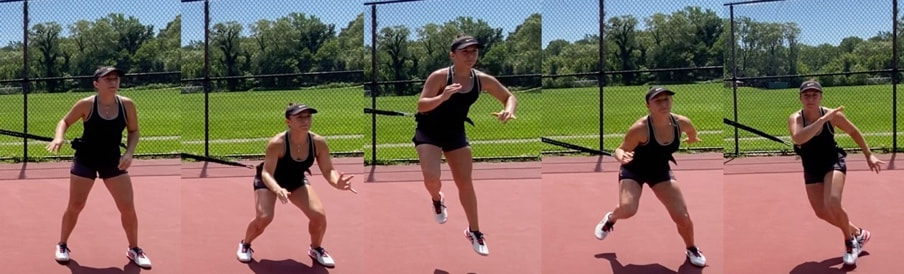
Figure 9. Bungee-assisted lateral explosion. split-step, touchdown and crossover towards band attachment.
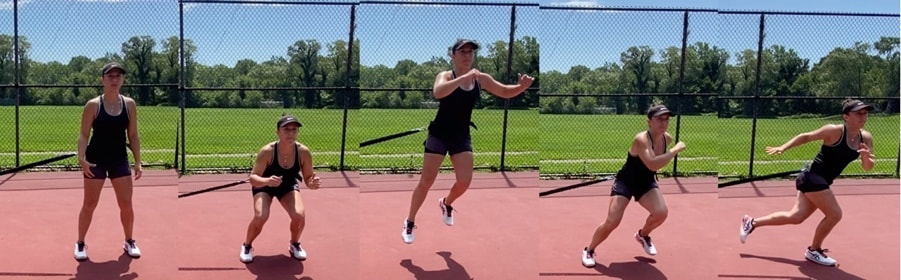
Figure 10. Bungee-resisted lateral explosion. split-step, touchdown and crossover away from band attachment.
CONCLUSIONS
Tennis movement is mostly lateral but athletes may have differences in movement to either side which should be trained. Movement in tennis is mostly short accelerations and decelerations rather than top end speed. In this article, specifically lateral acceleration was tackled from a physical off-court training with regards to technical training. Tennis players who use the forehand weapon to cover most of the court often run farther for the forehand than backhand, which requires higher acceleration to the forehand. Focus in this article was on physical training with some technical training. Physical training should require elastic unilateral reactive leg strength training and COD movement. Little research exists on unilateral reactive leg strength training which has implications in tennis. A series of tests were recommended but need to be correlated to actual lateral speed and acceleration in future studies.
REFERENCES