When you’re developing your tennis strokes, you’re going to look for power –and, in most cases, it will be sooner rather than later, especially if you’re going to play tennis competitively for points.
The problem when looking for power is that you’ll most likely associate it with the words “hard” and “strong”.
The words “hard” and “strong” are, in our minds, associated with tension. For example, if we want to lift or push something heavy, we will tense our muscles to create more force.
The reality of tennis is different from our typical experiences with creating force.
And speed is developed through a different process where muscles are much more relaxed and it feels effortless to generate speed.
Hitting Hard vs. Hitting Fast
I believe that the most common reasons for wanting to hit the ball hard with tense muscles are:
1. When the ball hits the racquet, the sound tells us that this was a hard impact – although in reality it wasn’t that hard (when the string bed absorbs the energy of the ball, it deforms and so does the ball!) and it doesn’t mean that our muscles were hard at impact!
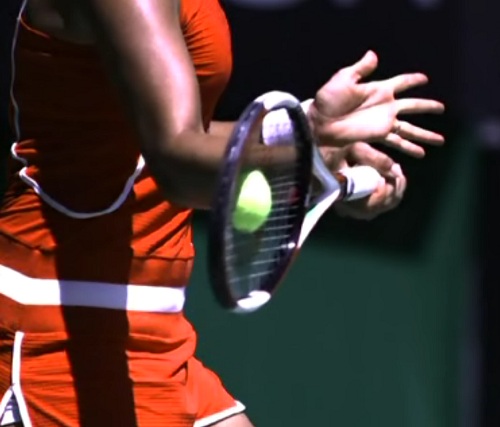
The ball and the strings deform at contact (image credit: Tennis Australia)
2. Our only experience in creating force is through tension and not through speed – we lift, carry, and push objects most of our life rather than throw them. (But almost all athletes that come from sports where balls are thrown or hit – like handball, volleyball, badminton, squash, etc. – have no problems accelerating a tennis racquet without tension!)

We are used to generating force through tension
3. We often hear the TV commentators say for example that the “serve was hit really hard”, and the words “hit hard” immediately trigger the idea of tension.
After all, when we’re tense, our muscles are hard.
But great tennis serves are hit fast and not with a lot of tension.
Again, in tennis we create force in a different way.
We are not pushing or lifting; instead, we’re swinging (in a controlled way), and the objects we’re dealing with – the racquet and the ball – are not heavy.
That’s why the key to creating force is speed rather than strength. (After all, except perhaps Rafael Nadal, most professional tennis players are not muscular and bulked up!)
Speed is also a much more important factor in creating kinetic energy (Ek) than mass:
If we increase mass by two times, the Ek will increase by two times, but if we increase the speed by two times, the Ek will increase by four times!
And kinetic energy is the energy that is released at contact from the racquet to the ball. A faster ball is a result of a faster racquet head that transfers more kinetic energy to the ball; therefore, the key is to increase speed.
Speed is created by a different process in the body than the usual force with tensing our muscles that we’re familiar with, and once you get a good hold of it, it’s fairly effortless compared to “muscling the ball”.
We need to learn to generate racquet head speed through more relaxed muscles and feel rather than tension and brute force.
Hitting Effortless Groundstrokes In Tennis
You can learn so much by simply drop feeding the balls to your forehand and backhand groundstrokes and simply hitting the ball short over the net while at the same time looking for the minimum effort.
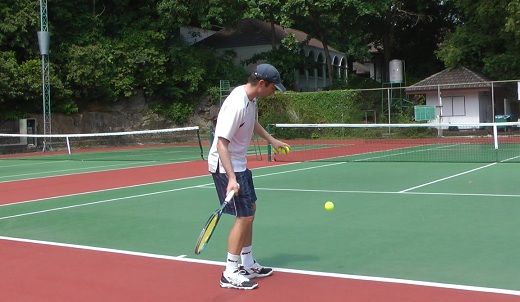
So much can be done on feel without needing a partner
You will see that you can relax your body and your muscles more and more and work less and less AND YET the ball will STILL go over the net!
That is the realization you have to come to in order to switch your concept of power from its association with strength and tension to relaxation and speed.
Note that you won’t be completely placid as there is some tension required to accelerate the racquet, but it’s a different way of generating force than what you’re used to.
Once you see that it works, it will be easier to trust it.
Gradually progress from mini tennis to full court tennis (or if someone is feeding you balls – from aiming just over the net to aiming to about ¾ distance), and all the time experiment with how much force and effort is needed to play the ball to your target zone.
The benefits of this drill can be felt immediately, even in one practice session, but if you do this regularly, you will see that there are many more levels of hitting the ball well with little effort.
In fact, that’s what must always be in your mind when you rally or warm up your strokes: “I want to hit the ball with good speed and find the least effort needed to do that while still maintaining control.”
I have been telling myself (consciously and unconsciously) that for many years, and that’s one of the main reasons my strokes produce power with little effort.
Effortless Volleys
As you’ve seen in the video, the same idea can and must be applied to volleys.
I believe volleys are much less forgiving than groundstrokes when it comes to hitting with tension rather than feel.
You have less court to aim to, and you need to control the speed of the incoming ball in a very short period of time.
Most shots that are not hit well with feel and control will end up as errors – while on the baseline, you have much more margin for error, even if you perform strokes incorrectly.
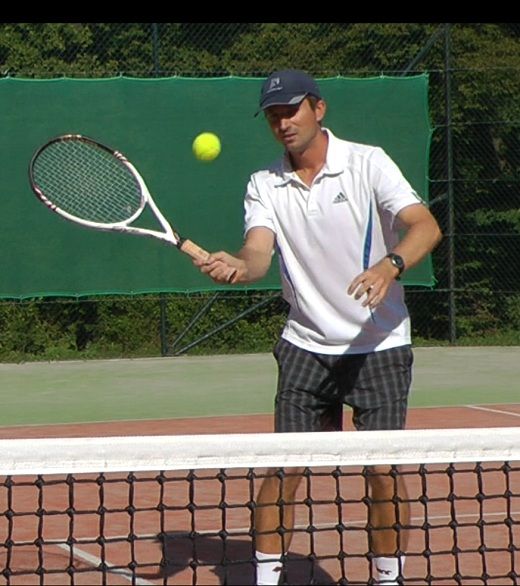
Volley is based on feel - we redirect the ball and often need to take speed away from the ball in order to control it.
Therefore, it’s critical that you know how to hit the volley with feel and control rather than knowing how to punch it.
The approach is very similar – play the balls short and look for the minimum effort needed to achieve your goal.
Try less and less and see at what point you lose control of the racquet head.
By less and less, I mean look for less tension in your muscles and griping the racquet less tight.
You need to tighten your grip only a split second before the contact, and even with that, you need to find out what is the least “tightness” needed to control the ball.
Another great variation of this drill is to alternate between hitting the ball short and hitting the ball deep and looking to alter your technique and force as little as possible.
This is so important that I am simply going to write this again:
Alternate between playing the volley short and deep and look for the minimum difference in force.
What is the least extra force you need to change from playing the ball short to playing the ball deep?
Keep asking your mind and body to find that out and keep hitting ball after ball.
It’s one of the best ways to learn a great tennis volley stroke.
Effortless Serves
Hitting tennis serves with strength (serving hard!) is probably the biggest and the most common mistake of club tennis players.
Besides the three reasons listed above (the sound that tricks us into thinking of hard contact, our limited experience of generating force, and the common misconception that the pros hit the ball “hard”), it’s actually hard to imagine that we can hit the ball really fast without being “strong”.
But good tennis serves are hit fast and not with a lot of tension. So, our goal is to achieve a high velocity of the racquet head – and with tense muscles, that’s not possible.
Feliciano Lopez serves with effortless power – note the speed of the racquet and his relaxed way of achieving that.
We quickly hit a limit of how fast we can serve with the idea of “hitting hard” and being tense, whereas the approach of hitting the ball with speed and more relaxed muscles will produce much higher racquet head speed and therefore higher speed of the ball.
In order to become familiar with the idea of hitting the ball in a relaxed state, we can apply the minimum effort drill again and progress from serving just over the net to serving close to the service line.
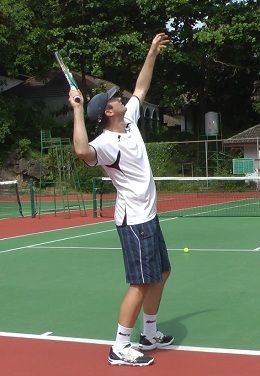
Practice serving with minimum effort and look for relaxation and feel
The key to a really fast tennis serve is actually not creating tension in your muscles until just the moment of impact.
That’s where all the stored energy is released in a very short time.
Most of the service action is therefore performed in a very relaxed way where the goal is to gradually build energy.
Therefore, we need to learn to perform most of the service action in a relaxed manner and learn to hit with a loose wrist – which will allow the energy built up in the body to be released through the wrist into the racquet.
The minimum effort drill again encourages you to let go of the idea of hitting the ball hard and try to hit the ball with more relaxed muscles and feel.
Through repetition, you realize that you CAN hit the ball relatively fast and deep even with little effort and little tension in the muscles.
That will put you on the right track, and in time you’ll learn to master this process of hitting fast tennis serves with little effort.
Summary
I realize that some tennis drills like the minimum effort drill may just be an interesting thing you found online and you’ll probably try it just out of curiosity to see what happens.
I cannot emphasize enough how this approach improves your tennis strokes and how important it is in the long term to keep asking your mind and body to find a way to generate good racquet head speed with as little effort as possible.
Finding more power and control for your shots will become easier and easier – so I really encourage you to play with the idea of the minimum effort on your strokes for a while and see what that does to your overall tennis game and enjoyment on court.
I want to challenge your beliefs in the end with this statement: “You do NOT need to hit the ball HARD in order to make the ball fly FAST.”
How exactly you can do that, I cannot explain in words; you simply need to experience it.