In order to make the most of your forehand technique in tennis, you need to find your ideal forehand contact point because only there will you be able to generate the most power with the least amount of effort.
Hitting the ball at the optimal contact point whether on the forehand or the backhand side also enables you to play with high consistency.
Keep in mind that having good technique does not guarantee having a good contact point; often, we have to use certain drills to help the player feel and find that optimal strike zone.
6 Drills For Finding The Ideal Forehand Contact Point
The following tennis drills can be applied to any forehand grip even though the contact point differs for a continental, eastern, semi-western or western grip.
The only thing that the player needs to focus on is whether he feels good energy transfer and good “contact” with the ball.
Shaheed uses a semi-western forehand grip, so his ideal contact point has to be well in front.
How much in front is based on biomechanics, and the best way to find that point (or strike zone) is through feel.
1. Just swing is a simple exercise where the player just swings the racquet and listens to the swoosh of the racquet. He then tries to feel and hear where the swoosh is so that he gets his first idea of how much in front the contact point is.
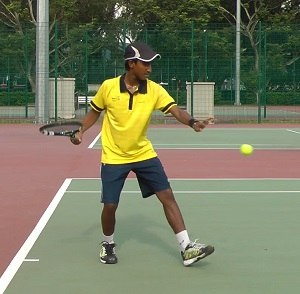
Stopping with the non-dominant hand helps you become very aware of the contact zone
2. Stop and hit is another simple drill which can be played on the same side of the net.
The player has to stop the ball with his non-dominant hand, let it bounce, and then play it gently with his forehand.
Stopping the ball with the non-dominant (left) hand helps him “feel” the contact zone, and the left hand is crucial for this awareness of the contact zone when the player is hitting his forehand in a regular play.
3. Playing behind the net is a drill that already positions the racquet almost in the ideal forehand contact point and prevents the backswing so the player cannot hit the ball too late.
Once the player gets used to playing almost from the contact point, he steps a few steps back and plays mini tennis but still tries to hit the ball with almost no backswing while making sure he hits the ball well in front in the ideal contact point.
4. Feed from behind is a very effective drill to improve the forehand contact point because the ball keeps going away from the player and there is no way the player can be too late on the ball.
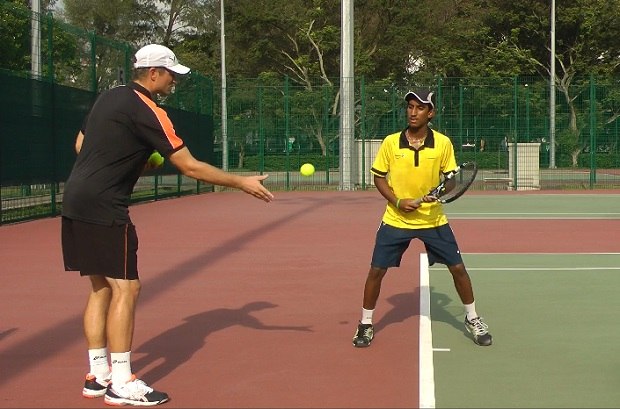
Feeding from behind is a very effective drill for all skill levels
It also encourages the player to extend more through the contact zone which helps with control and depth of forehand groundstrokes.
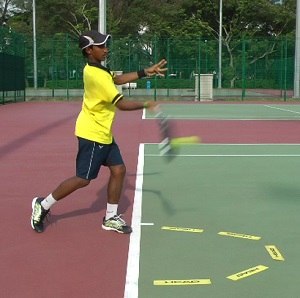
Just focus on meeting the ball in the contact zone regardless of the speed of the incoming ball
5. Hit in the zone is one of my favorite drills. The goal for the player is to meet the ball in the zone area which is marked by cones or tape just inside the court.
The player needs to stand behind the baseline and make sure he meets the ball in the marked zone.
6. Take the zone with you is the final drill where the player imagines that the zone moves with him and he says yes or no based on his observation of whether he hit the ball in the optimal contact point for his forehand stroke.
This final drill is also an excellent way to take your mind off technique, especially if you have trouble doing that in your practice sessions.
It’s very important that you “switch off” thoughts on the forehand technique or any other technique in order to focus on timing the shot and meeting the ball in the ideal contact point.
After all, eventually you want to play tennis, which is nothing else than playing each ball with a certain intention into a certain target area without any awareness of your technique.
Then your mind is clear, and you can finally play and really enjoy the game.