I can’t trust my forehand.
I’ve heard the above sentence more than any other when it comes to fixing the forehand. It’s an extremely common problem that I struggled with myself as a teenager for many years.
The fundamental problem, though, isn’t the lack of confidence itself, not directly. The problem is a mechanically flawed, non-fault tolerant stroke that shouldn’t be inspiring confidence.
Trust = Fault Tolerance
The typical player’s forehand stroke will fail unless executed perfectly; if said player executes their forehand even slightly wrong (for example, by slightly mistiming the ball or by slightly mishitting it), they are going to miss. Under those circumstances, of course the player doesn’t trust their stroke; it’s untrustworthy.
Your brain is smart – it’s lack of trust in your forehand, the reason it sends the “don’t be confident in this” signal as you go to hit, is that it should not trust a fault sensitive stroke to succeed consistently, especially under any sort of pressure.
On the other hand, a fault tolerant stroke is extremely trustworthy. Since the stroke will succeed in the face of a small fault, you can trust it even in cases where small faults are unavoidable, like when you’re tired or nervous. It is this property – succeeding when things aren’t perfect – that inspires your brain’s confidence.
Therefore, we improve your forehand confidence by improving the stroke’s fault tolerance. We’ll start by fixing the #1 fault tolerance destroyer on the forehand – changing your string angle through contact.
Some Quick Terminology

When I say “string angle,” I am referring to the angle between the strings and the ground. We refer to certain string angles as “open,” “neutral,” or “closed” depending on orientation.
Open string angle – strings angled up towards the sky
Neutral string angle – strings parallel to the net
Closed string angle – strings angled down towards the court
The modern forehand is hit with a slightly closed string angle, which is adjusted slightly depending on contact point and desired ball flight path.
Maintaining the String Angle
The string angle should barely change through the hitting zone. The longer you maintain your string angle through the hitting zone, the more fault tolerant your swing will be.
This is a simple case of collision physics. If a ball strikes an open racket face, it will deflect up more, and if it strikes a closed racket face, it will deflect down more. There is a certain range of string angles such that the ball will fly over the net and come down before landing out. In order for your forehand to work, you need to contact the ball while the strings are at an angle in this range.

The longer you can maintain a correct angle through the hitting zone, the less precise you have to be with your swing timing. Look at Novak Djokovic’s forehand above – if he were to contact the ball in any of frame 2, 3, 4, or even 5, his shot would go in. His string angle is roughly the same for his entire hitting zone. This is just one of the many things he does that allows him to practically never miss.
What String Angle to Choose?

The lower the ball is, the more open your strings should be, and the higher the ball is, the more closed your strings should be. Again, this is simple collision physics – you want low balls to fly higher off your racket and high balls to fly lower off your racket.
The change in string angle between shots is very minor. On low balls, for example, topspin shots are played with a neutral or even slightly closed string angle, not an open string angle. There is a ton of frictional force pulling the ball up through contact; it’s not necessary to actually deflect the ball up at all, even on a low ball. Only topspin lobs require an open string angle.
I will reiterate – the most important aspect of string angle on any shot is that it is unchanging through contact. Whatever shot you’ve elected to hit, however you’ve decided to orient your string angle through contact, make sure that angle barely changes through the hitting zone.
Don’t Players Rotate Their Rackets?
Yes, but in a different plane, a plane which does not change their string angle through contact. Elite players rotate their rackets (passively) about their forearm through the hitting zone, not about the handle.
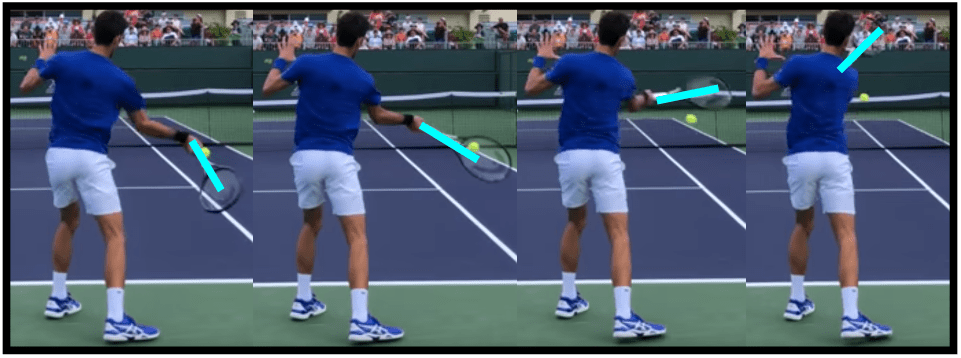
Look at the back view of Djokovic’s forehand above. The racket is rotating, but it’s rotating in such a way as not to alter the angle of his strings through contact. From frame 1 all the way to frame 4, his string angle is slightly closed. That string angle remains consistent, even though the racket whips around his forearm throughout the stroke.
Relaxation and String Angle
At first, it’s tough to relax your wrist and maintain your string angle. You have to pull the racket with your core movers at a pretty specific vector to avoid your forearm going crazy and rolling all over the place.
On the other hand, it’s very easy to maintain a consistent string angle with a tight wrist – this is why you naturally tighten up when you know you need to make a shot; your brain understands that a tight wrist isn’t ideal, but at least you’ll be able to maintain a string angle that will keep the ball in play.
But relaxation is the holy grail of forehand topspin and power, so it’s a worthy goal to practice your string angle maintenance with a relaxed wrist.
Shadow Swings
Shadow swings are the best tool for teaching yourself to maintain your string angle through contact.
The racket can (and often will) roll over during the follow-through, but throughout the hitting zone the string angle must remain constant.
Turn sideways, place your racket into its starting position for your forehand, and then lightly rotate your trunk and swing forward. Start at half speed and work up from there. Relax your hand, and swing out, up, and through an imaginary ball in front of you.
Observe your string angle through the hitting zone. Is it changing? The racket can (and often will) roll over during the follow-through, but throughout the hitting zone that angle must remain constant. Tweak the way you pull your arm with your chest until the angle is in fact remaining constant through the racket’s rotational whip.
You can add a small amount of tension with your hand/forearm to maintain the string angle, but ensure that your wrist is still loose enough that, when you initiate your rotation, your racket naturally lags behind your hand, and then flicks around your forearm as you swing.
Ensuring Shadow Swings Translate
Additionally, ensure two things on your shadow swings:
- Your hips get all the way around (back to parallel with an imaginary net) each swing. Don’t leave them under-rotated.
- Your imaginary contact point is out in front of and laterally away from your body.
It’s very easy to lose those two points when you’re not hitting a real ball, but in order for the shadow swings to translate, we need to ensure specifically that these two good habits stay ingrained.
The Angle Actually Changes a Little
You’re tweaking your shadow swing, and you finally find a comfortable, whippy, natural feeling swing where the string angle isn’t changing very much through the hitting zone. You notice, though, that despite your best efforts, the angle is still closing a little as the racket comes around.
That’s fine. On a correct forehand, the string angle typically does roll over a very small amount through the hitting zone. This is a very muted effect and it certainly isn’t volitional.

Let me clarify the three differences that distinguish this small, acceptable angle change from the typical one that destroys the forehand’s fault tolerance.
1. It’s Non-Volitional
This angle change happens completely naturally as a result of other forces during the swing. The player is not at all trying to change their string angle through contact – they aren’t trying to “roll their racket over the ball.”
That means that this angle change never results in any unnecessary tension in the wrist, never hampers racket head speed, and naturally adjusts itself appropriately based on the exact situation of the stroke.
2. Correct Angle is a Range
There does not exist one specific string angle at which the stroke must be contacted. Rather, there exists a range of correct angles, contact at any of which will lead to a decent shot.
A slightly closed angle will cause the ball to fly lower over the net, and land shorter, while a slightly open angle will cause the ball to fly higher over the net and land deeper. But that doesn’t mean you’ll miss.
The small angle change that occurs naturally isn’t big enough that the angle of your strings leaves this acceptable angle range – it’s still the case that if you’re a little early, or you’re a little late, your stroke will succeed. As a result, your stroke is still fault tolerant, and thereby still trustworthy.
3. Contact Height Effects Desired String Angle
On a typical shot, the ball is moving down through the hitting zone and racket is moving up through the hitting zone. In this situation, the very slight angle change through contact can actually help the ball stay in when the swing is mistimed.
If you contact the ball early in the swing by accident, that also means you contact the ball higher, and in that case you actually want a slightly more closed string angle. And, similarly, if you contact the ball late by accident, you’ll contact it lower and want a slightly more open string angle. (This is different if you’re hitting on the rise, one of the reasons that shot’s degree of difficulty is higher.)
Just Get Rid of the Bad Habit
I only mention fact that a very small angle change does occur so that you don’t happen upon a correct swing and think that it’s wrong. When you relax your hand, rotate your body, swing out, up, and through, and hit the ball in front of you, the small change will occur completely automatically, without you having to think about it.
All I really want is for you to understand the role that string angle plays in fault tolerance and to find the swing path that causes it to remain mostly constant through the hitting zone. Any very small string angle change that still occurs, without you focusing on it, won’t effect your swing’s fault tolerance.
On the opposite end of the spectrum, we have the large, fault tolerant killing string angles change that most players unintentionally employ. These changes are volitional; the movements are usually bad habits that transpire due to intentional effort by the player to do something like “roll your racket over the ball.”
That’s what we have to get rid of. That’s what’s killing your forehand’s fault tolerance.
Restore that fault tolerance, and you restore your confidence.