Biomechanical Deep Dive: The Subtle Racket Drop, Gravitational Unweighting ("Antigravity" Effect), and the Extended C-Curve
THE CENTRAL LAW OF STROKE PRIMING: "The subtle 'drop' of the arm and racket unit just prior to the forward swing primes the neuromuscular system = unweights or releases the gravity and tense contact between the racket and the hand = creating an apparent 'antigravity' effect, allowing the racket to accelerate effortlessly and freely along its forward swing trajectory." — Original Technical Field Note.
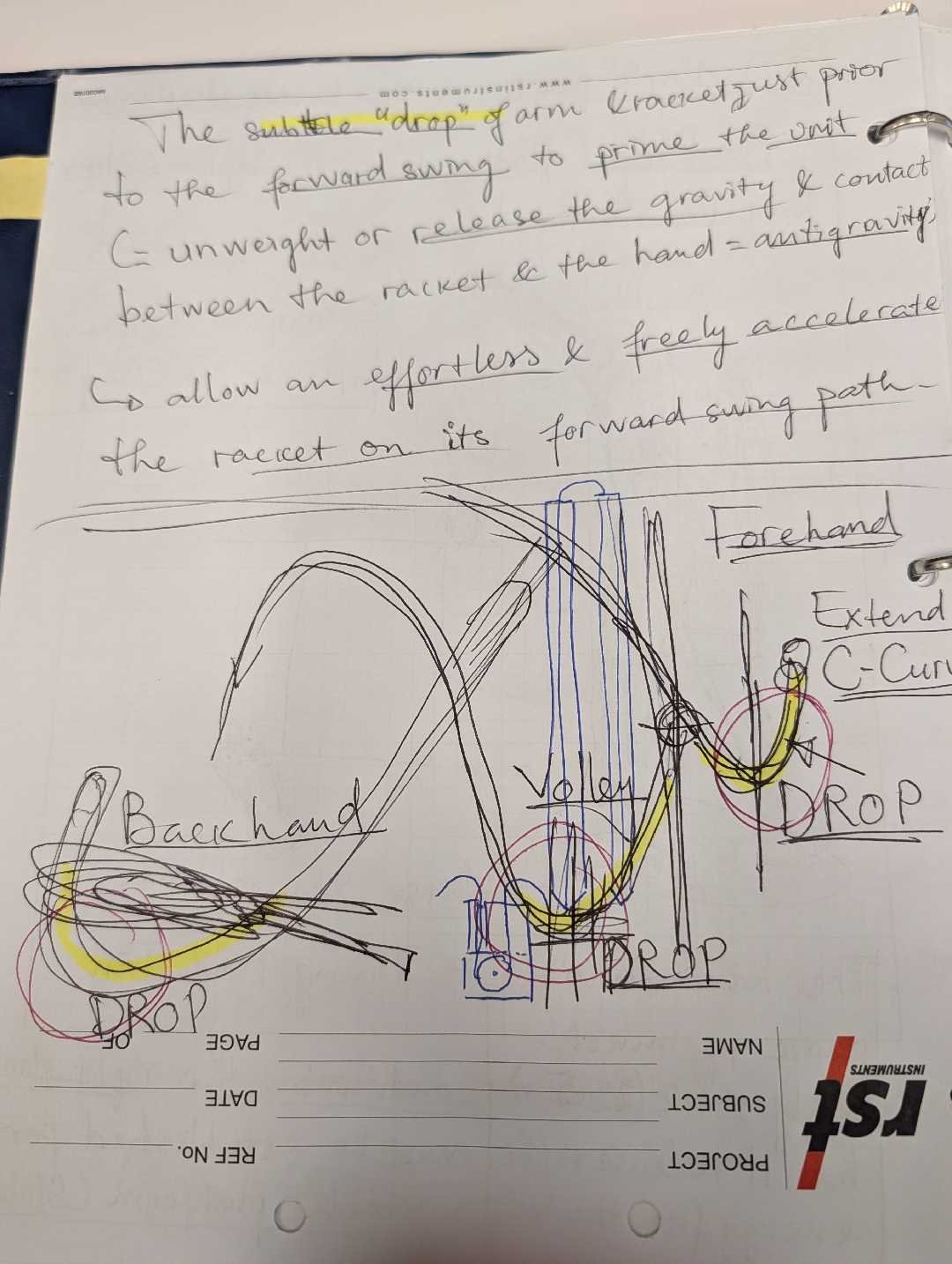
Figure 1: Original Engineering Field Notes — Documenting the mechanics of the subtle "Drop", unweighting, the three stroke manifestations (Backhand Drop, Volley Drop, Forehand Drop), and the continuous "Extend C-Curve" trajectory.
1. Physical & Physiological Principles of the "Drop"
1.1 Converting Gravitational Potential Energy into Rotational Kinetic Speed
In high-performance tennis, maximum head speed is achieved not by pulling with the shoulder muscles, but by letting gravity do the heavy lifting during early acceleration. When the racket is held high in the preparation phase, it stores gravitational potential energy:
Where $m$ is the effective mass of the racket and swinging forearm ($\approx 2.1 - 2.5\text{ kg}$), $g = 9.81\text{ m/s}^2$, and $\Delta h \approx 0.35 - 0.50\text{ m}$ is the vertical drop distance into the slot. By consciously releasing muscular tension rather than pushing down, this potential energy converts effortlessly into rotational kinetic energy:
The player enters the forward slot with positive angular velocity ($\omega$) at zero metabolic muscular cost.
1.2 The "Antigravity" Effect: Unweighting the Hand-Handle Connection
When an amateur squeezes the handle tightly ($7 - 9 / 10$ grip pressure), co-contraction locks the wrist and creates antagonistic friction. The "Drop" executes an instantaneous unweighting:
- Grip tension drops to a feather-light $2 - 3 / 10$.
- The hand-to-racket contact softens, releasing opposing muscular resistance.
- As the racket reaches the nadir of the drop, sudden forward hip uncoiling catches the lagging racket. Centrifugal force and tendon elasticity reverse the downward descent into a violent upward/forward snap that feels completely weightless to the player—an "antigravity" rebound.
1.3 The Stretch-Shortening Cycle (SSC)
The rapid transition from gravitational drop to forward whip activates the neuromuscular Stretch-Shortening Cycle (SSC). The anterior shoulder tendons and forearm flexors are passively pre-stretched under zero tension. When the core uncoils, the elastic collagen springs recoil, delivering an immediate **$20 - 35\%$ boost in sweetspot speed** without muscular fatigue.
2. Stroke Applications: Forehand, Backhand & Volley Drops
| Stroke Category | Drop Mechanism | Kinematic Trajectory | Resulting Performance Benefit |
|---|---|---|---|
| Forehand DROP | Racket held high on edge; drops into slot via gravity | Extended C-Curve: Butt cap points toward the ball with maximum passive wrist lag | Effortless tangential acceleration ($v = \omega r$) and heavy topspin |
| Backhand DROP | Hand pulls 15–20 cm down below ball level with non-dominant hand support | Inverted C-Curve: Racket head plunges into the slot beneath the ball plane | Steep upward WSWM ramp ($25^\circ - 35^\circ$), generating heavy Magnus topspin |
| Volley DROP | Subtle 3–5 cm micro-drop of the wrist unit just prior to punch | Micro-Drop Prime: Softens grip, unweights wrist, and pre-stretches flexors | Delivers crisp underspin "pop" and knife-carve control with zero excess backswing |
3. Passive Gravitational Drop vs. Active Muscular Pushing
| Biomechanical Feature | Passive Gravitational Drop ("Antigravity") | Active Muscular Pushing (Amateur Flaw) |
|---|---|---|
| Grip Tension | Relaxed and receptive ($2 - 3 / 10$) | Death grip squeezing ($7 - 9 / 10$) |
| Swing Trajectory | Continuous, flowing Extended C-Curve | Jerky, straight-line pull or hitch at the slot |
| Energy Source | Gravitational potential energy + SSC tendon recoil | Isolated voluntary concentric muscular contraction |
| Point of Peak Velocity | Peaks exponentially directly at ball collision | Peaks prematurely, decelerating into contact |
| Joint Safety (50+ Players) | 100% joint protection; zero tendon strain | High risk of Tennis Elbow, Golfer's Elbow, and tears |
4. Masterclass Super Slow-Motion Video Breakdowns
5. Sensory Drills & Self-Audit Checklist
Drill 1: The "Dead Weight" Free-Fall Calibration
Raise your racket to eye level in ready stance. Soften your grip to $1 / 10$ and completely relax your forearm. Allow the racket head to fall purely by gravity. Observe how it naturally bottoms out and rebounds upward. Repeat 15 times to extinguish the habit of "pushing" the racket downward.
Drill 2: The Continuous Extended C-Curve Shadow Swing
Execute a high unit turn. Without stopping at the top, guide the racket in a continuous, sweeping C-curve loop into the slot. Feel the "antigravity" weightlessness at the bottom as your hips uncoil forward, releasing the racket into a fluid follow-through. Practice 20 repetitions daily.
Drill 3: The Volley Micro-Drop "Pop" Drill
From the ready position at the net, soften your grip as the ball approaches, allowing a subtle 3–5 cm downward micro-drop of the wrist unit. Immediately step forward, firming your grip to $6 / 10$ at contact to knife cleanly beneath the ball with explosive underspin bite.
5-Point Diagnostic Self-Audit
- [ ] Grip Softness: Is grip pressure relaxed at $2 - 3 / 10$ during the drop phase?
- [ ] C-Curve Continuity: Does the racket trace a seamless continuous loop without hitching or pausing at the slot?
- [ ] Gravitational Drop: Is the racket allowed to fall by gravity, or is the shoulder actively pushing it downward?
- [ ] Natural Lag: At the bottom of the drop, does the butt cap point forward toward the oncoming ball?
- [ ] Volley Micro-Drop: On volleys, does the player prime the punch with a compact 3–5 cm micro-drop instead of taking a giant backswing?
Conclusion
The subtle **Drop** is the biomechanical gateway to effortless power. By **unweighting the racket**, **releasing hand-handle tension**, and **allowing gravity to prime the kinetic chain**, tennis players unlock a state of apparent "antigravity" that maximizes head speed, enhances topspin, and protects their joints for decades of healthy play.