Serve & Backhand Biomechanics: The Continental Grip Behind the Handle & Hand-Below-Ball Preparation
DUAL-STROKE STRUCTURAL AXIOM: In modern tennis, two vital shot families—the Service Delivery and the Single-Handed Backhand Groundstroke—share an identical structural foundation: the hand must be positioned firmly behind the racket handle via the Continental Grip (Bevel 2). On the serve, placing the hand behind the handle unlocks explosive forearm pronation and internal shoulder rotation. On the one-handed backhand, placing the hand behind the handle creates a rigid skeletal backstop against heavy incoming collision forces. Furthermore, in 1HBH preparation, actively pulling the hand 15–20 cm down below the ball level keeps the racket head elevated, creating a steep, gravity-driven low-to-high brushing vector that produces heavy, dipping topspin.
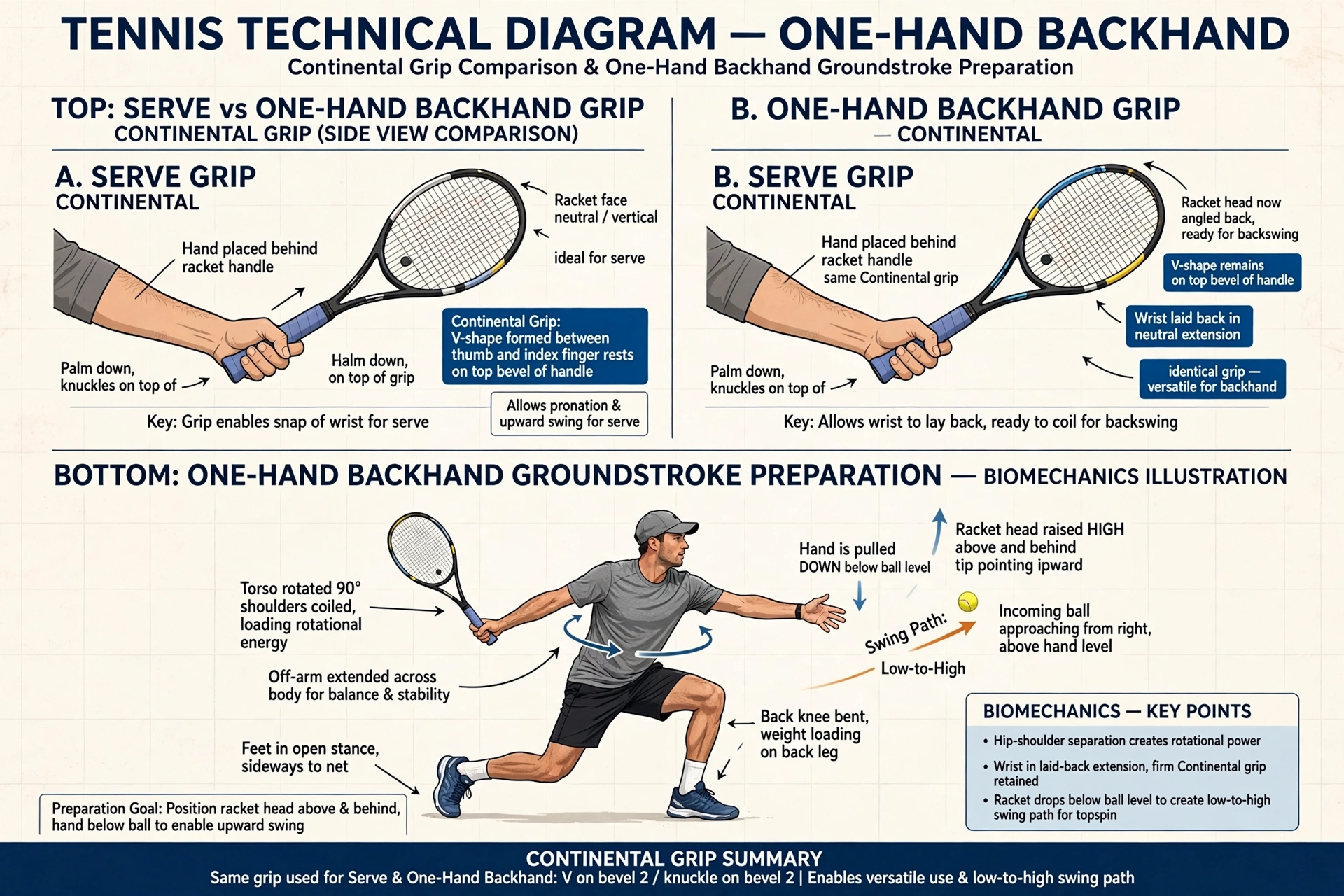
Figure 1: Master Biomechanical Blueprint — Panel 1: Continental Grip alignment for Serve (hand behind handle unlocks pronation); Panel 2: Continental Grip for 1HBH (hand behind handle squares stringbed at contact); Panel 3: Groundstroke preparation mechanics (pulling hand down 15–20 cm below ball level, racket head elevated, 90° shoulder unit turn, 60% rear leg load).
1. The Hand-Behind-Handle Principle: Serve vs. Backhand Groundstroke
One of the most profound revelations from technical coaching notes is that the Continental Grip (Bevel 2) forms the unified anatomical bridge connecting power generation on the serve to collision stability on the one-handed backhand.
When the hand is placed behind the racket handle (base knuckle of index finger and heel pad resting on Bevel 2 with palm facing obliquely downward):
- On the Serve: The racket ascends into the hitting zone leading with the frame's edge. This orientation permits the subscapularis and pronator teres muscles to fire explosively through the ball, executing complete forearm pronation ($180^\circ$ outward roll) at zenith. Players using a flat "frying-pan" grip place the hand underneath the handle, which mechanically jams the wrist and causes chronic rotator cuff tendonitis.
- On the One-Handed Backhand: The carpal bones of the wrist (*scaphoid, lunate, capitate*) sit directly in line behind the incoming collision vector. A 50–80 km/h shot delivers $250 - 400\text{ N}$ of instantaneous impact force. Because the hand is behind the handle, this load is absorbed as compressive axial force through the radius and ulna into the shoulder and torso, completely protecting the vulnerable lateral extensor tendons.
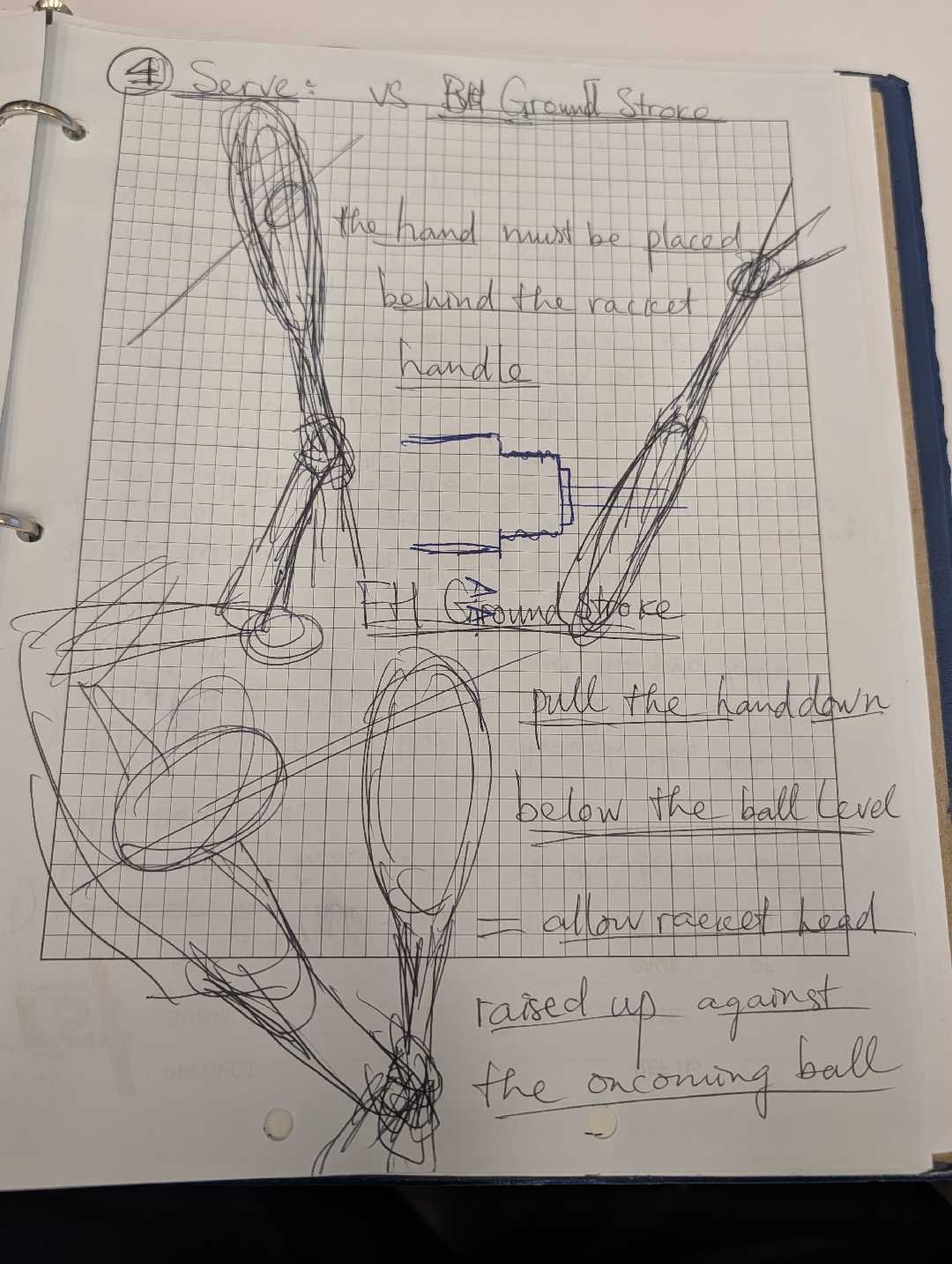
Figure 2: Original Engineering Field Notes — Documenting Point (4): "Serve vs BH Ground Stroke: the hand must be placed behind the racket handle" and Point (5): "BH Ground Stroke: pull the hand down below the ball level = allow racquet head raised up against the oncoming ball."
2. The Hand-Below-Ball Preparation Principle
2.1 The Geometry of Hand-to-Racket Head Separation
A widespread amateur flaw is holding the hitting hand at the same height as the oncoming ball during takeback. This results in a flat, horizontal swing plane with near-zero vertical clearance over the 3-foot center of the net.
By consciously pulling the hand down 15–20 cm below the projected ball height:
- The racket head remains elevated ($30^\circ - 45^\circ$ above horizontal) relative to the wrist during early preparation.
- The body creates potential gravitational energy and pre-stretches the posterior kinetic chain (*latissimus dorsi, rhomboids, gluteus maximus*).
- As the hips rotate forward, the elevated racket head drops by gravity into the "slot" beneath the depressed hand.
2.2 Topspin Aerodynamics: The Magnus Force
Because the hitting arm enters the strike zone from deep beneath the ball, the strings brush vigorously up the back surface (from 7 o'clock to 1 o'clock for a right-hander). The resulting topspin ($1,800 - 3,200\text{ RPM}$) generates an aerodynamic downward Magnus force:
This downward aerodynamic dive pulls high-speed drives safely into the court before the baseline, allowing players to swing with maximum aggressive racket head speed while maintaining immense margin over the net.
3. Kinetic Chain & Full-Body Integration
| Anatomical Anchor | Kinematic Action | Biomechanical Purpose |
|---|---|---|
| Shoulder Unit Turn | $90^\circ$ rotation perpendicular to baseline; chin over lead shoulder | Stores elastic strain energy in latissimus dorsi and core obliques |
| Rear Leg Loading | $60\%$ of body weight loaded on flexed rear leg; lowered CoM | Provides ground reaction foundation for explosive forward drive |
| Hitting Hand | Pulled down 15–20 cm below oncoming ball level (Continental Grip) | Establishes steep low-to-high swing ramp and keeps racket head elevated |
| Non-Dominant Arm | Points along baseline / toward incoming ball; guides throat | Calibrates spatial distance and acts as counter-rotational brake ("wingspan") |
| Grip Tension | Relaxed (2–3 / 10 pressure) during preparation | Allows effortless gravitational drop into the slot without arm muscling |
4. Super Slow-Motion Video Masterclasses
5. Step-by-Step Training Drills & Self-Audit Checklist
Drill 1: The Mirror Height Calibration (Static Check)
Stand in front of a full-length mirror in your 1HBH unit turn posture. Visually mark hip height as the incoming ball trajectory. Consciously pull your hitting hand down to mid-thigh/knee height while keeping the racket head angled upward at $30^\circ - 45^\circ$. Verify in the mirror that your hand is visibly 15–20 cm lower than the imaginary ball height. Hold for 2 seconds. Repeat 10 times.
Drill 2: The "Drop - Pull" Rhythmic Live Feed
Have a practice partner drop balls from a feeding basket. As the ball bounces, verbally call out "DROP" and pull your hitting hand deep below the bounce height. As the ball peaks, call out "PULL" and drive your torso forward, whipping the racket up into a high chest-expansion finish. Confirm that the ball clears the net by at least 50 cm and dips inside the baseline.
5-Point Diagnostic Self-Audit
- [ ] Bevel 2 Alignment: Is the hand placed firmly behind the handle on Bevel 2 with palm facing downward/oblique?
- [ ] Serve Pronation: On the serve, does the racket ascend on-edge and snap through full forearm pronation?
- [ ] Hand Depression Depth: During 1HBH takeback, is the hand pulled 15–20 cm below the projected contact height?
- [ ] Racket Head Angle: Does the racket head remain tilted upward relative to the depressed hand during preparation?
- [ ] Rear Leg Load: Is $60\%$ of body weight loaded on the flexed rear leg during the $90^\circ$ shoulder unit turn?
Conclusion
The **Continental Grip (Bevel 2)** with the hand placed behind the handle provides the master mechanical foundation uniting the modern tennis serve and the one-handed backhand. When coupled with an active **hand-below-ball preparation**, players unlock effortless power, penetrative topspin, and complete anatomical joint protection across their entire tennis career.