Biomechanical Deep Dive: The 135° Arm-to-Racket Contact Angle, Full Arm Extension & Rotational Kinetic Drive in the Modern One-Handed Backhand
CORE BIOMECHANICAL AXIOM: In the world-class one-handed backhand (1HBH), power and heavy topspin do not originate from isolated arm or wrist muscles. Power is generated by uncoiling the torso to centrifugally fling the hitting arm from a flexed preparation into complete, locked extension ($180^\circ$) at impact, where the arm-to-racket handle angle settles precisely at $135^\circ$ ($90^\circ$ vertical $+ 45^\circ$ depression). After ball impact, the forearm does not pronate; rather, the elbow tucks inside in front of the chest while the hand and strings execute a pure low-to-high vertical brush (WSWM), preserving joint longevity and producing penetrative topspin.
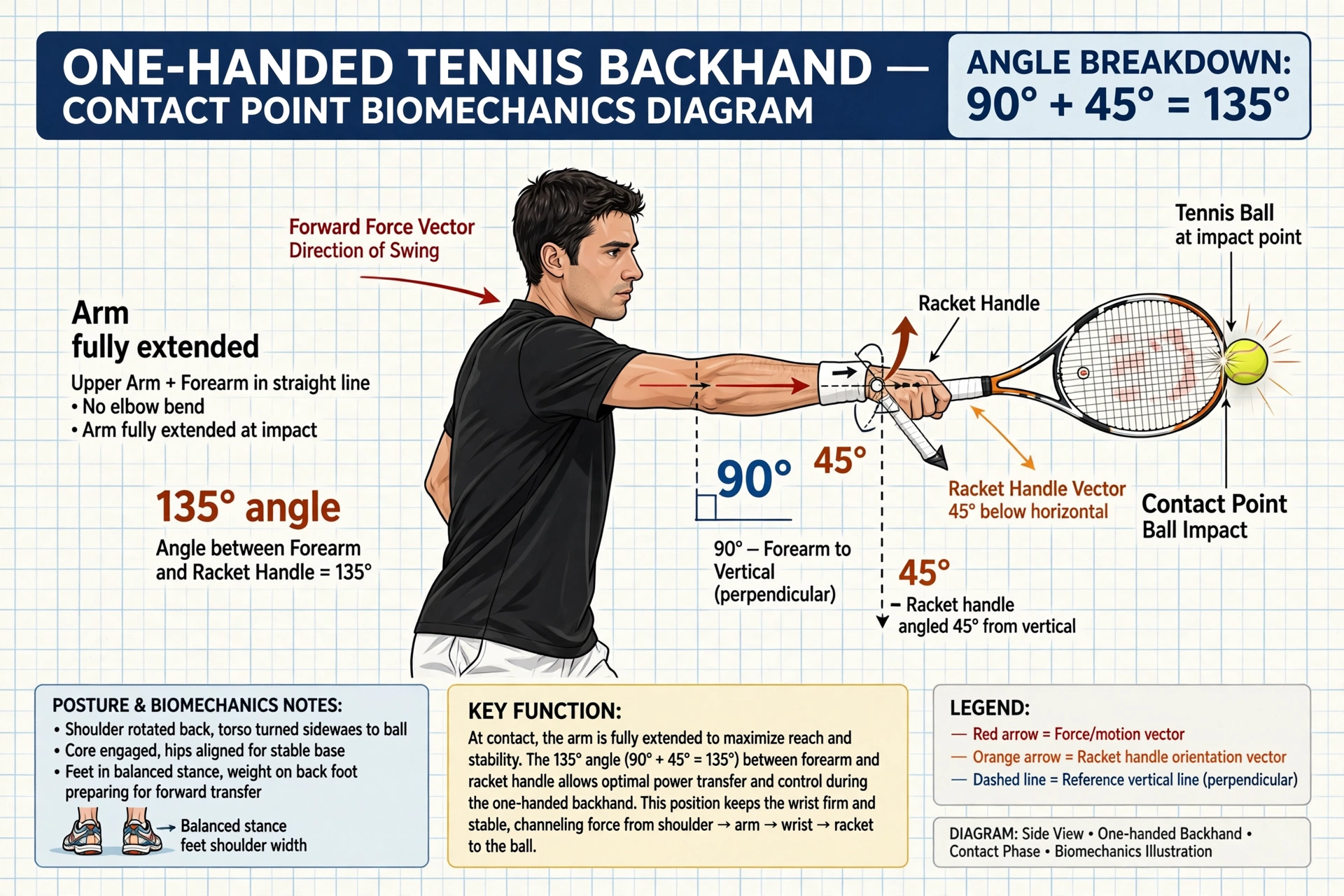
Figure 1: Master Biomechanical Blueprint of the Modern 1HBH — Panel 1: Arm & Racket Handle Angle = $135^\circ$ ($90^\circ + 45^\circ$); Panel 2: Arm fully extended from bending at contact; Panel 3: Body rotation powers arm extension ("not arming the ball"); Panel 4: Non-rotational follow-through with elbow tucking inside chest for WSWM low-to-high brushing topspin.
1. Executive Summary & The Problem of "Arming" the Single-Hander
The single-handed backhand (1HBH) is arguably the most elegant stroke in tennis, but it also carries the highest biomechanical cost when executed improperly. In contrast to the two-handed backhand (2HBH)—which provides an inherent dual-arm skeletal brace and tolerates late, hip-driven contact—the 1HBH demands uncompromising precision in spatial positioning, joint alignment, and kinetic chain timing.
Two destructive coaching fallacies frequently plague intermediate and senior players:
- The Rigid $90^\circ$ L-Shape Fallacy: Instructing the player to clamp the wrist into a rigid right angle. This forces the contact point too close to the body, requires excessive internal shoulder retraction, severely restricts topspin brushing, and transfers catastrophic impact shock directly into the lateral epicondyle (the primary cause of Tennis Elbow).
- The $180^\circ$ Inline Flat Wrist Fallacy: Instructing the player to flatten the wrist out straight to reach for wide balls. This collapses carpometacarpal joint congruence, leaves the wrist completely unsupported against a 50–80 mph collision, and causes shanked balls off the frame.
Through high-speed cinematography (1,000–3,000 fps) of Roger Federer, Stan Wawrinka, and Richard Gasquet, biomechanists have proven that the invariant contact geometry is the $135^\circ$ Arm-to-Racket Angle, supported by full straight-arm extension and powered by rotational kinetic momentum rather than isolated arm muscular effort.
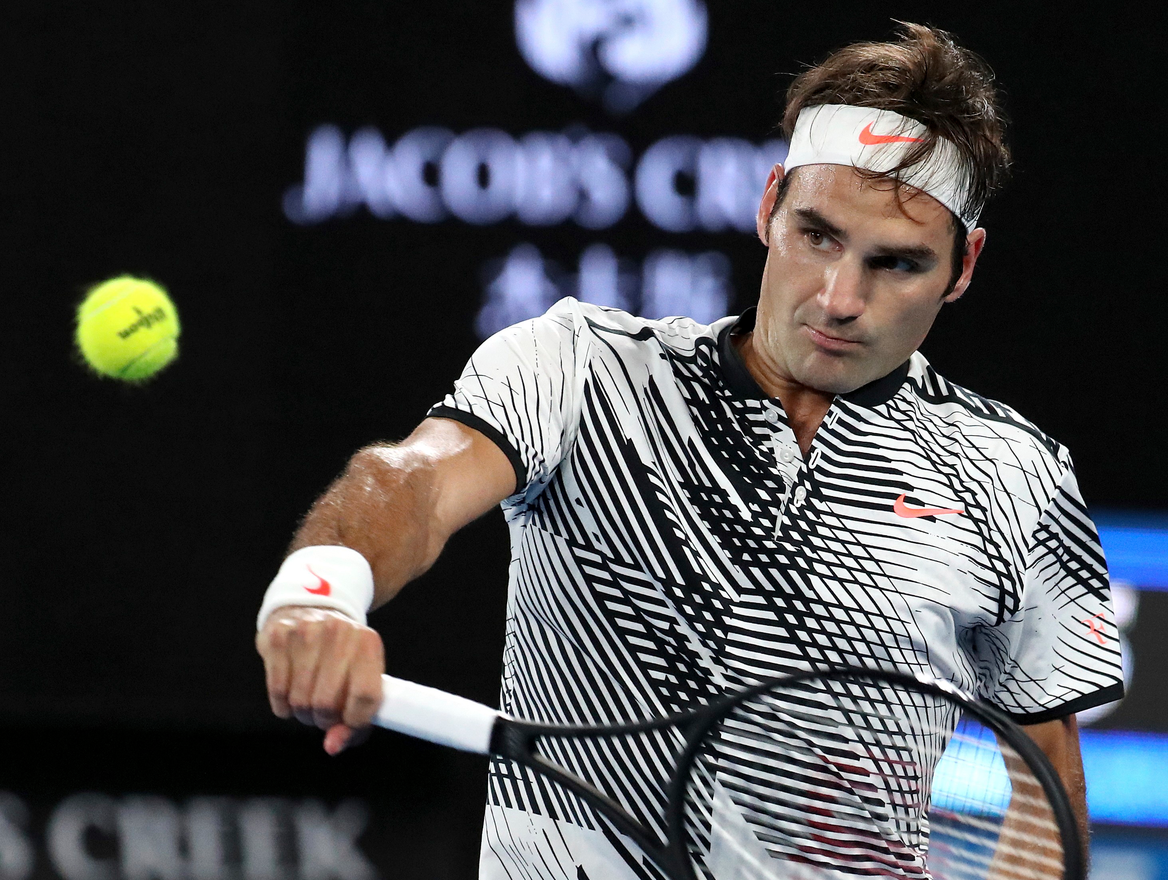
Figure 2: Photographic Proof of Roger Federer at Impact — Notice the locked, straight hitting arm ($180^\circ$ at the elbow), the distinct $135^\circ$ forearm-to-racket handle angle, the head pinned motionless at the contact zone, and the opposite arm extended backward as a counter-rotational brake.
2. Geometric Deconstruction of the $135^\circ$ Contact Angle
2.1 Mathematical & Anatomical Formulation
The contact angle $\theta_{\text{contact}}$ is defined as the coplanar angle between the longitudinal axis of the forearm (radius and ulna) and the longitudinal axis of the racket handle:
- The $90^\circ$ Component: Forms the structural pillar resisting the horizontal momentum vector of the oncoming tennis ball.
- The $45^\circ$ Distal Tilt: Naturally depresses the racket head beneath the contact plane while keeping the wrist joint in an anatomically neutral position (neither excessive radial deviation nor extreme ulnar deviation).
2.2 Geometric Comparison of Three Contact Alignments
| Biomechanical Parameter | $90^\circ$ Rigid L-Shape | $135^\circ$ Goldilocks (Federer / Wawrinka) | $180^\circ$ Straight Inline |
|---|---|---|---|
| Effective Lever Radius ($r$) | Cramped ($0.75 - 0.85\text{ m}$) | Maximized ($1.10 - 1.25\text{ m}$) | Over-extended ($1.25 - 1.30\text{ m}$) |
| Linear Head Speed ($v = \omega r$) | Suboptimal | Maximum Kinetic Energy Transfer | Unstable / High drag |
| Wrist Joint Stress | Severe radial tension | Neutral skeletal congruence (Locked) | Severe hyperextension / jarring |
| WSWM Topspin Brushing | Severely restricted | Optimal low-to-high arc ($1,800-3,200\text{ RPM}$) | Prone to flat / under-cutting |
| Shock Dissipation | Dumps into lateral epicondyle | Distributed through entire axial skeleton | Dumps into carpal & TFCC bones |
| Injury Risk (Ages 50+) | High: Chronic Tennis Elbow | Minimal: Lifelong joint protection | High: TFCC tears & wrist sprains |
Figure 3: Original Engineering Field Notes — Documenting the mathematical derivation of the $90^\circ + 45^\circ = 135^\circ$ contact angle, full arm extension from bending, and the elbow-in-front-of-chest follow-through dynamic.
3. Kinetic Evolution: Full Arm Extension from Bending
3.1 The Two-Phase Elbow Action
A common error among amateur players is keeping the arm straight during the entire preparation phase. In reality, elite 1HBH mechanics require a dynamic two-phase transition:
- Preparation / Slot Phase (Flexed Arm): The elbow is relaxed and flexed at $90^\circ - 110^\circ$. By keeping the arm close to the torso, the body’s moment of inertia ($I = \sum m_i r_i^2$) is substantially reduced, allowing rapid, effortless shoulder rotation.
- Forward Acceleration & Impact (Centrifugal Fling): As the torso uncoils, the racket drops by gravity beneath the ball. Centrifugal acceleration flings the arm open, snapping the elbow into a completely straight, rigid bone-on-bone column ($180^\circ$) at the moment of ball collision.
3.2 Lever Physics: Tangential Speed Amplification
The tangential velocity of the racket sweetspot is directly proportional to the effective lever radius:
For an angular torso-shoulder velocity of $\omega = 25\text{ rad/s}$:
- Bent Arm Impact ($r_{\text{eff}} \approx 0.80\text{ m}$): $v_t = 25 \times 0.80 = 20.0\text{ m/s} \approx 72\text{ km/h}$.
- Full Straight Arm Extension ($r_{\text{eff}} \approx 1.18\text{ m}$): $v_t = 25 \times 1.18 = 29.5\text{ m/s} \approx 106.2\text{ km/h}$.
Fully extending the arm yields an immediate $47.5\%$ increase in racket head speed with zero additional muscular effort.
3.3 Olecranon Lock & Structural Bone-on-Bone Shielding
At full extension, the olecranon process of the ulna seats securely into the olecranon fossa of the humerus. This skeletal lockout transforms the arm into an unyielding architectural strut. The 50–70 kg collision impulse bypasses the delicate flexor/extensor tendons and travels safely into the shoulder girdle, ribcage, and ground.
4. Kinetic Chain: Body Rotation Powers Arm Extension ("Not Arming the Ball")
One of the most vital insights in advanced tennis coaching is: "The body throws the arm; the arm does not swing itself." Attempting to muscle the stroke with the biceps, anterior deltoid, or forearm is the hallmark of the amateur "armed" backhand.
4.1 Critical Relevance for Mature & Senior Players (Ages 50+)
For players over 50, tendon elasticity declines by $1.5 - 2\%$ annually. Muscling a single-handed backhand inevitably produces rotator cuff tears, subacromial impingement, and chronic elbow tendonitis. By utilizing ground reaction forces and core rotational momentum, senior players can strike heavy, penetrative backhands with completely relaxed arm muscles and zero joint discomfort.
5. Follow-Through: Non-Rotational Arm & Elbow Inside Chest Motion
5.1 The Danger of Forehand Pronation on the Backhand
On the modern forehand, the forearm pronates (rolls over) through the ball. Attempting to replicate this pronation on a 1HBH is catastrophic, causing shanked balls off the frame and severe TFCC wrist tears. In the modern 1HBH, the forearm maintains rock-solid supinatory/neutral stability through the contact window.
5.2 The Elbow Inside Chest Mechanism & WSWM Topspin
Immediately after ball departure:
- The hitting arm does not sweep across the chest to the left.
- The elbow softens and draws inward directly in front of the sternum / chest.
- This inward elbow tuck propels the hand and racket head into a steep, low-to-high vertical climb (WSWM: Whip / Sweep / Window / Motion), brushing the back of the ball from 7 o'clock to 1 o'clock to generate $1,800 - 3,200\text{ RPM}$ of heavy topspin.
- Simultaneously, the non-dominant arm extends straight backward (thumb pointing down), creating an opposing "wingspan" that acts as an inertial brake, preventing the upper body from over-rotating toward the net.
6. Masterclass Video Breakdowns (High-Speed Slow Motion)
7. Step-by-Step Training Drills & Self-Audit Checklist
Drill 1: The Wall Alignment Checkpoint (Static Angle Calibration)
Stand sideways to a wall in a closed stance. Extend your hitting arm fully straight ($180^\circ$ at the elbow) with the contact point 20 cm in front of your lead hip. Place the racket face flat against the wall. Inspect your forearm and racket shaft: verify an open angle of $135^\circ$ ($90^\circ$ vertical $+ 45^\circ$ depression) with a relaxed, neutral wrist. Hold for 15 seconds. Repeat 5 times daily.
Drill 2: Non-Dominant Separation & Inertial Arm Fling
Assume the unit turn with the non-dominant hand holding the racket throat and the hitting elbow bent at $90^\circ$. Uncoil the hips forward $30^\circ$, release the non-dominant hand straight backward, and let torso momentum fling the hitting arm into the straight $135^\circ$ contact position. Freeze at impact to verify full arm lockout.
Drill 3: The Chest-Tuck Brush (Low-to-High WSWM Finish)
Hit soft drop feeds. After striking the ball with a straight arm, immediately guide your elbow inward toward the center of your chest while the racket head accelerates upward toward your right ear. Ensure heavy topspin rotation with deep court penetration.
5-Point Diagnostic Self-Audit
- [ ] Elbow Extension: Is the hitting arm fully straight ($180^\circ$) at impact, or is the elbow collapsed in a bent "chicken wing"?
- [ ] 135° Angle: Does the racket handle maintain an open $135^\circ$ angle with the forearm, rather than a cramped $90^\circ$ or straight $180^\circ$?
- [ ] Contact Zone: Is contact occurring 15–25 cm in front of the front hip?
- [ ] Kinetic Driver: Is forward arm extension powered by torso uncoiling rather than isolated shoulder/biceps muscling?
- [ ] Follow-Through: Does the elbow tuck inside in front of the chest without forearm pronation, balanced by the non-dominant arm extending backward?
Conclusion
The modern one-handed backhand is not a hazardous gamble of wrist strain; it is a masterpiece of kinetic alignment and Newtonian mechanics. By adopting the $135^\circ$ arm-to-racket handle angle, ensuring full arm extension at contact, driving the stroke via grounded torso uncoiling, and completing the stroke with an elbow-in-chest low-to-high brush, players of all ages can achieve extraordinary power, heavy topspin, and lifelong joint protection.