Research · Biomechanics · v1.1
Three points, four contacts, and what the constraint costs
A coaching framework built on a three-legged stool, tested against the literature, the geometry, and the drills that carry it into a player's week.
The claim One phrase, three questions The constraint budget Three corrections The evidence, graded The practice layer The 40-second film Six cues that survive What would falsify this
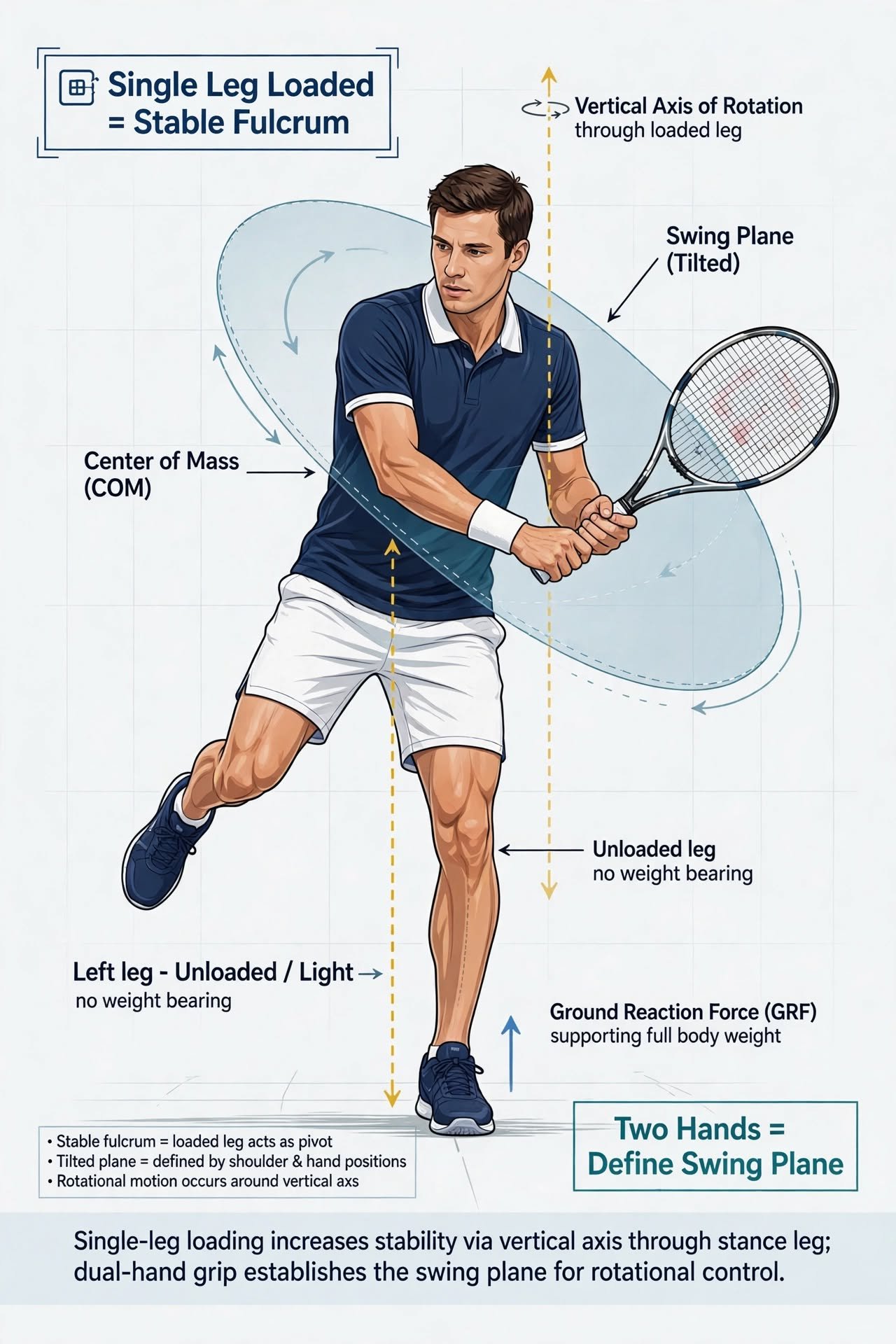
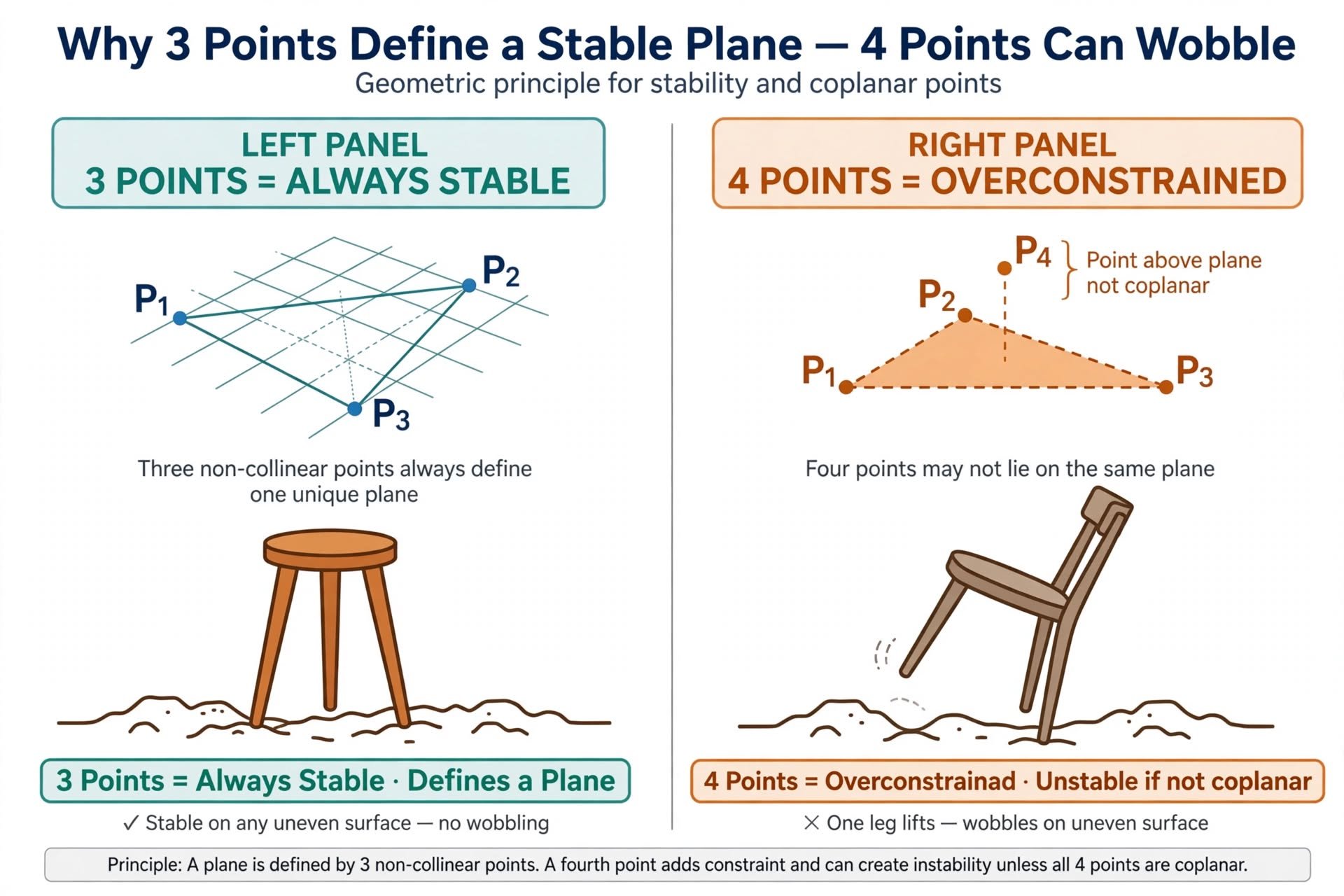
A three-legged stool never wobbles. A four-legged chair does. From that observation a coaching framework was built and taught: three points define a plane, the fourth creates instability unless it lies in the same plane; therefore load one leg, define the swing plane with two hands, and tuck one hand close to the body.
The observation is good. The geometry, as far as it goes, is correct. What the framework does is subtler and more interesting than it claims: it fuses three different physics questions into a single phrase, and when they are separated, they do not all point the same way.
This page is the short version of a dossier that takes the framework seriously enough to test it. It does three things the original document did not: it separates the questions, it corrects the geometry at its weakest joint, and it grades every load-bearing claim — including the ones that turn out to be coaching doctrine wearing the clothes of measurement.
The claim, as stated
Five principles, in the framework's own words:
| Principle | Claim |
|---|---|
| 1. Single-fulcrum loading | One leg must be fully loaded at a time. This creates a single clean vertical axis through that leg's ground reaction force; 50/50 loading creates two competing axes and you get stuck in the middle. |
| 2. Wide-base compensation | If two legs are loaded, they must be wide. A narrow base is a small support polygon; gravity escapes it. |
| 3. Two hands define a plane | The racket path is a disc, not a line. Two hands set the tilt, height and direction of that disc before the swing. |
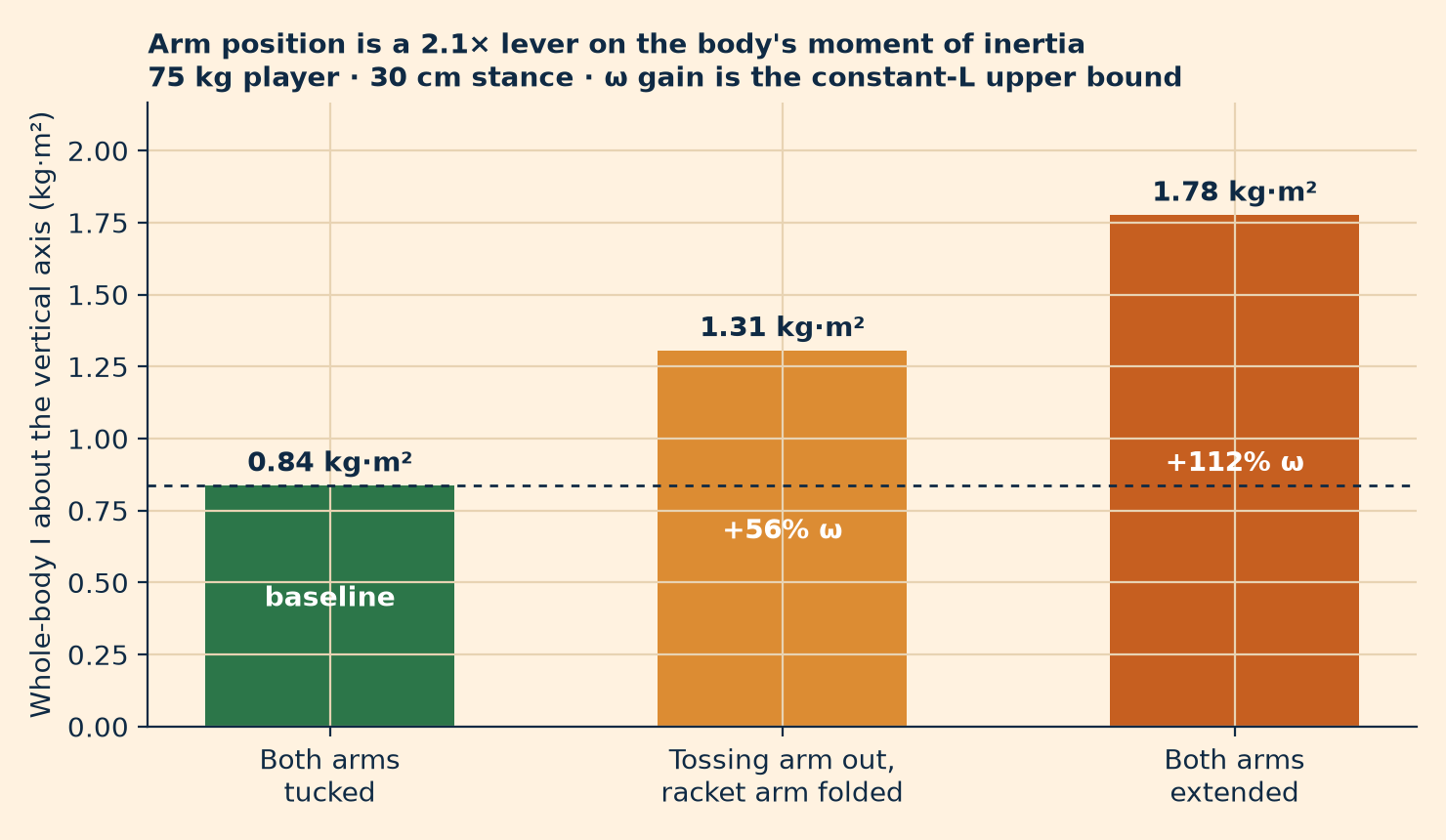
| 4. The proximal tuck | Pull one mass close to the axis. L = Iω: lower moment of inertia means higher angular velocity. The tossing arm tucks; the off-hand pulls to the chest. |
| 5. The three-point check | At contact, exactly three points work in one plane: the loaded leg, the tucked hand, the extended racket hand. |
One phrase, three questions
"Three versus four points" is doing three jobs at once. Separated, they give three different answers — and in one respect they point in opposite directions.
| "3 vs 4 points" is really about… | More contact means | Verdict |
|---|---|---|
| Determinacy — geometry. Three non-collinear points fix a plane; a fourth overconstrains it unless coplanar. | Irrelevant. What matters is where the swing plane is, not how many contacts exist. | True |
| Sufficiency — statics. A larger support polygon resists a larger perturbation. | More stable. More contact is strictly better here. | False |
| Freedom — rotational dynamics. Every contact that transmits torque can constrain the axis. | Less free. More contact means less rotational freedom. | True — for a different reason |
The framework's persuasive force came from moving between these three registers without announcing the move. The stool is a statement about determinacy. The wide base is a statement about sufficiency. The tuck is a statement about freedom. Only the first and third support "fewer contacts"; the second says the opposite, and it is the one coaches quote when they teach the ready position.
The constraint budget
Restated, the framework becomes sharper than it was:
The optimal configuration is the minimum constraint that still satisfies the task's stability demand — because every constraint beyond sufficiency is paid for in rotational freedom.
That one sentence absorbs all five principles, and it explains the studies that look like counter-evidence. Open stance produces the same racket speed as square, by a different route, because each architecture spends its constraints where they are cheapest. The two-handed backhand is not an exception to "fewer contacts"; it is a closed chain with a coplanar fourth point, which is a different design that buys rigidity where rigidity is useful.
The budget has a parameter. Call it λ — the stability demand of the task. Ready position, return of serve and a defensive slide are high-λ: they want a wide base, two legs, and they accept the rotational cost. A first serve and an attacking forehand are low-λ: they want one anchor and a free axis. The framework's error was to state a low-λ rule as a universal law, and then to teach it during high-λ tasks.
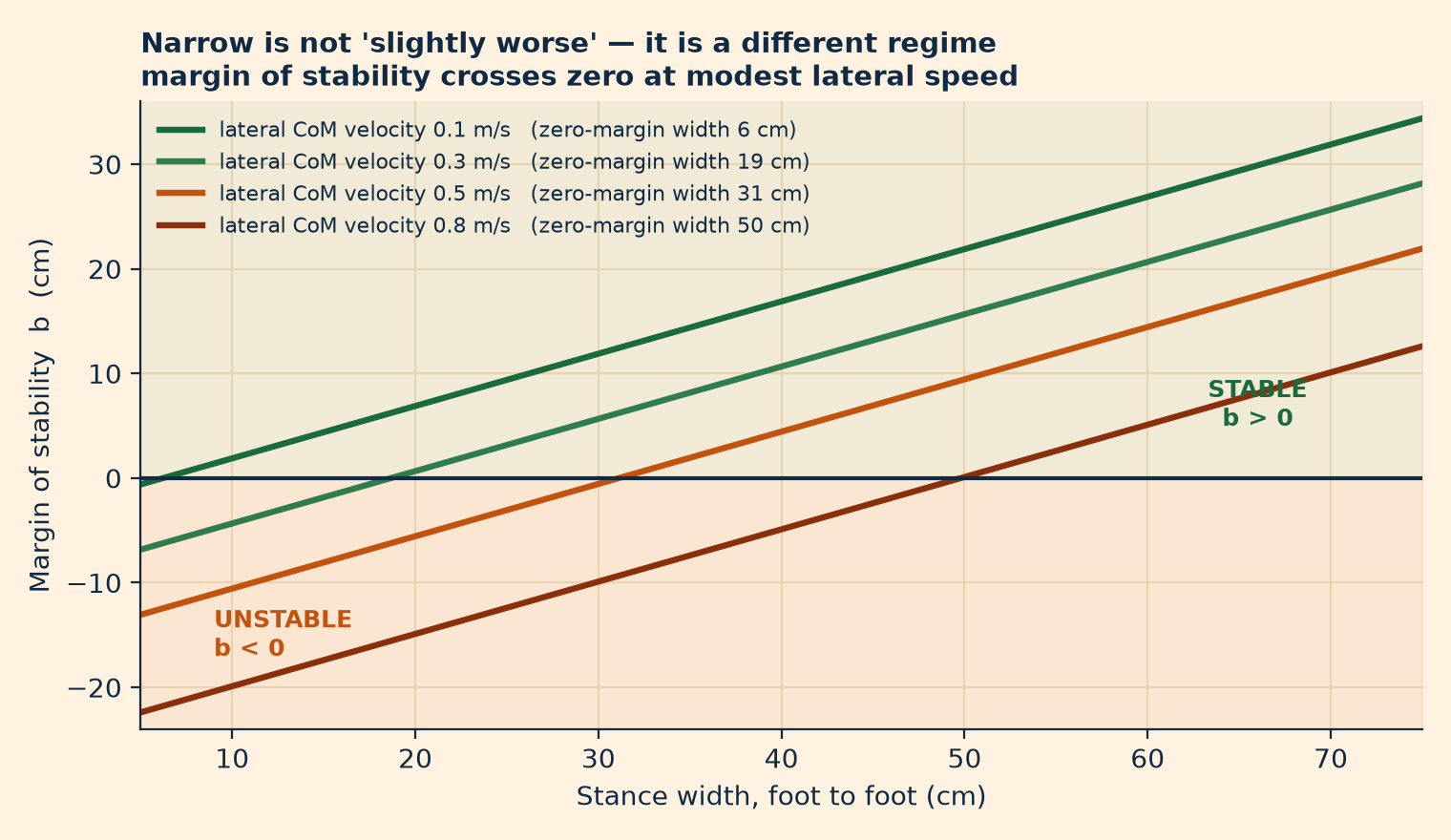
| Lateral centre-of-mass velocity | Stance width for zero margin | Task that resembles it |
|---|---|---|
| 0.1 m/s | 6 cm | Standing ready, no ball |
| 0.3 m/s | 19 cm | Split-step landing |
| 0.5 m/s | 31 cm | Receiving a wide serve |
| 0.8 m/s | 50 cm | Defensive slide at full speed |
Modelled values, not measured ones. The model is a linear inverted-pendulum margin of stability with a stated leg length and a fixed foot; Appendix A of the dossier lists every assumption. The point is the shape of the relationship, which is robust: the required width scales with the lateral velocity you must arrest.
Three corrections
Correction 1 · geometry
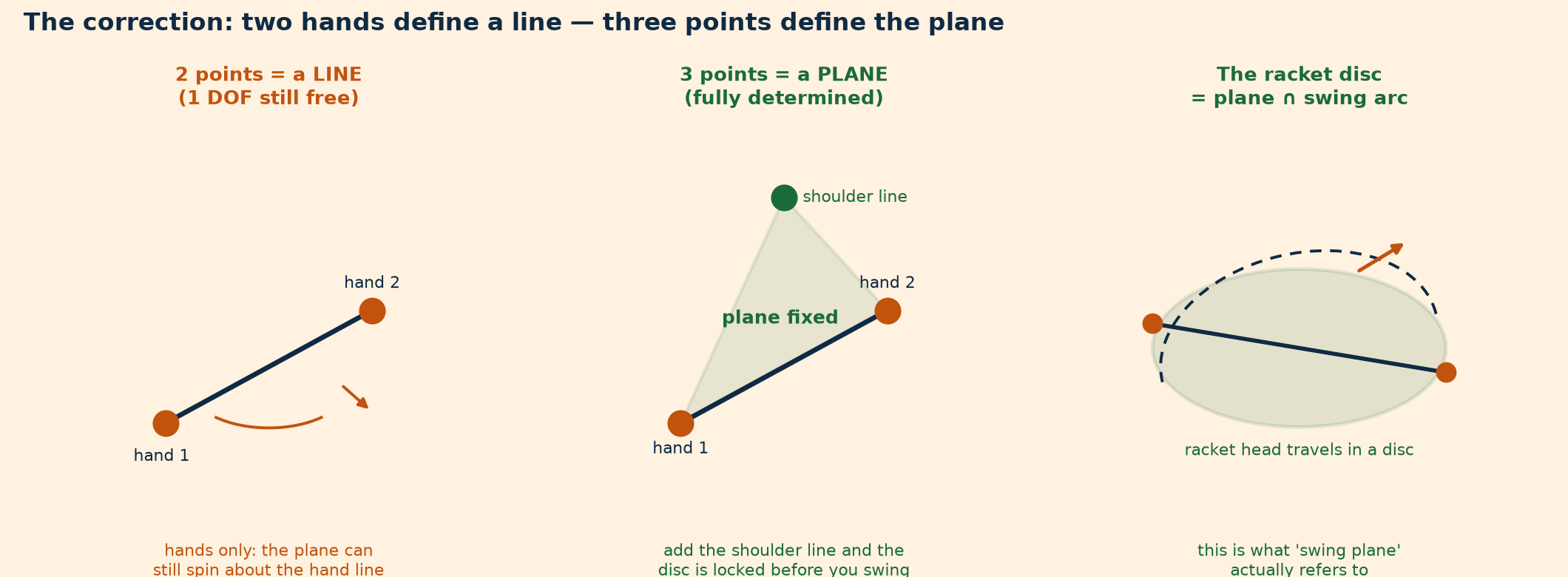
Two hands do not define a plane
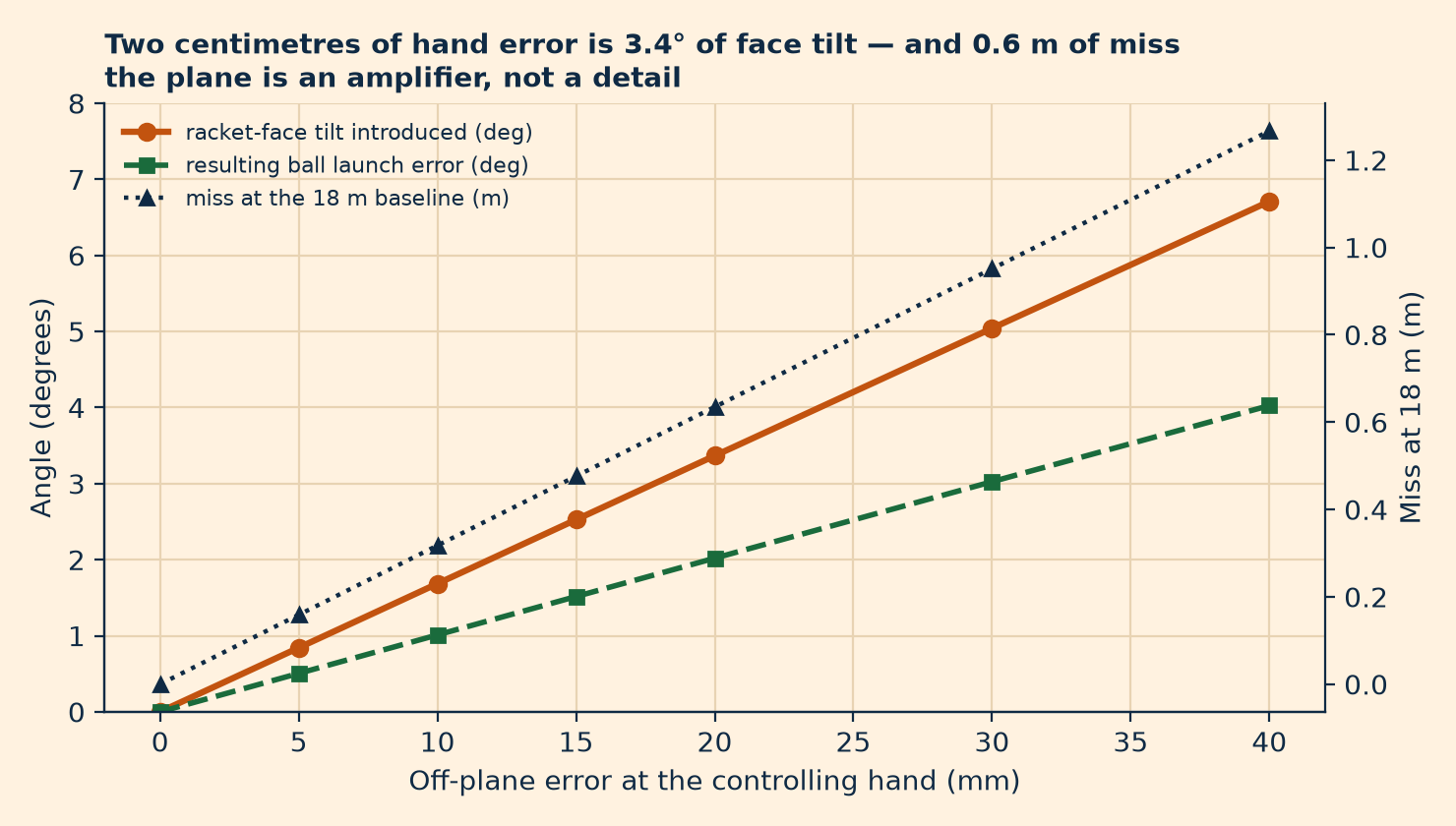
Two points define a line. A plane needs a third non-collinear point, and in a swing that point is the shoulder line — or the racket head. The framework's own axiom says so, which means the principle is one constraint short exactly where it is meant to be strongest.
Repair: "Chest and hands, one plate." Hands fix the line; the chest line fixes the tilt.
Correction 2 · mechanics
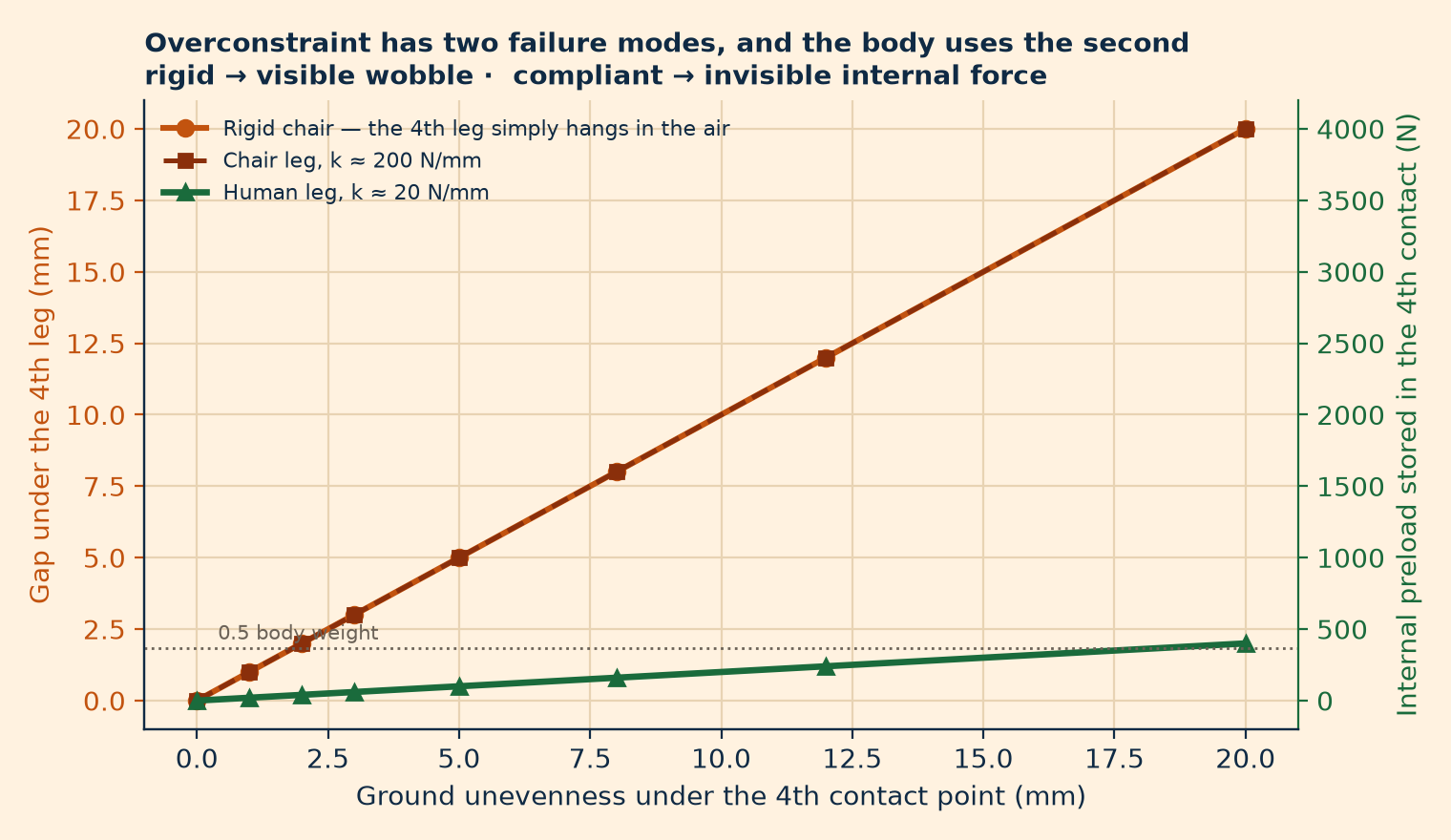
Overconstraint makes you rigid, not wobbly
A chair wobbles because its fourth leg is rigid and cannot close the gap. A body is compliant: the fourth contact closes, and the misfit is stored as preload — about 400 N at 20 mm of unevenness for a leg at 20 N/mm. You do not fall over. You lose rotation, and you arrive late.
Repair: "One leg owns the turn" — which teaches the right failure mode.
Correction 3 · the serve
The serve is not a vertical-axis spin
The figure-skater image belongs to groundstrokes. In the serve, Bahamonde's angular-momentum decomposition found the vertical component small and inconsistent; the dominant transfer is proximal-to-distal into the racket arm, and 75% of total angular momentum near impact sits in that arm. Teaching a server to "spin like a skater" points them at an axis the stroke does not use.
Repair: keep the tuck as a trunk-acceleration cue for groundstrokes, and drop the vertical-axis language from serve coaching entirely.
The evidence, graded
Every load-bearing claim in the dossier carries a grade, because the framework's persuasive force came largely from inferences that read like measurements. The grades are not decoration: they determine what a coach is allowed to say.
| Grade | Meaning | Coach may say |
|---|---|---|
| A | Measured in tennis players, replicated or large-sample, directly on point | "Research shows…" |
| B | Measured in tennis players, single study or narrow sample | "One study found…" |
| C | Established general biomechanics, imported to tennis by inference | "The physics says…" |
| D | Coaching doctrine or expert consensus, not measured | "Most coaches teach…" |
| X | Asserted in the source, contradicted by evidence or by its own geometry | Do not say it; say the restatement instead |
What the audit found, principle by principle:
| Principle | What the literature actually measures | Grade | The restatement |
|---|---|---|---|
| P1 Single fulcrum | The legs matter, and matter more for better players: peak vertical GRF in the serve is 2.12 ± 0.36 BW in elite versus 1.68 ± 0.33 in beginners, correlating with impact height at r = 0.85. But which leg is never measured as 100%. Open and square stances produce equal racket speed; one study found single-leg loading reduces total available force. | A legs X 100% |
At maximum rotation demand, the majority of load sits under one leg — 70–85%, with the inside leg a light brace. During high-stability tasks, two legs and a wide base are correct. |
| P2 Wide base | Widening reduces lateral sway, and lateral force is higher in defensive than attacking stances. But widening also raises the moment of inertia about the vertical axis: the knowledge base itself puts the redirection cost at 100–150 ms. | A band C mechanism |
Wide enough that the margin of stability stays positive at the task's lateral velocity — roughly 1.5–2× shoulder width. Beyond that, width buys stability and spends rotation. |
| P3 Two hands | "Swing plane" has no standardised peer-reviewed definition; it is used in at least three non-equivalent senses. The two-hander is a closed chain with eight degrees of freedom against the one-hander's seven, with greater upper-extremity rigidity. | C geometry D mechanism |
The swing plane is the plane of the shoulder–hand–hand triangle. Hands fix the line; the chest fixes the tilt. Keep any fourth point either on that plane or out of the equation. |
| P4 The tuck | Angular momentum near impact is 75.1% in the racket arm; the transfer is proximal-to-distal. But no tennis study shows that tucking the non-hitting arm raises trunk angular velocity, and the best controlled trial of tossing-arm timing found it changed the toss and the timing, not head or trunk kinematics. | C | During trunk acceleration, keep the off-arm close so it does not brake the turn; release before contact so the hitting arm can extend. The benefit is permissive, not generative. Attach no percentage. |
| P5 Three-point check | As stated, the three named points are the loaded foot, the tucked hand and the racket hand. They do not generally lie in one plane — the foot is on the ground and the plane is in the air. | C relabelled | One plane (shoulder–hand–hand) plus one axis (the loaded leg), and the two must agree. That version is testable, and it becomes a four-item worksheet. |
An unexpected finding. The 1,000-article knowledge base this project draws on contradicts itself on four of the five principles — including two opposite definitions of which leg is "outside" on the forehand, and a biomechanics article (ART-011) stating that loading predominantly on one leg "reduces the total force available for the stroke." The dossier lists all five in §7.6 and recommends a task-phase qualifier pass: five articles, one editorial sitting.
The practice layer New in v1.1
A wrong claim in a document is inert. A wrong claim inside a drill is repeated three hundred times a week, by a player who is trying to comply, under a coach watching for the criterion the drill names. Every drill is a claim in operational form — so v1.1 applies the same instrument to the fifteen drills in the source framework.
Each drill was read for four things: the mechanism it assumes, the criterion it scores, the errors it can detect, and — more revealingly — the errors it structurally cannot detect. Verdicts: Keep, Repair, Relabel, Retire.
| # | Drill | Verdict | Why |
|---|---|---|---|
| 1.1 | Flamingo Freeze — outside leg only, inside knee up, 2 s hold | Repair | Trains static single-support balance, not axis placement. The knee-up position deletes the inside foot's corrective authority, so the player passes by stiffening. |
| 1.2 | Med-ball single-leg throw | Repair | The best of the three mechanically. Only the dose is wrong: 100% demand, inside foot removed rather than braced. |
| 1.3 | Serve front-leg lock — freeze on the front leg, back leg in air | Relabel | It is a landing drill. The serve's drive question is not trained; foot-up versus foot-back differ by 1 m/s, inside noise. |
| 2.1 | Tape-measure ready — feet at shoulder width + 50% | Repair | 1.5× is the lower bound of the band, presented as the target. No upper bound, no cost term — so it teaches over-widening. |
| 2.2 | Return wall sit — wide base, 10 s isometric hold | Repair | Ten seconds of isometric squat is a quad-burn drill with a stance attached. The margin that matters is dynamic. |
| 2.3 | Defensive slide and stick — slide, wide stop, 2 s hold | Keep | The one drill that trains the mechanism the model names: margin of stability at the task's lateral velocity. |
| 3.1 | Frame the disc — both hands on throat and tip | Repair | Two hands on the racket fix the racket's line and face roll. Tilt is the relation between that line and the chest line, which the drill never references. |
| 3.2 | Mirror plane — freeze and check both hands define one plane | Retire | A mirror returns a two-dimensional projection. The check cannot fail visibly, so it cannot teach. |
| 3.3 | Non-dominant guides — off-hand stays on the throat until the forward swing | Keep | The best-constructed drill of the fifteen: correct mechanism, a release condition, an observable criterion. |
| 4.1 | Serve tuck and hold — grab your shirt, serve holding it to contact | Repair | The tuck's window is the acceleration phase; it reverses before contact so the arm can extend. Holding to contact trains the opposite. |
| 4.2 | Pin the shirt forehand — towel under the off-arm | Repair | Good binary criterion, but only half of it. There are two errors — early drop and late hold — and the drill can only see the first. |
| 4.3 | Figure-skater spins — arms out, spin, pull in | Relabel | Correct physics for an upright spin, which is the groundstroke case. Not the serve case. Keep the drill, delete the transfer claim. |
| 5.1 | Freeze call — partner checks three points are coplanar | Retire | Geometrically false, and a judgement no partner can make in real time. It produces agreement, not measurement. |
| 5.2 | Video three-point audit — pause at contact, count the points | Repair | The method is exactly right and the only drill that produces a record. The checklist is wrong: it omits the shoulder line and mislabels the fourth point. |
| 5.3 | Stool test progression — wide, load, plane, tuck, contact | Relabel | Sound pedagogy that should survive. The name teaches the wrong failure mode: you do not fall off a chair, you stop being able to turn on it. |
Two keep, eight repair, three relabel, two retire. Two of fifteen survive unchanged. That is not a verdict on the coach who wrote them; it is what happens when a drill set is derived from five principles and two of the five turn out to be mis-stated.
Four faults that run through the whole set
F1
The 100% fault
Three drills demand complete single-leg loading. A player given an impossible instruction does not report failure; they find a way to feel compliant — usually by stiffening the ankle and hip and freezing the trunk. Fix: every load cue becomes a ratio, and the brace is scored, not tolerated.
F2
The hold-through-contact fault
Three drills keep the off-hand pinned through the hitting zone. That converts a rotation drill into a blocking drill, and it produces players who are stable, compact and slow. Fix: every tuck drill gets a release window, stated as a position.
F3
The unfalsifiable criterion fault
Two drills ask a human to see a plane in real time. Neither can fail in a way the player can dispute, so both produce the appearance of assessment — and teach that the check is a ritual. Fix: a criterion must be countable, or filmed.
F4
The one-sided scorecard
Every drill is scored on stability: did you fall, did the towel drop. Not one is scored on rotation cost. A drill set built to detect instability will report success for a player who has over-constrained into rigidity, because rigidity is stable. Fix: one extra column.
The last fault is the structural one, and it follows directly from correction 2. The framework's own thesis — that overconstraint is paid for in rotation — is nowhere in its assessment. The repair costs a stopwatch and a phone: every drill card gets a second score, time-to-redirect or shoulder-rotation range at contact or simply "did the follow-through finish."
One drill rewritten, in full
| Flamingo Freeze → the anchored hold | |
|---|---|
| Setup | Outside leg loaded to ~80%, inside foot toe-touching the ground with no weight. Shadow forehand to contact, hold 2 s. |
| Dose | 3 × 6 each side, then 2 × 6 at rally speed. |
| Criterion | Lateral excursion of the sternum under 5 cm during the hold, filmed from the front. Not "did you stay up." |
| Failure looks like | Sternum drifting over the inside foot — the axis was never placed. Not: the player wobbles. |
| Why the toe | It restores the small corrective authority a real stroke uses, so the drill stops rewarding stiffness. |
The 40-second film, audited
The framework now has a Vietnamese teaching film: forty seconds, four captioned segments, drawn from match footage. It is the first artefact in this project that a player will actually watch — which makes it the most consequential document in the set.
| t | Caption, v1.0 — as broadcast | Grade |
|---|---|---|
| 0:00 | Nguyên lý 1: Một chân trụ — Flamingo Freeze. 100% lực qua 1 chân, tạo trục quay thẳng đứng | X both halves |
| 0:10 | Nguyên lý 2: Đế rộng bù đắp — Wide Base. Hai chân bắt buộc dang rộng để ổn định | A in band, silent on cost |
| 0:20 | Nguyên lý 4: Thu tay giao bóng — Tuck Principle. Tay trái thu sát ngực → giảm I, tăng tốc độ xoay | C model caption |
| 0:30 | Nguyên lý 4: Forehand kẹp khăn. Giữ tay không thuận sát ngực, không làm rơi khăn | D criterion is one-sided |
Finding 1 — the omission is correct, and should be made deliberate. The two principles the film leaves out are precisely the two that failed the audit: P3 is one geometric constraint short, and P5's three points are not coplanar. A film cannot show a plane it cannot define. What looks like an incomplete edit is the only defensible edit. Make it a rule: film what can be shown; do not film what the model cannot specify.
Finding 2 — one caption carries an X-grade claim into the most-copied medium. "100% lực qua 1 chân, tạo trục quay thẳng đứng." Both halves are graded X: the load is never 100%, and the axis is a kinematic inference that has never been measured — and for the serve it is specifically wrong. A document can carry a caveat in the next paragraph; a caption cannot. This is the highest-priority edit in the whole project, because the film will be re-shared without the dossier attached. It has since been made.
Finding 3 — the Principle 4 caption is the model caption. It states the mechanism, names the quantity, and attaches no number. That is exactly the epistemic status of P4: sound physics, unmeasured in tennis. It should be the template for every other caption.
Finding 4 — the Principle 2 caption will be over-applied. True inside the band, silent on the cost. A viewer will widen until it stops feeling wrong, which is past 2× shoulder width. One word fixes it: vừa đủ — wide enough, not widest.
A production standard, derived from the four findings
- One claim per caption. Two claims on one line is how a caveat gets lost.
- No absolute quantifiers — 100%, always, must, never — unless the grade is A.
- If the mechanism is grade C, say the mechanism and withhold the number.
- Show the failure mode in the same shot as the success. A film that only shows correct execution teaches recognition, not correction.
- Caption the criterion, not the feeling. "Hand released before contact" beats "feel the tuck."
The reissue: v1.1
The audit above was not left as an observation. The film has been rebuilt as v1.1 with all four findings acted on, and the file above is that version. The footage is untouched — the same four clips, in the same order, in the same ten-second segments, at real-time speed — because the faults were in the words, not in the pictures.
| # | v1.0 | v1.1 | What changed |
|---|---|---|---|
| 1 | 100% lực qua 1 chân, tạo trục quay thẳng đứng | Dồn phần lớn lực vào chân trụ, chân kia tựa nhẹ | Both X-grade claims removed. The absolute quantifier is gone, and so is the vertical axis. What remains — load on the support leg, trailing foot resting light — is observable in the shot. |
| 2 | Hai chân bắt buộc dang rộng để ổn định | Rộng vừa đủ để dừng, hẹp vừa đủ để xoay | The missing cost is now stated, and bắt buộc ("must") becomes vừa đủ ("just enough"). The band is described from both ends. |
| 3 | Tay trái thu sát ngực → giảm I, tăng tốc độ xoay | Thu sát ngực (giảm I), rồi thả trước tiếp xúc | Kept as the template — mechanism named, quantity named, no number attached — with the release point added so the criterion can fail as well as pass. |
| 4 | Giữ tay không thuận sát ngực, không làm rơi khăn | Tay không thuận sát ngực đến lúc bắt đầu vung tới | The one-sided criterion is fixed. "Don't drop the towel" cannot be failed by holding too long; "hold until the forward swing starts" can. |
What was deliberately preserved. The caption geometry is unchanged to within a pixel of the original: measured from decoded frames, the text occupies rows 626–686 in both versions. A viewer who has seen the first cut will not notice a change of frame, only a change of words — which is the point. This is a correction, not a restyle, and nothing about it depends on the viewer noticing. The caption layer is re-rendered from text rather than patched over the old burn-in, so the Vietnamese diacritics are clean at every size instead of inherited from a re-compressed original.
The audio had to be re-derived, not copied. The four source clips are 24 kHz mono and already peak at 0.0 dBFS; concatenated, they clip. The reissue is resampled to 44.1 kHz stereo, trimmed 2 dB and limited, landing at −2.2 dBFS peak against the original's −1.7 dBFS, with mean level within 1 dB. Shipping corrected captions over a clipped soundtrack would have been a poor trade.
What the reissue does not fix. Segments 2 and 3 carry English graphics burned into the footage — "BASE OF SUPPORT", and "Trophy Position & Tuck Principle" with its subtitle "Rotational Acceleration in Tennis Serve" — sitting within a few pixels of the caption band. The Vietnamese caption stays legible because it is drawn with a shadow, but the two languages crowd each other, and on segment 3 the English subtitle and the Vietnamese first line are separated by less than one line-height. This cannot be repaired from the caption layer; it needs footage without burned-in text. It is a known defect of v1.1 — and not one v1.1 introduced, since v1.0 crowds identically.
Six cues that survive
Each is traceable to a restatement, executable, and does not require the player to believe something the evidence does not support. The first two change behaviour fastest, because they replace an impossible instruction with a ratio a player can actually hit.
| Cue | Replaces | Traces to | Grade |
|---|---|---|---|
| "One leg owns the turn." | "Be a stool, not a chair." | P1′ | C |
| "80 on the outside, 20 as a brace." | "Load 100% on one leg." | P1′ | C |
| "Wide enough to stop, narrow enough to turn." | "Wider is more stable." | P2′ | A |
| "Chest and hands, one plate." | "Two hands define a plane." | P3′ | C |
| "Tuck to accelerate, release to hit." | "Keep the hand tucked at contact." | P4′ | C |
| "Shoulder line agrees with hand line." | "Three points in one plane." | P5′ | C |
What would falsify this
A model that cannot be wrong is not a model. Six hypotheses are stated with their tests in §12.2 of the dossier; three of them would change the conclusion outright.
| If this were shown… | Then |
|---|---|
| Tucking the non-hitting arm measurably raises trunk angular velocity | P4 moves from C to A, and the framework's most-quoted mechanism becomes its best-supported one. |
| A single load split is optimal across tasks | The λ-framework collapses and the original universal rule is vindicated. |
| The rotation axis in a stroke does not pass near the loaded foot | The reinterpretation of single-leg loading breaks, and with it the reason the constraint budget works. |
Until then the honest position is the one the dossier takes: the framework survives, reframed. What emerges is a model with a name, a mechanism, a measurable cost function, quantitative predictions, and an explicit list of the experiments that would break it. That is more than the original document had, and it is more useful to a coach than a rule that cannot be questioned.
Read the full dossier
Two standalone editions, each written as its own document rather than a translation of the other. Every load-bearing claim is graded; modelled numbers are marked as modelled; Appendix A lists every assumption, including the one with the largest uncertainty (ball-launch coupling).
Provenance
- Framework
- The originating document, its Vietnamese edition Khung Ổn Định Ba Điểm, four infographic figures, and the 40-second teaching film.
- Literature
- 27 peer-reviewed sources, verified against primary bibliographic records. Claims that could not be verified are flagged in the working review and downgraded in the dossier.
- Knowledge base
- 1,000-article corpus (pillars 01, 02, 04, 05, 06, 10). Audit found self-contradiction on four of five principles — §7.6.
- Model
- First-principles calculations in
analysis/triplane_model.py; every modelled number is reproducible fromresults.json. - Version
- v1.1, 30 October 2026. Part X added; Parts I–IX unchanged.