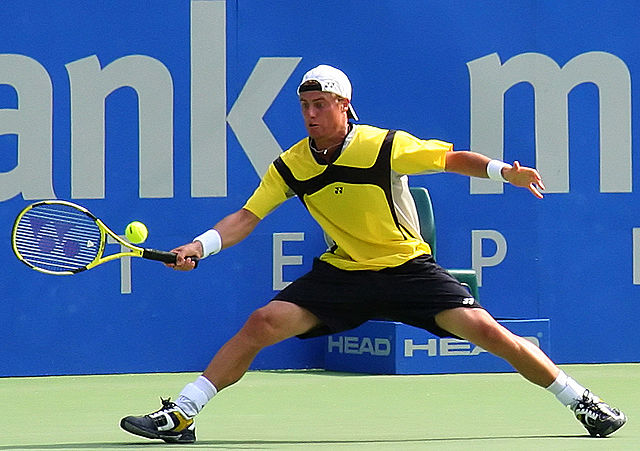
Lleyton Hewitt in 2006. Credit: Glenn Thomas In 2022, I’m counting down the 128 best players of the last century. With luck, we’ll get to #1 in December. Enjoy! * * * Lleyton Hewitt [AUS] Born: 24 February 1981 Career: 1998-2016 Plays: Right-handed (two-handed backhand) Peak rank: 1 (2001) Peak Elo rating: 2,192 (1st place, 2002) Major singles titles: 2 Total singles titles: 30 * * * It was impossible not to have an opinion about Lleyton Hewitt. In 2002, when Hewitt ruled the men’s tennis roost, Billie Jean King said: How can you not love Hewitt? He’s incredible for all of us that aren’t 6’2″…. He’s giving everybody hope again to play this sport. This guy loves it so much he just loves every ball, he’s just like… give me the ball. God, I love him. How can you not love this guy? Plenty of people were ready to answer Billie Jean’s question. In the London Times in 2003, Simon Barnes spoke for many fans as he basked in Lleyton’s first-round exit at Wimbledon: He looked–and behaved–as if he had left his skateboard parked outside. … He was the most unpopular champion since Jimmy Connors did his brat’s stuff in 1974 and has the air of a stormtrooper who has been ostracised by the other stormtroopers because they find him a bit on the fanatical side. Part of the problem was that he became a star so early. It’s a rare teenager who finds himself on the world stage and doesn’t act like a jerk. When he was 18, he proclaimed that the Australian public was stupid. Two years later, he called umpire Andreas Egli a “spastic,” and then gave one of the worst apologies in the history of lame athlete apologies: “If I did say it, it’s not something I’m proud of, that’s for sure. I apologise to whoever it may be.” He hinted that a line judge was giving calls to James Blake because both men were Black. He hated the practice of congratulating opponents on excellent shots. He constantly yelled C’MON!–every two seconds, according to Greg Rusedski–even if it was his opponent’s mistake that decided the point. When Juan Iganacio Chela spit at him on a change of ends in 2005, we all knew that it was wrong… but we understood. Expectoration at 2:06 Many of Hewitt’s peers were careful to make the distinction between his on-court and off-court personalities. He was pleasant enough out of the heat of competition, at least if he wasn’t talking to journalists. But with a match on the line, as Roy Emerson put it, “He plays every point as if it’s World War II.” Inevitably, there were casualties. Nobody liked to face him–partly because of the abrasiveness, and partly because Lleyton usually won. But it was impossible not to respect the way he played the game. * * * Hewitt certainly didn’t look like an elite tennis player. He stood only five-feet-ten-inches tall, and when he arrived on tour as an outspoken 16-year-old, he weighed barely 130 pounds. Reporters couldn’t decide whether he looked more like a surfer or a skateboarder. Vince Spadea, who played him in the quarter-finals of the 1998 Adelaide tournament, thought he looked “weak, inexperienced, unrehearsed, and unpolished.” Three sets later, Spadea was sent packing and Hewitt was in the semi-finals. The teenager backed up the win with a two-tiebreak victory over an out-of-form Andre Agassi. He took the title in a third-set breaker over fellow Aussie Jason Stoltenberg. Embed from Getty Images The 1999 Aussie champion Davis Cup team Hewitt said early in his career, “[W]hen I set my schedule at the start of the year, Davis Cup is the first thing that I write down.” He never wavered from that commitment. Lleyton holds just about every Australian Davis Cup record there is. He played 40 ties, winning 42 singles rubbers and another 16 in doubles. No one compared him to surfers or skateboarders anymore, but as retirement approached, Lleyton was still the same player he had always been. Wally Masur, the Davis Cup captain who preceded him, said in 2015, “The very first point I saw him play was as a junior at the US Open. He hasn’t changed a bit since then. He’s full of enthusiasm…. I used to say: ‘Whatever you think about Lleyton Hewitt, if you pay the price of admission, he gives you full value.'” The early, peak Hewitt–and his effect on an opponent–remains impossible to forget. “I’ve always enjoyed watching him. Playing against him has been cool at times,” Federer said at Lleyton’s final Wimbledon. “Not always so much fun.” Related