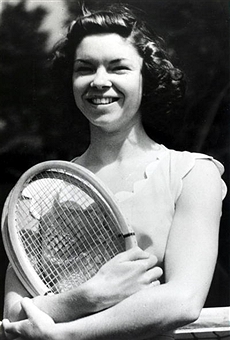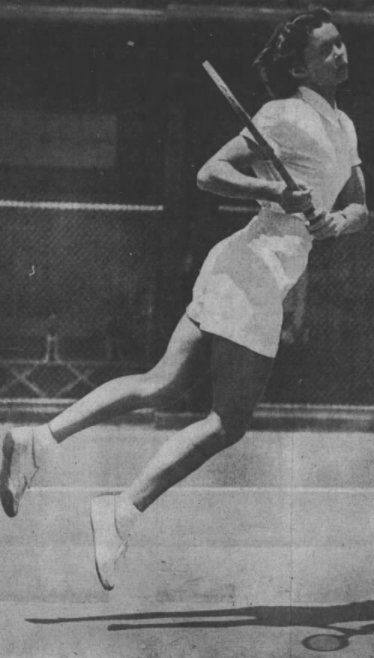
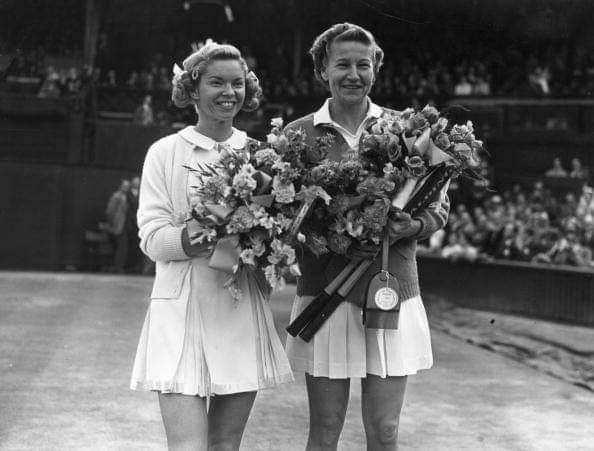
In 2022, I’m counting down the 128 best players of the last century. With luck, we’ll get to #1 in December. Enjoy! * * * Beverly Baker Fleitz [USA] Born: 13 March 1930 Died: 29 April 2014 Career: 1946-1959 (14 seasons) Plays: Ambidextrous (two forehands; served right-handed) Peak rank: 3 (1954, 1955, 1958) Peak Elo rating: 2,204 (2nd place, 1955) Major singles titles: 0 (1955 Wimbledon finalist) Total singles titles: 60 * * * If you know one thing about Beverly Baker Fleitz, it’s probably that she was ambidextrous, hitting forehands off both wings. If you didn’t know that, boy am I excited to be the one to tell you. One of the best players never to win a major, this Californian won the 1948 national girls’ championship, beat Mo Connolly eight times, and reached the 1955 Wimbledon final as a mother, all without a backhand. * * * Baker Fleitz was, to some extent, naturally ambidextrous. The young Beverly Baker (Fleitz was her married name) threw righty and wrote lefty, so when she first picked up a racket, it came easily for the tiny 10-year-old to use her left hand on what would typically be her backhand side. A couple generations later, she would’ve been a natural proponent of the increasingly popular two-handed backhand, but developing her game in the 1940s, a double-hander would’ve been just as weird as her pair of forehands. It wasn’t completely unprecedented to play with two forehands. The Australian Davis Cup player John Bromwich was a natural lefty who served right-handed, and he would hit one- or two-handed strokes at various times from both wings. He was part of the Aussie squad that traveled to Los Angeles for the Pacific Southwest tournament in 1938 and 1939, and he won the tournament the latter year. The example of Bromwich, well-known to tennis aficionados in Southern California, may have given her father and coach, Frank Baker, the assurance to let Beverly do things her own way. It worked: She hit both forehands hard and deep. The only drawback of her unorthodox technique showed up at the net, where it took too long to switch hands. But like most of her peers, she was content to stay back, and her game thrived. A 1949 shot of Baker switching from one forehand grip to the other The novelty itself made life more difficult for opponents. She won the 1947 Los Angeles Metropolitan tournament before her 17th birthday and made her first trip East that summer. At the prestigious Eastern Grass Court Championships in Orange, New Jersey, she reached the final four before falling to the reigning Wimbledon champion, Margaret Osborne (later Osborne duPont), and won two matches at the national championships at Forest Hills. Osborne’s 6-2 6-3 victory was hardly a close shave, but the veteran recognized her opponent’s potential. She described Baker as one of the game’s “coming players” and said, “Her ambidextrous style can be so confusing that at times you don’t know which way the ball is coming from.” While Osborne would win their next three meetings, Baker turned the tables when they clashed in a 1951 Wimbledon quarter-final. The 17-year-old solidified her status as a player to watch in the fall of 1947, grabbing the title at the Pacific Southwest, the same event where the similarly unorthodox Bromwich had triumphed eight years earlier. Reigning national champion and SoCal product Louise Brough skipped the event due to illness, so it was left to the rest of the strong West Coast contingent to stop the teen with two forehands. They failed. In the final, Beverly lost only five games to top-tenner Pat Canning Todd. As Baker’s results improved, the media quickly recognized the teen as more than a novelty act. Her small stature, at 5-foot-4 and under 120 pounds, left onlookers shocked by her power. Columnist Braven Dyer was awestruck by Baker’s performance against Todd: “Wham! How she socked home her drives, first with the right and then with the left.” Two years later, a writer for American Lawn Tennis claimed that he couldn’t recall a female player hitting harder than Beverly did. One late-career assessment would’ve fit the young player just as well: “Her service is weak, her volleying indifferent and her overhead a chore that she shirks at all costs. She doesn’t need them. … The formula [is] simple: rifle the ball down a sideline and if it dared to come back, slam it down the other.” * * * Baker arrived on the American scene at a tough time for would-be stars. Brough’s 1947 Forest Hills title was the first of her six majors, and Osborne won the second of her own half-dozen at Wimbledon that year. The seemingly endless supply of elite American women would win Wimbledon and the US Nationals every year from 1938 to 1958, tacking on nine French Championships and four Australian titles in the same span. The woman who would finally displace Brough, Osborne