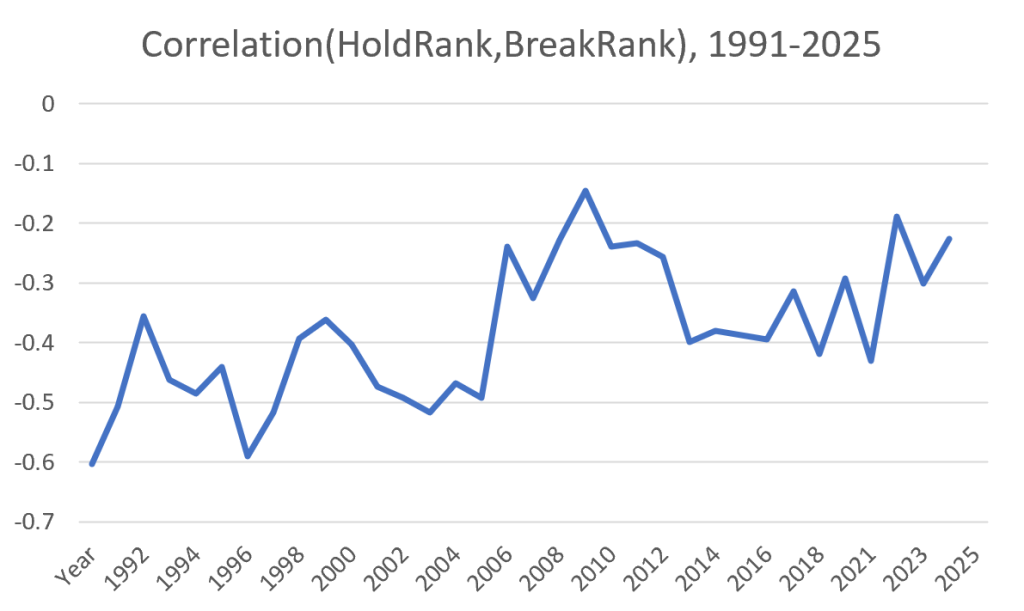
You might have heard that Jannik Sinner did something in 2025 that no one has ever done before. For the first time since modern statkeeping began in 1991, he led the tour in both hold percentage and return percentage. There’s a caveat here, because Sinner missed most of the clay season, which might have dragged down his return numbers relative to the field. Still, it’s a tremendous accomplishment. Only a few players have ever come close . Novak Djokovic ranked first in hold percentage and third in break percentage in 2023, and Andre Agassi reversed those rankings in 1999. In 1995, Agassi had placed third in both categories. Only a handful of others–basically the Big Three–have ever cracked both top fives simultaneously. We owe this whole framework to Cracked Racquets majordomo Alex Gruskin . He likes to talk about “clubs” of players who rank in the top 10, or top 25, or whatever, of both hold and break percentage. It’s a great way to quickly identify the best all-around players on tour. “Top 25” may not sound impressive, but this past year, only nine men made the cut. Doing so is a near guarantee of a top-ten finish. Only Casper Ruud (year-end #12) and Grigor Dimitrov (injured since Wimbledon) were top-25-clubbers without also finishing top ten in the rankings. Sinner, then, is on another planet, and most players are lucky to sniff the top ten in one category, let alone both. That said, the number of all-around superstars is creeping upwards. Three guys–Sinner, Djokovic, and Carlos Alcaraz–qualified for the top ten club this year. Jack Draper just missed, finishing 11th in break percentage. Excluding the 2020 Covid season, this is only the fifth time since 1991 that three men qualified. All but of those seasons have come since 2019. The most common number of top-ten-clubbers in a single year is one. There times in the 1990s, there were zero. The story is similar regardless of the threshold. 2023 saw nine top-20 clubbers, the most ever. For the first fifteen years of ATP statkeeping, the average season delivered fewer top- 25 finishers than that. The trend is clearest when we boil it down to one number. For every season since 1991, I took the top 50 from the year-end rankings and worked out their positions on the hold and break percentage lists. This graph shows the correlation between hold ranking and break ranking for each campaign: A correlation of zero would mean that there was no relationship between a player’s hold and break ranks; negative means that if someone is high in one category, they are more likely to be low in the other. Of course, it’s a matter of degree. Over time, the inverse relationship between serving and returning skill has eroded. We hit peak well-roundedness around 2010, and we appear to be back in a similar state of affairs. Why? This is where it gets interesting. (And, I’ll admit, rather speculative.) In sports (and the economy in general), specialization tends to increase over time. We rarely see multi-sport athletes these days. NFL players once played both offense and defense; now specialists handle each side of the ball. Baseball teams once got through entire seasons with a handful of pitchers; now it can take as many arms to get through a single game. Specific skillsets are deployed to handle right-handers, left-handers, and the late innings. This has happened in tennis, too, kind of. There has probably never been a better server than John Isner. Never a stronger returner than Novak Djokovic. Setting aside skills that have fallen into the background in today’s game (everything associated with net play), the best of every specific thing is on display now, or has been recently. This isn’t to say that Richard Gonzalez, or Ken Rosewall, or Ivan Lendl couldn’t have done it better. They just didn’t have the chance. Modern sports encourage early specialization. The whole ecosystem then delivers training, coaching, and equipment that yesterday’s greats never dreamed of. But! Isner only (“only”) peaked at #8. Diego Schwartzman, who at his best rivaled Djokovic as the sport’s most brilliant returner , also topped out at #8. We all know why: Neither one was very good at the other half of the game, at least by pro standards. In the NFL, half of a player’s job was handed to someone else who was better at it. At the Olympics, the entries in the 400 meters and the 800 meters can be given to different athletes. In tennis, though, Isner’s gotta hit the returns, and Peque had to serve. Player development, then, becomes a sort of optimization problem. Do you find the most extreme physical specimens you can, then coach them to adequacy in the skills that don’t come naturally? Or do you look for all-around talents, even if they’ll never hit a 140-mile-per-hour serve? The answer isn’t obvious. But the trend is moving toward the latter. I th