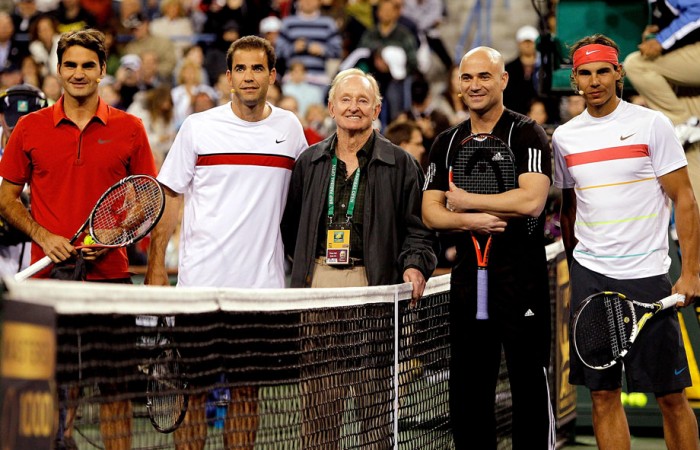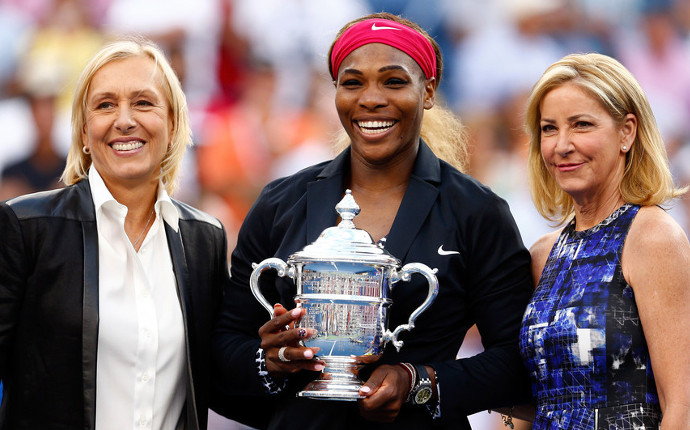
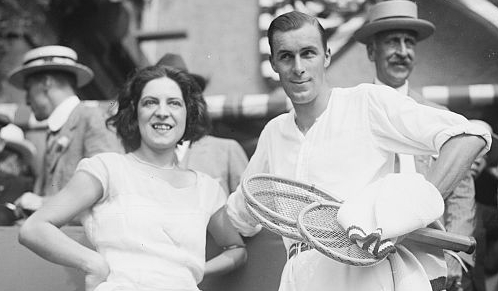
A few contenders for the top spot, posing with the husband of another contender Scroll down or click here for the list of players published so far. * * * You know what tennis really needs? More arguments about the greatest players of all time. Really! I could take or leave the Djokovic-Federer-Nadal debate, and I don’t need to read another word about Serena versus Margaret Court. But the quest for greatness is what defines elite athletics, and the appreciation of elite performance is an essential part of what it means to be a fan. Too much of tennis history has been lost, forgotten, or caricatured. The 150-year story of lawn tennis is full of larger-than-life figures, underrated champions, and local heroes. I don’t know about you, but I want to know a lot more about those players. I wish I had a deeper understanding of earlier eras, especially those that came before the dawn of the Open Era in 1968. That’s why I’m writing the Tennis 128. * * * In a couple of days, I’ll begin counting down the 128 greatest tennis players of all time. The list includes men and women, and it takes into account more than a century of play, from 1919 to the present. I’ll publish an essay about each one. We’ll dive into who they were, what they accomplished, and how they fit into the overall arc of tennis history. (Why 1919? It’s a convenient starting point. It was the first full season after World War I, and it gives us about 100 years to work with. There were great players before the war, of course, and there’s no clear dividing line between pre-modern and modern tennis. But the game has changed so much that while I can just manage a comparison of Helen Wills to Billie Jean King or Serena Williams, it’s a much bigger stretch to somehow consider Lottie Dod.) This may all sound familiar. In 2020 and 2021, Joe Posnanski wrote a similar series for baseball, counting down his top 100 players. He published it a few months ago as a giant book, The Baseball 100 , which you should buy. Joe’s project is the inspiration for this one. I’m not as good a writer as he is, so I’m giving you 28% more players to make up for it. A few more all-time greats we’ll be talking about If you think it’s audacious to the point of silliness to try to rank 100 years’ worth of tennis players, you’re right. It’s ridiculous. There are short careers and long careers, number ones with no slams and multi-slam winners who never reached number one. There’s the amateur era and the Open Era, and there were separate professional tours during the amateur era that meant some of the best players on earth went a decade without playing each other. There are at least 20 players with some plausible case for the #1 spot. * * * Any best-of-all-time list is subjective. Still, I tried to make mine as objective as possible. The ranking is primarily based on an algorithm that incorporates three things: a player’s peak, their five best years, and their entire career. Those components are measured by Elo ratings . I only considered seasons above a fairly high threshold, and there are no negative values for bad seasons. I’m interested in how good players were at their best, not whether they stuck around for too many seasons at the end. The ranking is almost entirely based on singles performance. Doubles used to be more prominent than it is now, but greatness has always been defined primarily as excellence on the singles court. In a few instances, I’ve broken ties in favor of the better doubles player. I’ve also moved a (very small) handful of players toward the top of the list because of their off-court contributions to the game. In general, I follow Roger Federer’s edict that you can only compare players to their own eras. Objectively speaking, today’s players are better than those of the past. They take advantage of personalized training and nutrition, technologically advanced rackets and strings, high-quality coaching from younger ages, and all the tactical knowledge developed by their predecessors. In that sense, Novak Djokovic is unquestionably better than Bill Tilden, and so is Adrian Mannarino. That’s not a very interesting way of approaching the problem, though. The Tennis 128 reflects the fact that there have been strong eras and weak eras, but the ultimate test of any player is how they performed against their peers. Suzanne Lenglen and Bill Tilden, pretending not to despise each other The ratings for amateur-era players rely on the exhaustive women’s tennis database I’ve assembled that goes back to the 1910s, as well as the impressive records put together at TennisArchives.com and in Chris Jordan’s book, The Professional Tennis Archive . These datasets aren’t perfect, nor are they complete, especially for men’s tennis before World War II. But they are more than enough to allow us to compare