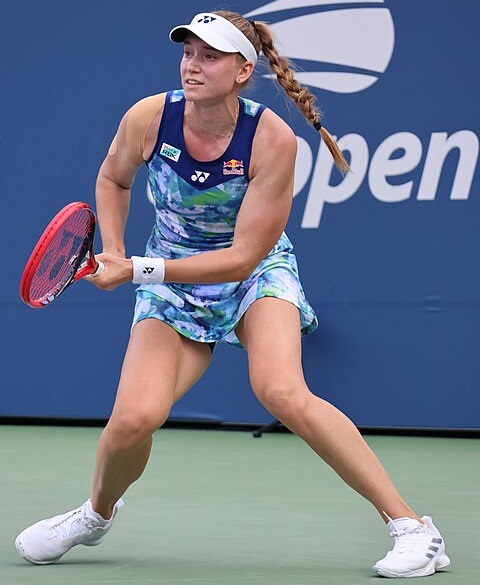
Also today: Ugo Humbert in the (Elo) top ten; South American Davis Cup hard courts Elena Rybakina at the 2023 US Open. Credit: Hameltion Never underestimate average . Establishing oneself on the top level of the pro tennis circuit is extraordinarily difficult; proving that any particular skill is average among one’s tour-level peers is even harder. Most players are better than the norm in some categories, worse in others. Anyone who can beat the middle of the pack in every department is virtually guaranteed to be a superstar. Average is Elena Rybakina’s secret weapon. You probably didn’t know she needed one, because she has a very effective, very evident non-secret weapon: an unreadable bullet of a first serve. In the last year, over 43% of her first serves have gone unreturned. No one else on tour comes within three percentage points of that, and only five other women top 35%. On a good day, the serve can put a match out of reach nearly on its own. When she faced Aryna Sabalenka in Beijing last fall, 65% of her first serves didn’t come back. Most women barely manage to win that many first serve points, let alone decide them with one stroke. I’ll come back to the serve in a moment, because it is so remarkable, and it would be strange to talk about Rybakina without discussing it. But what makes her a contender every week–not to mention a champion in Abu Dhabi yesterday–is the way that the rest of her game doesn’t hold her back. Among the other women who end points with more than 35% of their first serves, you’ll find a long list of weaknesses. Qinwen Zheng doesn’t put nearly enough of them in the box. Donna Vekic and Caroline Garcia struggle to break serve. Liudmila Samsonova doesn’t break much, either, and her mistakes come in excruciating, match-endangering bunches. Lopsided player profiles make sense. Only a few people have the combination of natural gifts and discipline to develop a dominant serve. Tennis skills are correlated, but not perfectly so. Someone who serves like Vekic can often learn good-enough groundstrokes and secondary shots. But players with one standout skill are unlikely to be solid across the board. Just because someone is top ten in the world in one category, why would we expect them to rank in the top 100 by a different measure? Rybakina has reached the top–or close, anyway–by coupling a world-class serve with a set of skills that lacks defects. (You can nitpick her footwork or technique, but none of that holds her back when it comes to winning enough points.) After we review the devastation wrought by her serve, we’ll see just how average she otherwise is, and why that wins her so many matches. First serves first I’ve already given you the headline number: Since this time last year, 43.4% of Rybakina’s first serves haven’t come back. That’s one percentage point better than Serena Williams’s career rate. Serena’s numbers are based on matches logged by the Match Charting Project, a non-random sample skewed toward high-profile contests against strong opponents, so I’m not ready to say outright that Rybakina is serving better than Serena. But I’m not not saying that–we’re within the margin of error. Some back-of-the-envelope math shows what kind of gains a player can reap from the best first serve in the game. Rybakina makes about 60% of her first serves–lower than average, but probably worth the trade-off. (And improving–we’ll talk about that in a bit.) When the serve does come back, she wins about half of points, roughly typical for tour players. All told, 43% of her serve points are first-serve points won. Tack on about half of her second serve points–she wins 48% of those, better than average but not by a wide margin–and we end up with her win rate of 62.5% of serve points–fourth-best on tour. Put another way: We combine one world-class number (unreturned first serves) with a below-average figure (first serves in), one average number (success rate when the serve come back), and one more that was slightly better than average (second-serve points won). The result is an overall success rate that trails only those of Iga Swiatek, Sabalenka, and Garcia. That, in case you ever doubted the value of an untouchable first serve, is the impact of one very good number. The key to Rybakina’s first serve–apart from blinding speed–is its unreadability. She must lead the tour in fewest returner steps per ace, a stat I dreamed up while watching the Abu Dhabi semi-final on Saturday. Samsonova seemed to stand bolted to the ground, watching one serve after another dart past her. After one business-as-usual ace out wide, Samsonova even offered a little racket-clap of appreciation, an unusual gesture for such a routine occurrence. In addition to the deceptiveness of a nearly identical toss and service motion,