
Some things never change, eh?
For the sixth time in the last eight editions of the prestigious tournament, Novak Djokovic wins Wimbledon.
Predictable AF? At least the man standing on the other side of the net was an unfamiliar sight. Nick Kyrgios had made his first Grand Slam final and was ready to try and shout and serve his way to the trophy.
Not on Novak's watch.
Today we're looking at three aspects of the seven-time champion's win historic win:
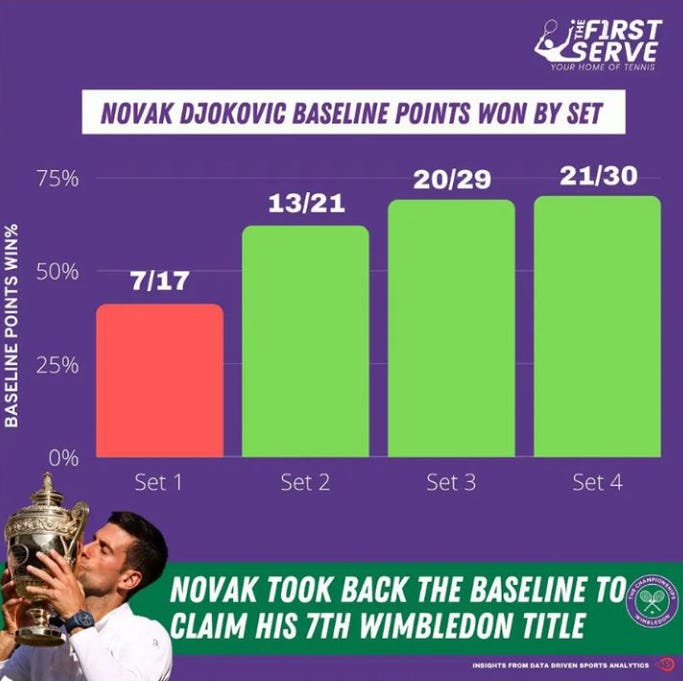
How Djokovic changed the dynamic of the match after dropping the first set.
A key tactic Djokovic used to constantly keep his service games ticking over.
A point-by-point play of two key moments.
Enjoy!
Changing The Dynamic Of The First Set
The Dynamic of the First Set
From the get-go, things were pretty surprising.
Yes, both players were winning cheap points on serve but, when things did go to a rally, Kyrgios was winning the majority of the baseline rallies.
A few of these rallies proved crucial to Kyrgios getting the first break at 2-2 in the first set. What happened to the normally superpowered Novak?
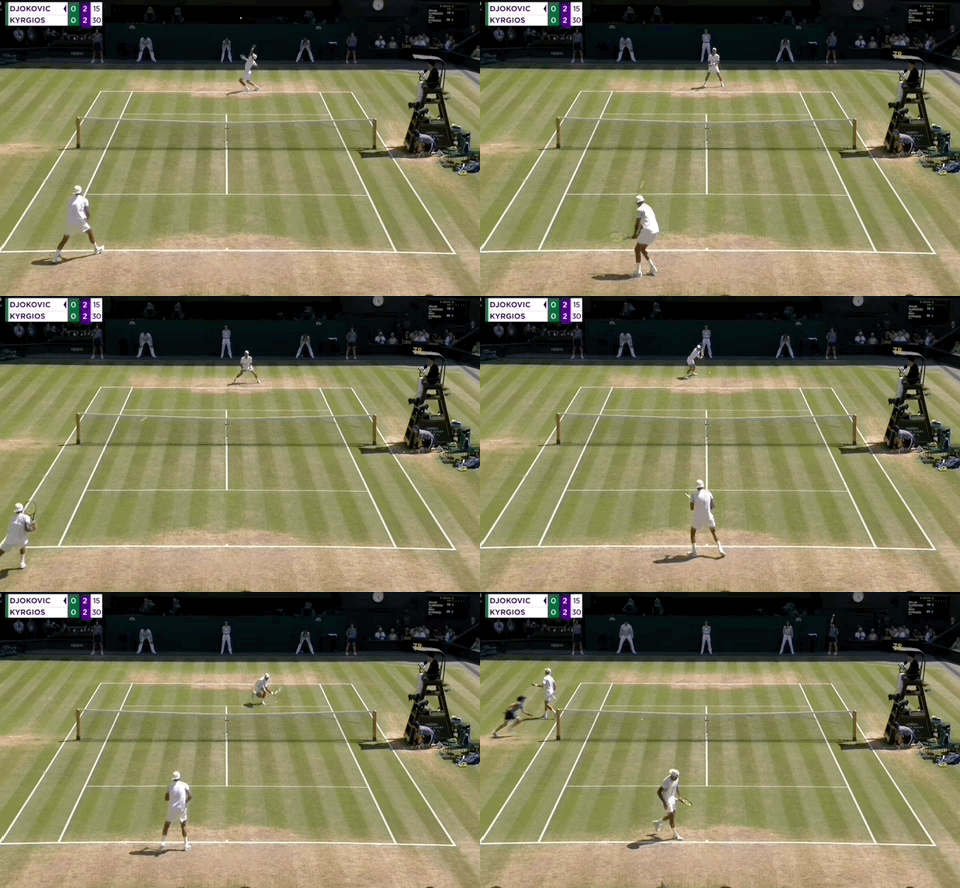
Using slices and backhands with little net clearance, Kyrgios was often able to settle into a very rhythmic rally temperament, not taking on anything too risky with pace but staying safe by keeping the ball low.
This made it very difficult for Djokovic to attack in the opening act before he'd properly revved up1.
The game ended in a double fault... but more on that later.
Changing That Dynamic
As the match wore on, Djokovic began to find his range on the forehand to wrestle back control of the baseline.
There was a transition period at the start of the second set however where he hadn't found his full range. Something was needed to counter the steady rally balls Kyrgios was feeding the Serb.
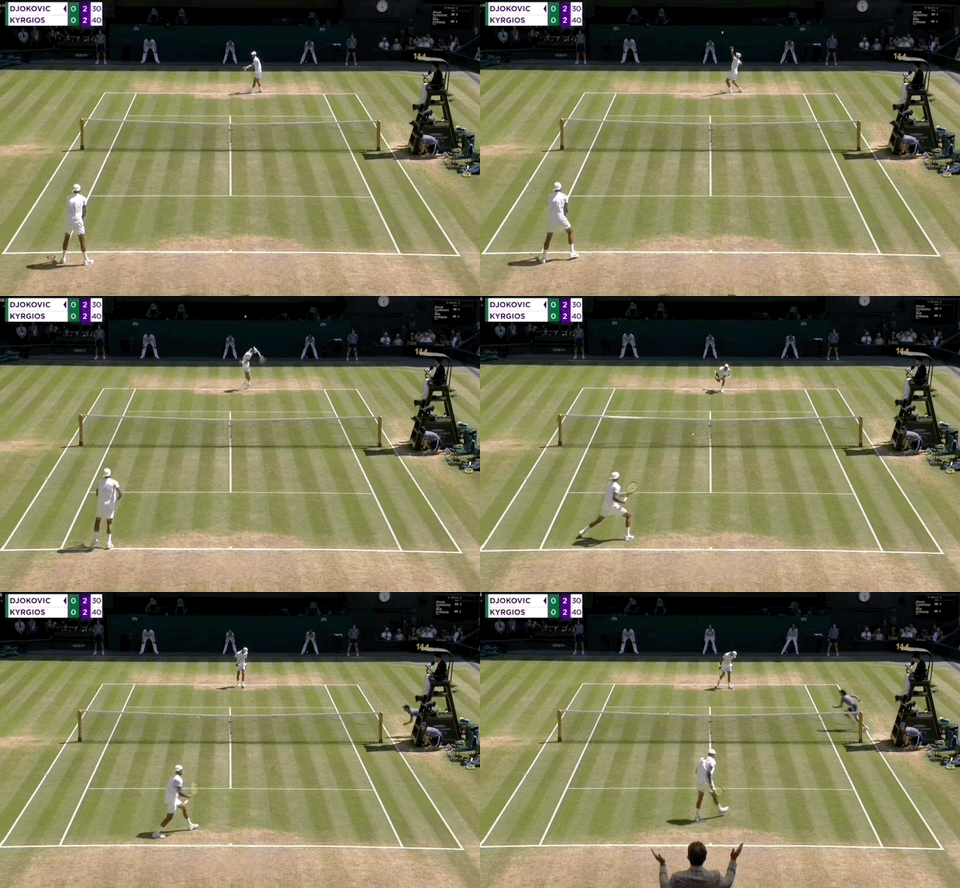
Enter the bane of Nolefam's existence - the Djokovic drop-shot.
For once, Djokovic's decision to play the drop-shot came at the right time. Something was needed to counter the low balls coming off Kyrgios's racket - the drop-shot was the perfect antidote.
It can be easier to play a cute drop-shot than to have to generate the racket head speed necessary to get the ball up and over the net off a low ball.
The drop-shot is a good rhythm breaker. Kyrgios had settled nicely at the baseline and looked as though he could trade backhands with Djokovic all day. This shot moved Kyrgios out of his comfort zone.
A shot that gave Djokovic some breathing room as he moved into fifth gear.
Constant Lifeline
Though Djokovic had declared himself the dominant force from the baseline, the final three sets didn't play out without their stickier moments.
Kyrgios was always going to hold serve fairly easily so it was crucial Djokovic could avoid being broken wherever possible.
One constant lifeline that made his serve impenetrable for the remainder of the match was to direct towards the Kyrgios forehand return.
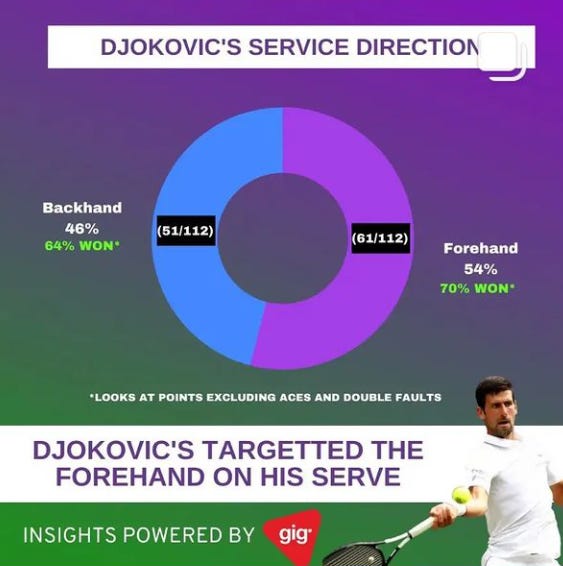
Two things allowed this to happen.
The Djokovic slice serve out wide in the deuce court has improved out of sight over the last few years - it's tough for any player to neutralise. (Dare I say it) It's almost Federer-esque!
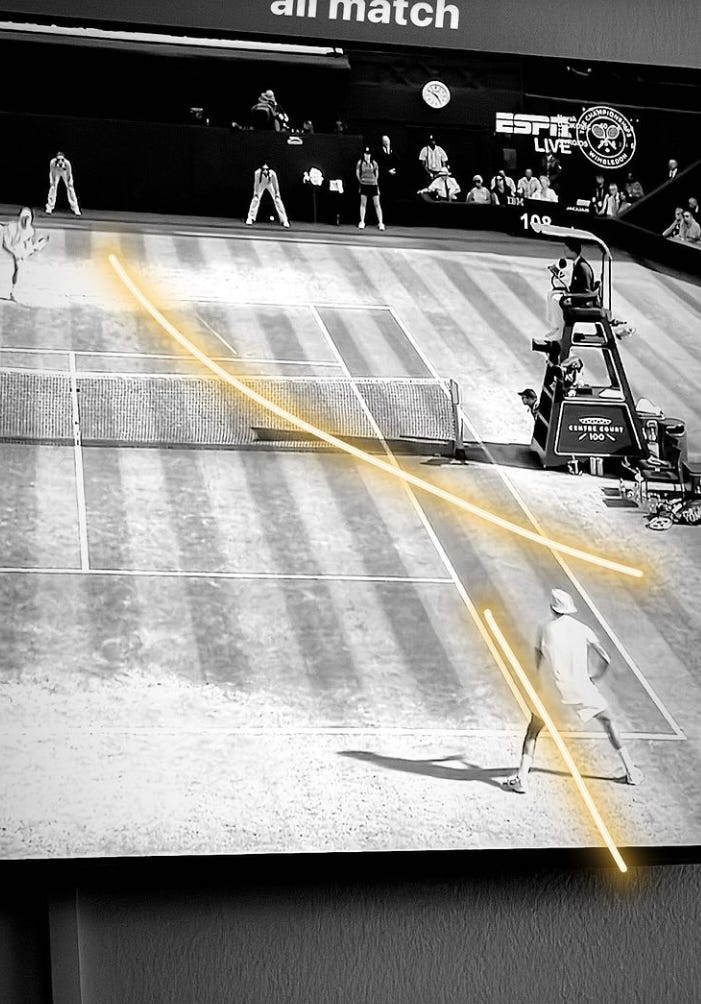
Kyrgios's backhand return is superior to his forehand return. He can absorb and redirect pace well off his backhand but prefers to wind up his forehand - this can force him into hitting with a takeback that's unnatural to him when rushed on this wing.
Even on second-serve, this bailed Djokovic out of some pressure situations throughout the match.
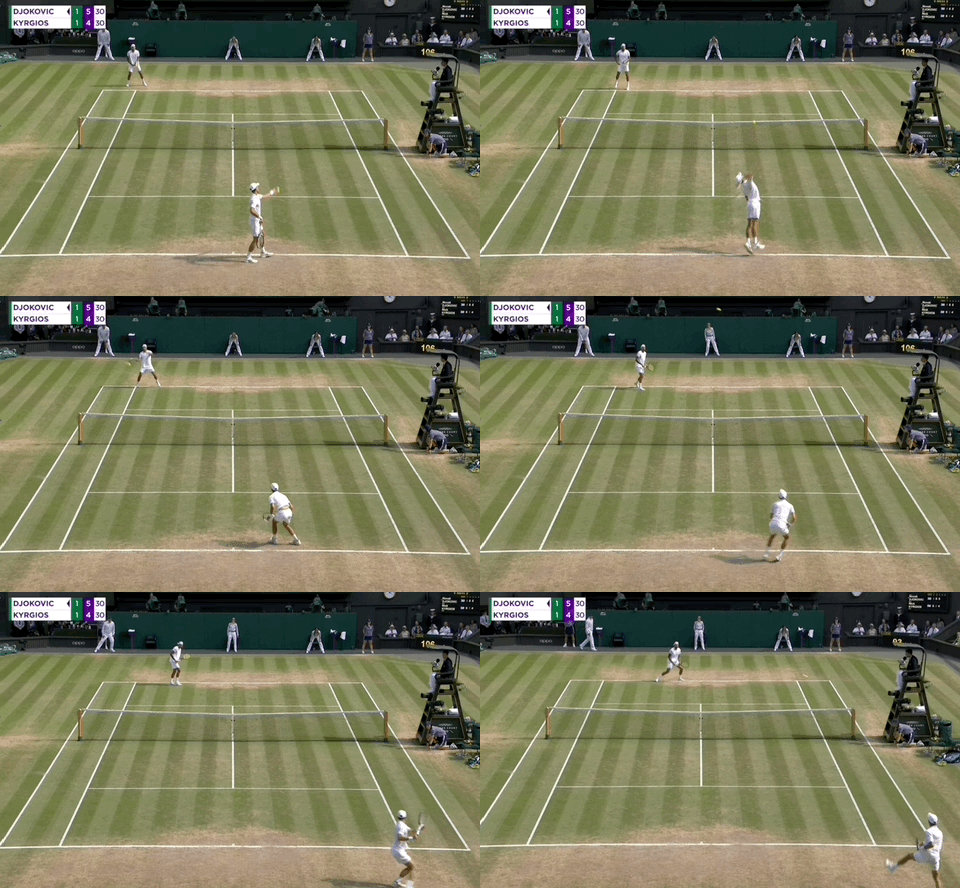
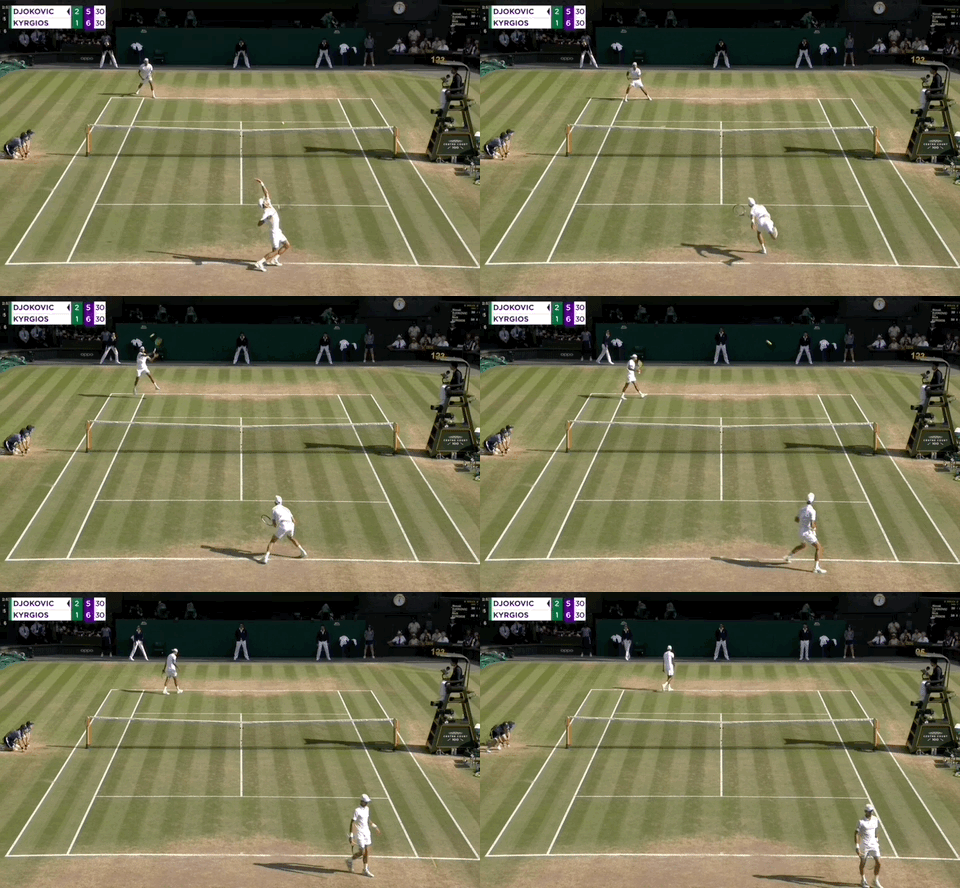
Thaaaat's why we saw Djokovic double fault on second-serve early on.
Djokovic's ability to exploit the Kyrgios forehand return kept his service games from going awry.
Breaking Down Two Key Moments
With these tactics in mind, I'd like to break down two key junctures of the match.
2nd set: Djokovic serving at 5-3, 0-40
Point-by-point...
0-40: Kyrgios misses a forehand return.
15-40: Kyrgios misses a forehand return.
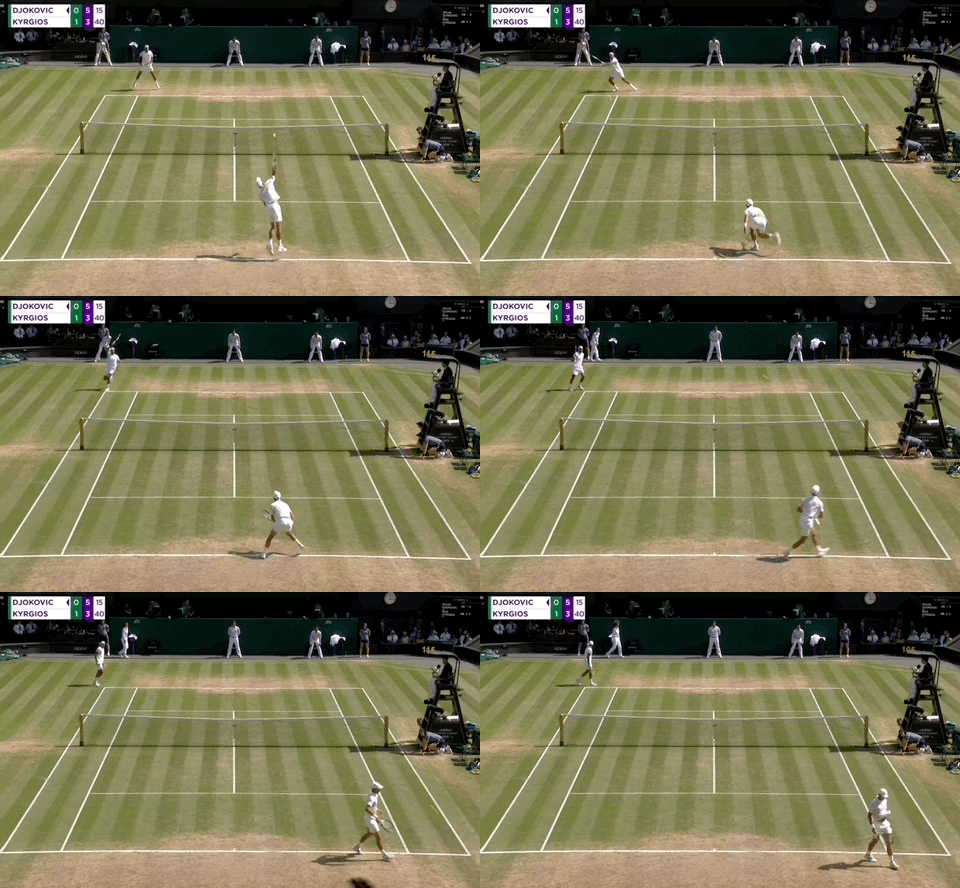
30-40: Kyrgios makes the forehand return but nets a backhand. He's looking for minute net clearance again so the tactics weren't terrible, just the execution was lacking.
40-40: Djokovic misses a forehand by an inch.
40-Ad: The Djokovic drop-shot bails him out of a long rally (see above!).
40-40: Kyrgios successfully covers the forehand return but Djokovic breaks a neutral rally with a backhand down the line.
Ad-40: Djokovic mixes things up at the right time with a wide serve to the backhand, catching Kyrgios off-guard - he nets the return.
A game full of our aforementioned tactics.
Moving on...
3rd set: Kyrgios serving at 4-4, 40-0
Point-by-point...
40-0: Second-serve and volley. Good surprise tactic but Kyrgios can't get enough on the first volley.
40-15: First-serve and short forehand. Djokovic chooses the right direction to set himself up for a rifled passing shot. Again, Kyrgios didn't do much wrong.
40-30: First-serve and amazing return finished with some calculated forehand aggression. This is just too good from Novak.
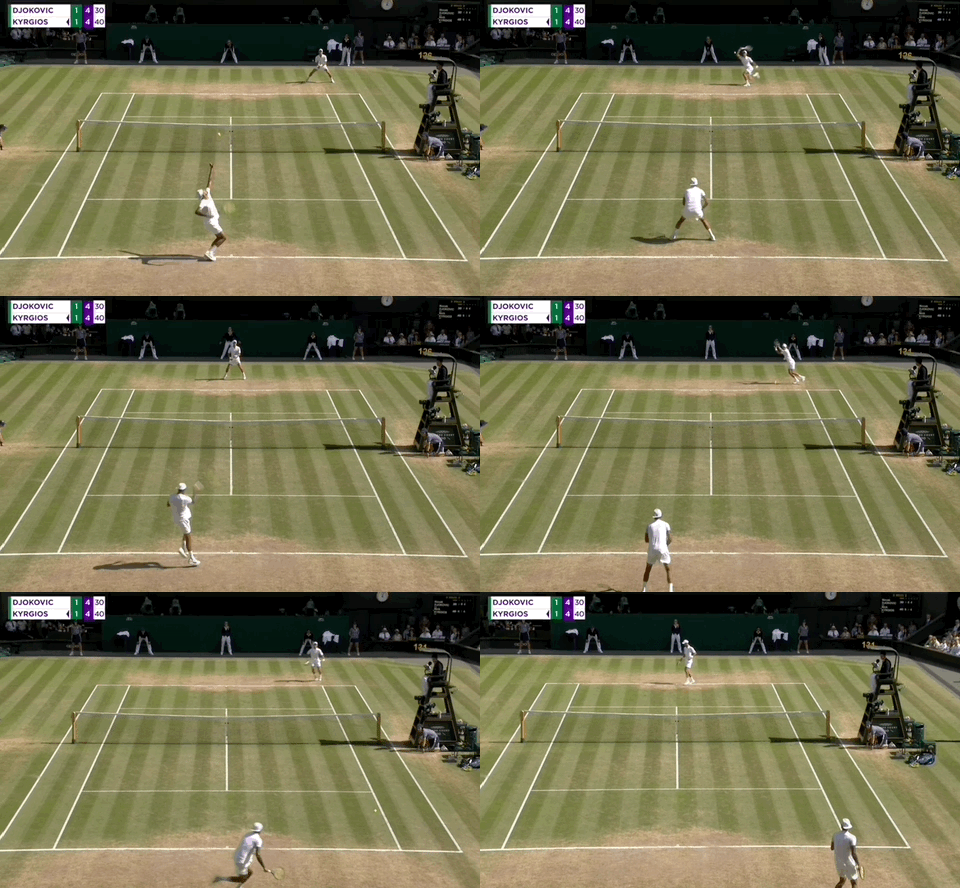
40-40: Big 114mph double fault. This a result of constant pressure from Djokovic from the baseline - can't blame Kyrgios for going for this shot.
40-Ad: Backhand into the top of the net. Again, Kyrgios is trying to keep the backhand low whenever he can.
For me, there was little or no lapse in concentration here. Kyrgios made plenty of right decisions but was unstuck by some Novak genius and a little bad luck (risky tactics didn't fall his way).
How Novak Djokovic defeated Nick Kyrgios
In summary...
Kyrgios won the first set after asking Djokovic the question, keeping the ball low enough to force Novak to respond with something different.
Djokovic started to take control of the baseline. Though he raised his groundstroke game generally, drop-shots paved the way for him to get more comfortable, helped him in some important neutral rallies and acted as a nice counter to Kyrgios's low balls.
Djokovic targeted the Kyrgios forehand on serve throughout the match even going towards it on second-serve on important points. Kyrgios didn't step up on this return often enough allowing Djokovic to wriggle out of some tricky situations.
So there was some tactical nuance to the match...
... but I wouldn't be surprised if many of you chose not to read this article.
Why?
The result of the match felt pretty inevitable.
This match could have been played out ten times and the result likely wouldn't have changed. Both players were able to take care of proceedings on serve comfortably enough but Djokovic was just a class above Kyrgios from the baseline - a tale as old as time.
Seven titles at Wimbledon.
22 and 212.
How long before somebody consistently outclasses the very best on the biggest stage at a Grand Slam?
Until then, all we can do is applaud... Bravo Novak 👏
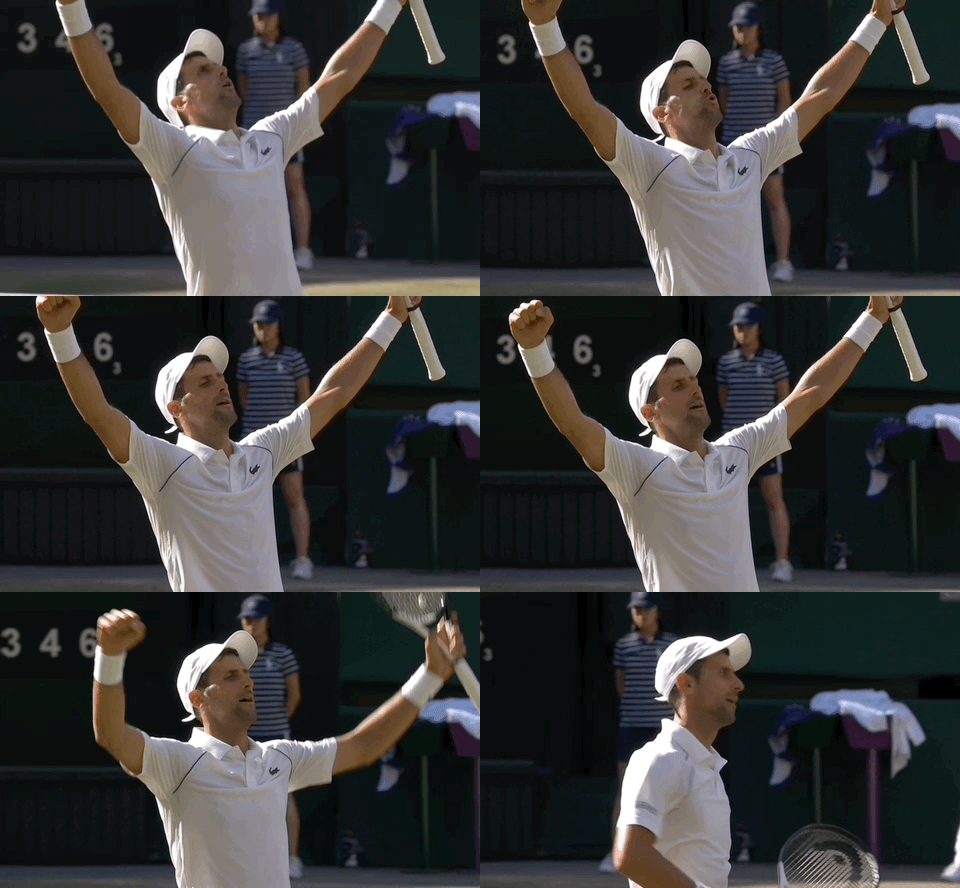
Kyrgios's rally temperament is an underrated asset of his (when he's switched on) - staying steady was a savvy tactic to take advantage of any possible Novak nerves.
Safe to assume Federer is out of the picture for now. Djokovic and Nadal have won 15 of the last 17 Slams (Thiem and Medvedev at the US Open 2020 and 2021).