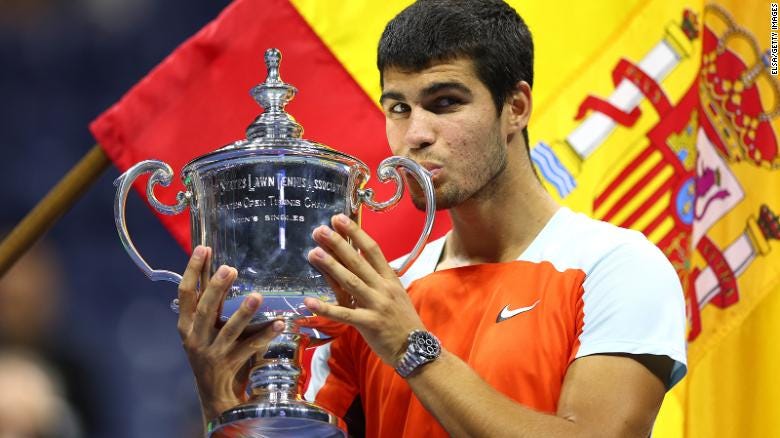
Carlos Alcaraz is your US Open champion!
... Two weeks ago that is. Sorry for the tardiness, yadda yadda yadda, I know the Laver Cup is on - let's got on with how we've found ourselves with the youngest ATP world #1 in the Open Era!
Casper Ruud was able to keep things super competitive but Carlitos eventually squeaked through.
How was the match so close?
How did the Spaniard find the winning edge?
Better late than never!
Ruud's Resistance
Casper Ruud isn't world #2 in the world for nothing.
The Norwegian put up some fight with astute tactics. He even earned himself two set points with the pair tied at one set apiece in the third set.
How did the impolite one1 come so close?
Resisting The Return
Throughout the match, Alcaraz was only able to break Ruud's serve three times. Ruud was able to limit the number of return points Alcaraz won to a lowly 34%, the world #1's lowest winning percentage on return for the tournament.
Looking at the break points Ruud saved in particular, we start to get an idea of how Ruud was able to stave off the otherworldly returning abilities of the Spanish super-soldier.
The resistance was two-fold.
The first was Ruud's ability to keep points short.
Ruud's first-serve has improved a lot over the last year and a half, contributing greatly to his steep ascendancy on hard-courts. His wide-sliding serve in the deuce court has now become his bread-and-butter. He delivers his first-serve most frequently to this area and has his highest success rate serving to this portion of the court.
Four of the eight break points Ruud saved were on the back of one or two swings of his racket.
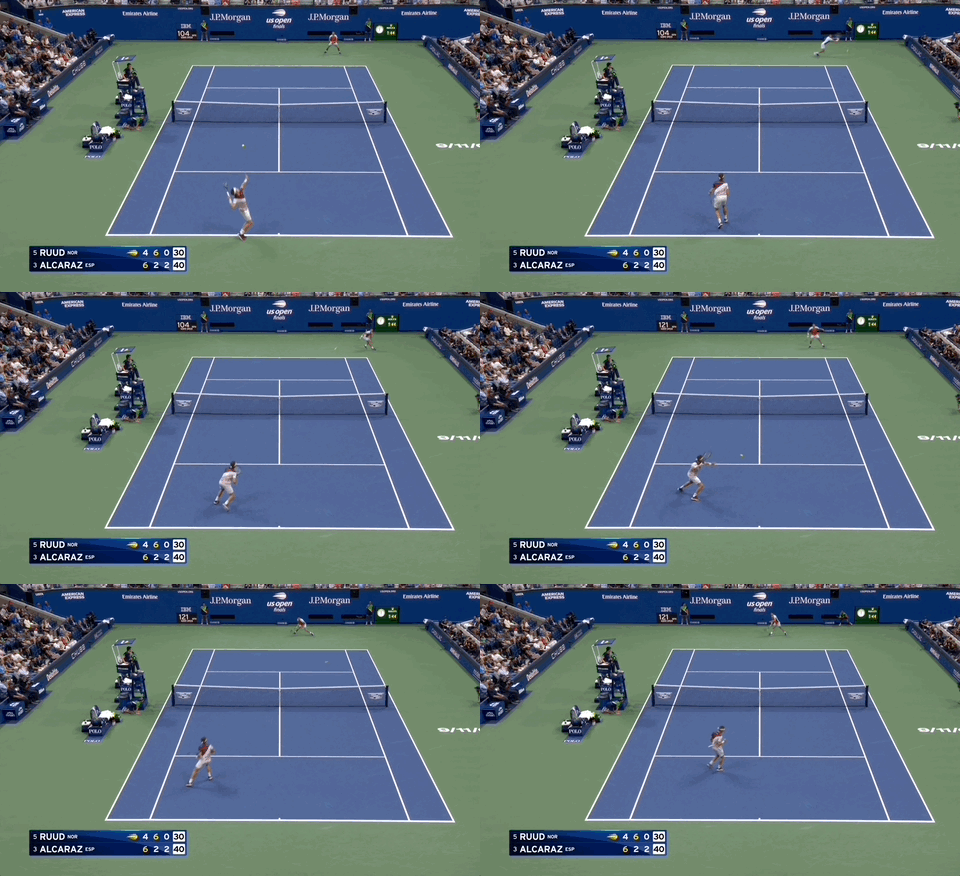
The second is in complete contrast to the first. If Ruud's first-strike was neutralised, he wasn't afraid to let the rally go on.
Ruud's ability to control depth with alien amounts of topspin is such a massive factor in his game. He made nods to using it to keep Alcaraz pinned back to keep the match physical (thus making the rallies longer) and to take away the drop-shot.
"Yeah I tried [seeing what Alcaraz had left in his legs], that was the thought for sure. I knew he’d played more hours than me2 and was finishing late plenty of days..."
Whilst extending rallies with length on the ball didn't make the teenager look any less fresh than we've come to expect (barring some unforced errors maybe), Ruud's knack for hitting with heavy depth on the ball served as a strong foundation for neutralising Alcaraz's quick-strike tennis.
This actually made the Norwegian the slight favourite from the back of the court - Alcaraz even said it himself.
"I thought that in the point, in the baseline, he had more chances to win the point than myself."
Let's look at a few points for a deeper understanding of how Ruud used depth to his advantage.
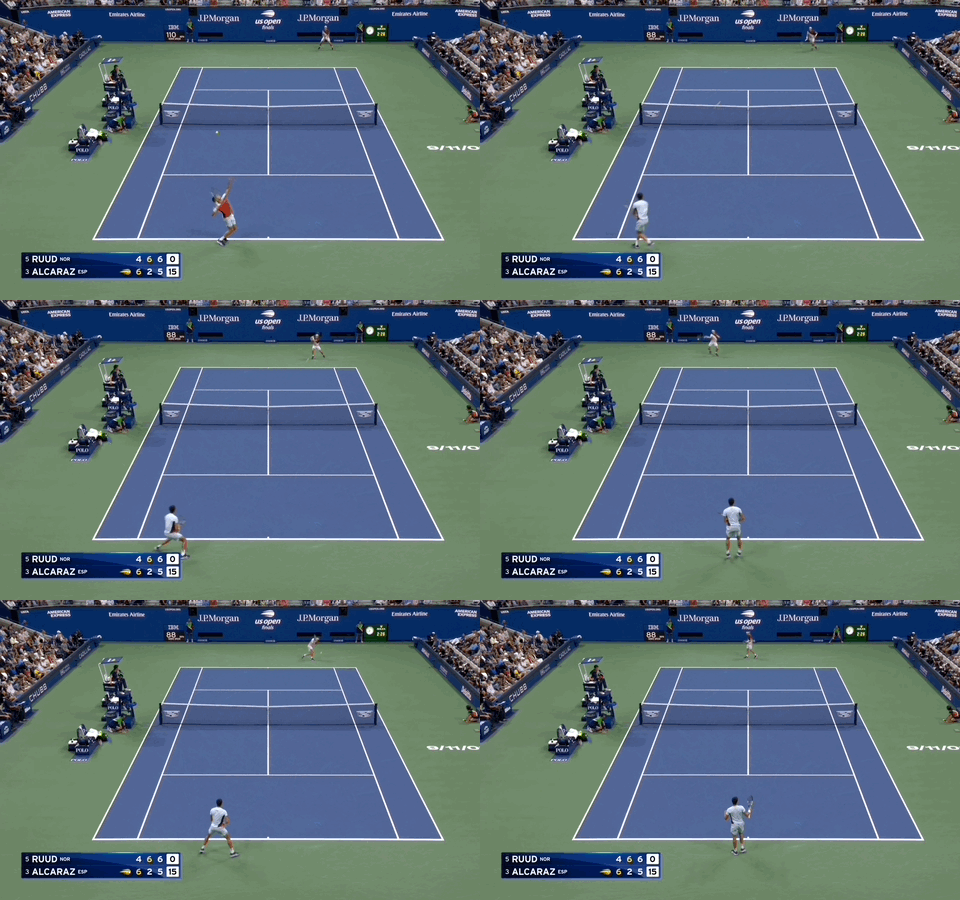
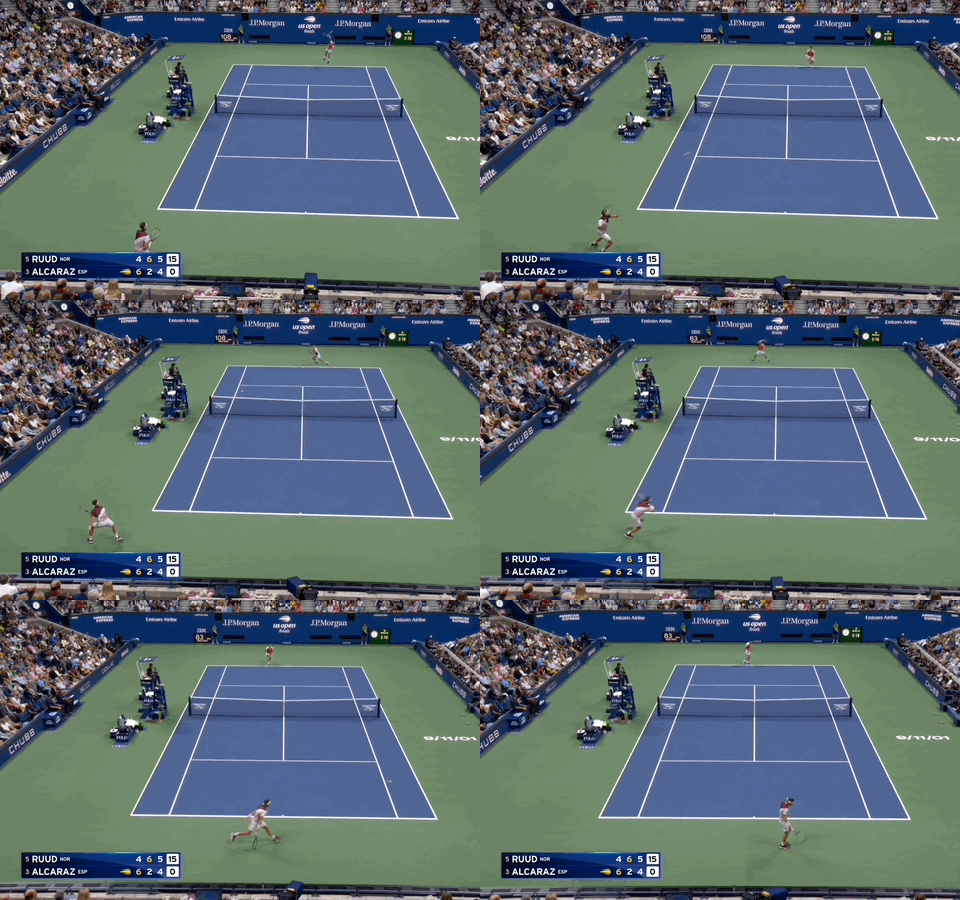
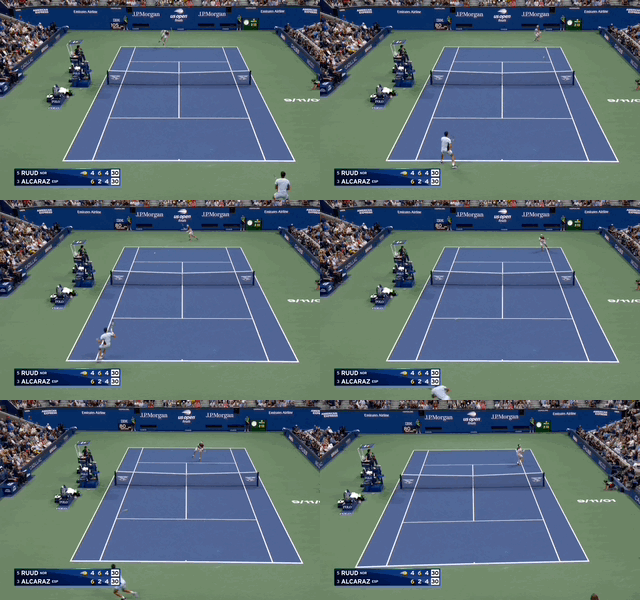
In summary...
Ruud rarely opened up the court to Alcaraz's forehand by directing his backhand nearer the middle of the court when he looked to change direction.
Couple this with Ruud's ability to transition from defence to offence on his forehand wing and it became very difficult for Alcaraz to go into the deuce court at the right time.
This resulted in Ruud being able to absorb many of Alcaraz's first blows, making it difficult for him to rush Ruud in the same way as his previous victims. Carlos walked away with the lowest second-serve return points won percentage in a match that he's won in his career (35%) and broken even with Ruud in rallies five or more shots in length, the only opponent during Alcaraz's US Open run not to have a losing record in this department.
Great defence and depth, taking the early strike or being patient under pressure3...
Exceptional stuff from Ruud.
How did Alcaraz turn the tide?
Alcaraz's Attack
It's so important to know the context of that 5-6 game in the third set when Ruud had two set points. It provides some valuable insight into why Alcaraz made the decisions he did on the most important points of the match.
"I did serve and volley a lot because I was really nervous, as well (smiling). I thought that in the point, in the baseline, he had more chances to win the point than myself. That's why I use more the net."
Alcaraz is absolutely right. He won 76% of his net points and won just 43% of his baseline points throughout the match, the biggest disparity between the two percentages in any of his matches throughout the tournament.
Alcaraz serve and volleyed against Ruud 21 times.
Against Cilic, Sinner, and Tiafoe, he serve and volleyed a total of five times.
Let's dissect some of the points at 5-6 in the third set to get an idea of what was going on.
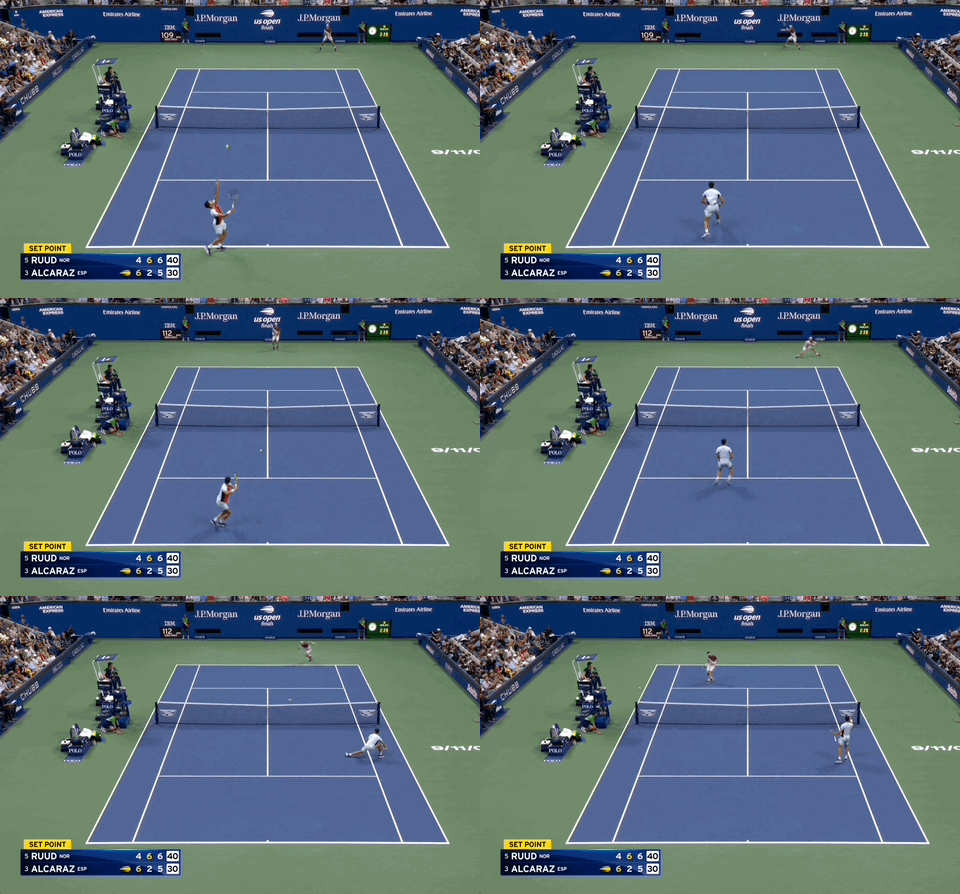
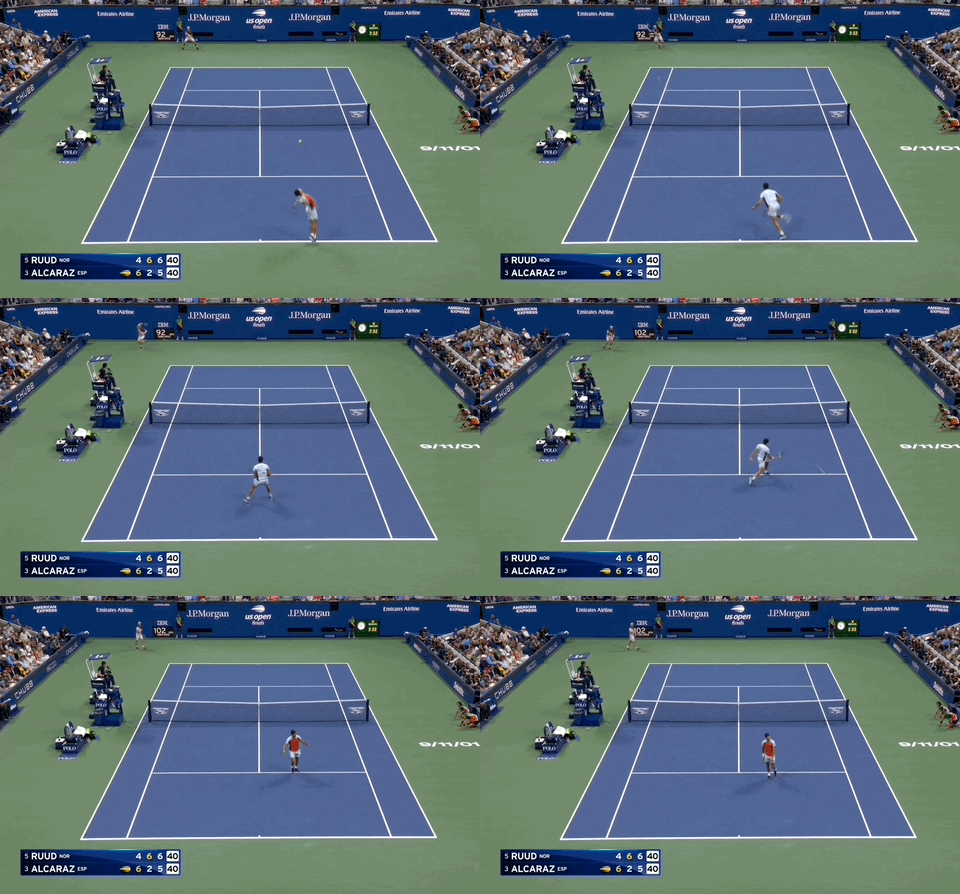
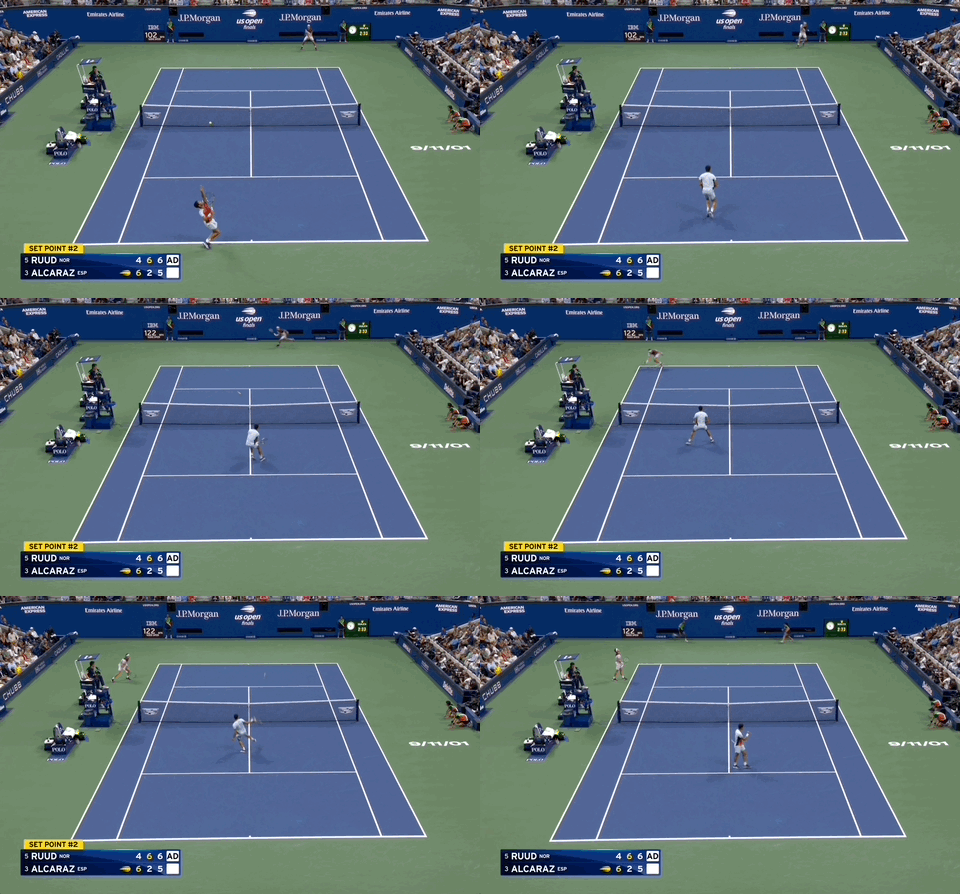
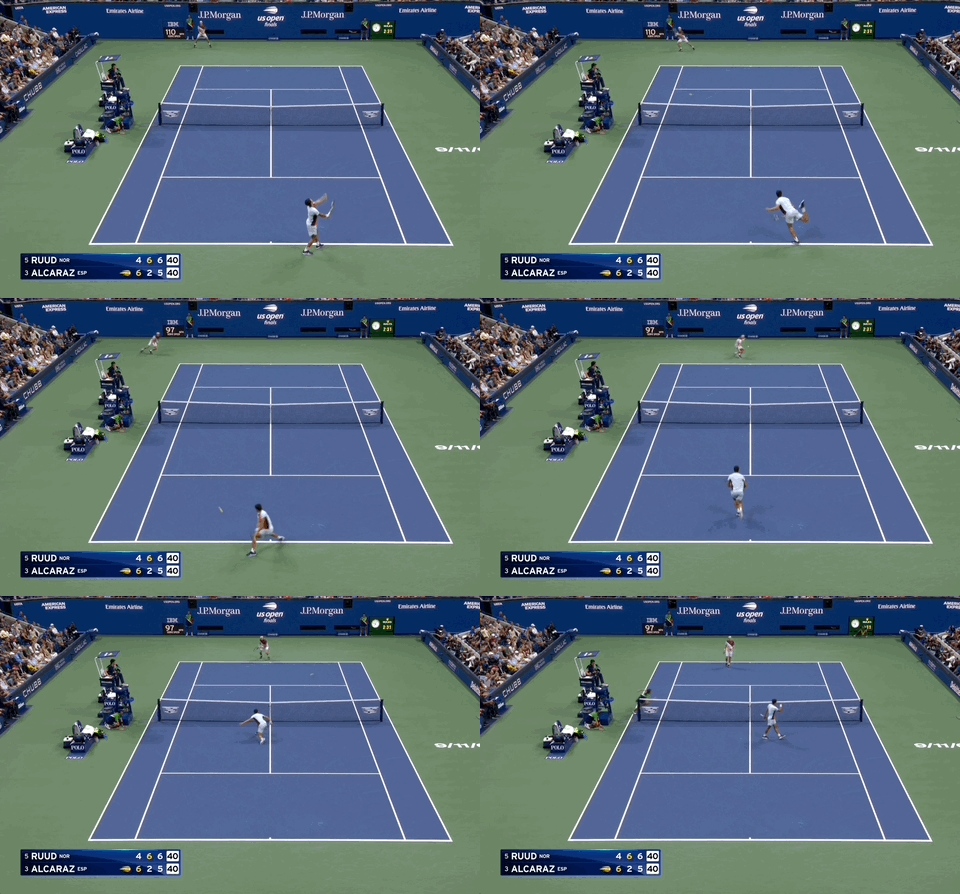
The match was done and dusted in that game.
Ruud would admit that the set points distracted him going into an ugly tiebreak from him and, boosted by the lead, as Ruud put it "[Alcaraz] served great in the fourth set, [giving Ruud] no chances to break him, [hitting] the spots and lines with the serve."
US Open 2022: How Carlos Alcaraz defeated Casper Ruud
There you have it.
Juan Carlos Ferrero has made one of the most complete players we've ever seen at such a young age. If Carlos didn’t posses a penchant for the net, I have no doubt the defensive capabilities and depth in Ruud's groundstrokes would have seen him emerge victorious in this match.
But Carlos can and did come forward on the precipice of handing over a two sets to one deficit.
After 23 hours and 39 minutes on-court, the muscular mutant from Murcia scrapped and fought his way to the trophy in New York, operating at only 60%.
Vamos Carlos 👏
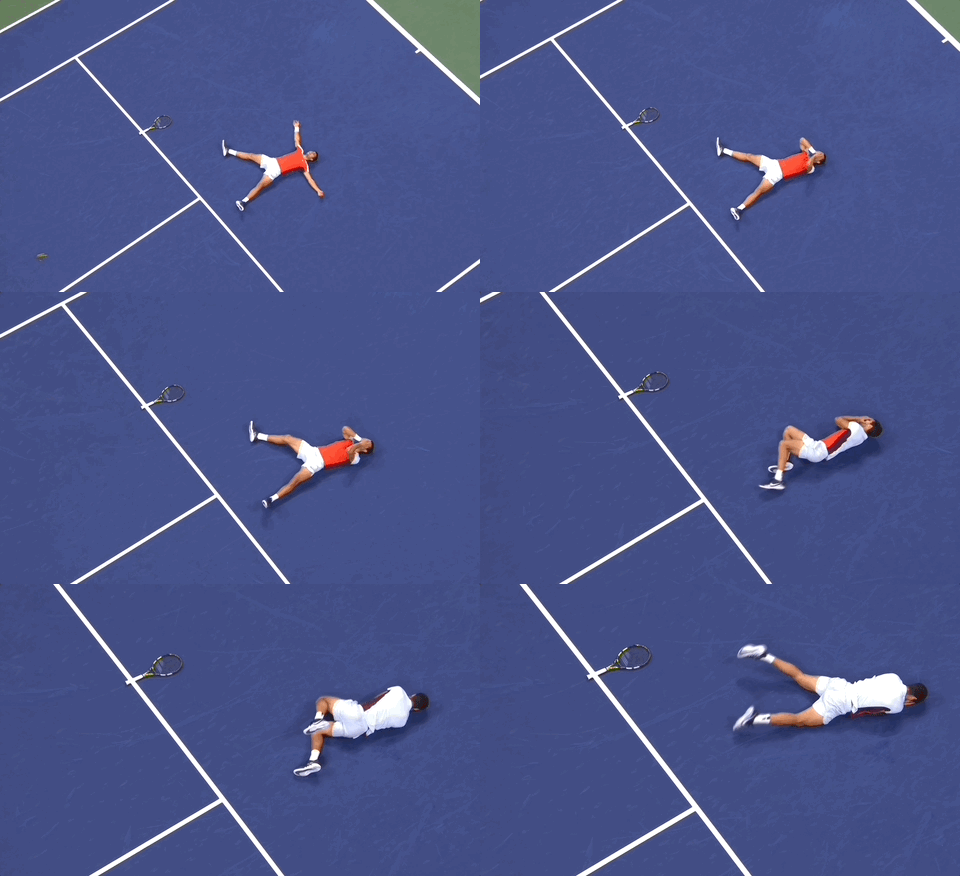
Thanks to David for this one!
Alcaraz won the US Open spending 23 hours and 39 minutes on court, the most hours played in any Grand Slam title run in the Open Era.
Four break points saved by Ruud in the 0-4 shot range, the other four in the 9+ shot rally length.