One-Handed Backhand
One-Handed Backhand Guide - technique, pro tips, and common mistakes for the classical stroke. Covers grip, stance, backswing, racquet drop, contact point, follow-through, off-arm stabilization, topspin mechanics, arm-bending errors, and the rear-leg power myth through Wawrinka and Thiem analysis.
Source: "One-Handed Backhand .docx" - comprehensive guide compiled from multiple tennis coaching sources on the classical one-handed backhand stroke.
One-Handed Backhand Guide: How to Hit with Proper Technique, Pro Tips, & Common Mistakes
However, the last decade has seen a resurgence of the one handed backhand at the top of the game demonstrating that a good one-handed backhand can be as effective or even more effective than a two handed backhand. The goal of this guide is to help you understand and improve your one-handed backhand so that you can take your game to the next level.
We will explore the following concepts: One-Handed Topspin Backhand Technique & Fundamentals Pro Tips to Improve Your One-Handed Backhand Common Mistakes on the One-Handed Backhand
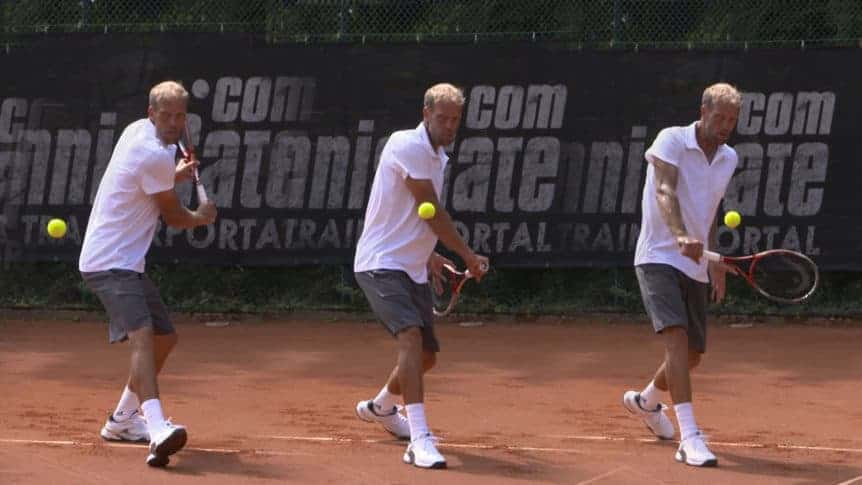
ONE-HANDED TOPSPIN BACKHAND TECHNIQUE & FUNDAMENTALS
The reason the one-handed topspin backhand is so challenging to master is because it requires perfect timing and stroke mechanics. While on the two-handed backhand you have the non-dominant hand to help you adjust for late hits or situation where you missed the ideal contact point, on the one-handed backhand you do not have that luxury. Your perception, timing and footwork have to be spot on to hit a good shot. The following slider will help you visualize the mechanics of a solid stroke.
Backhand one-handed closed stance Now that you have seen the various segments of the shot, let’s review the proper grip, technique, and fundamentals for this groundstroke.
THE ONE HANDED BACKHAND GRIP
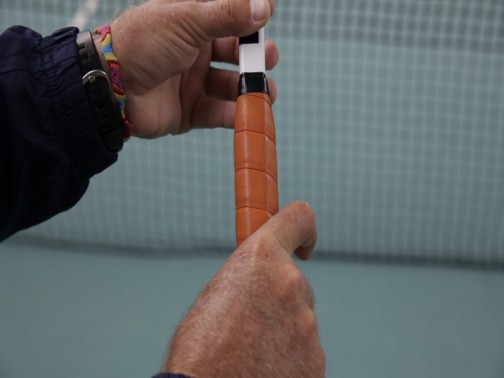
One of the most common mistakes on the one-handed topspin backhand is trying to hit the shot using the wrong grip. Unless you are holding the racquet with an Eastern backhand grip, you are always going to struggle. In recent years some professional players will even turn the grip more, using a Western Backhand grip, however, for most players the Eastern backhand grip will be the best option. For this grip, the knuckle of your index finger will be on top of the grip as the picture shows.
THE FOOTWORK & STANCE
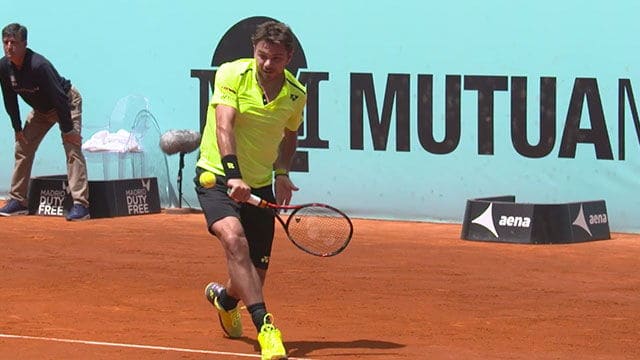
The footwork on the one-handed backhand is a bit different than that of the forehand or two-handed backhandin which you can hit with an open stance. On the one-handed backhand the preferred stance is a closed stance, with the player stepping slightly across the body to hit the ball. Here is an example:
THE BACKSWING
It is important to take the racket back rotating the body as a unit and not only with the arms. Ideally, you will take the racquet back keeping your non-dominant hand on the throat of your racquet, your arm should be fairly straight with the racquet head pointing upwards.
THE RACQUET DROP OR END OF THE BACKSWING
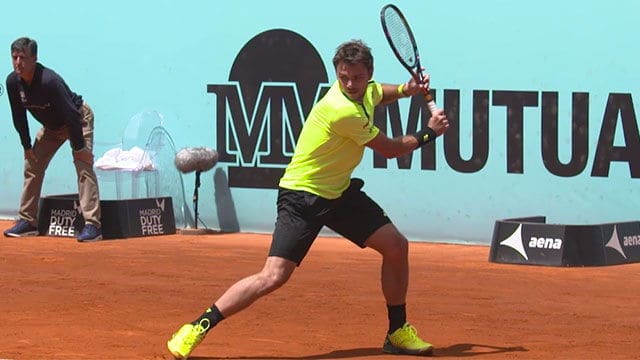
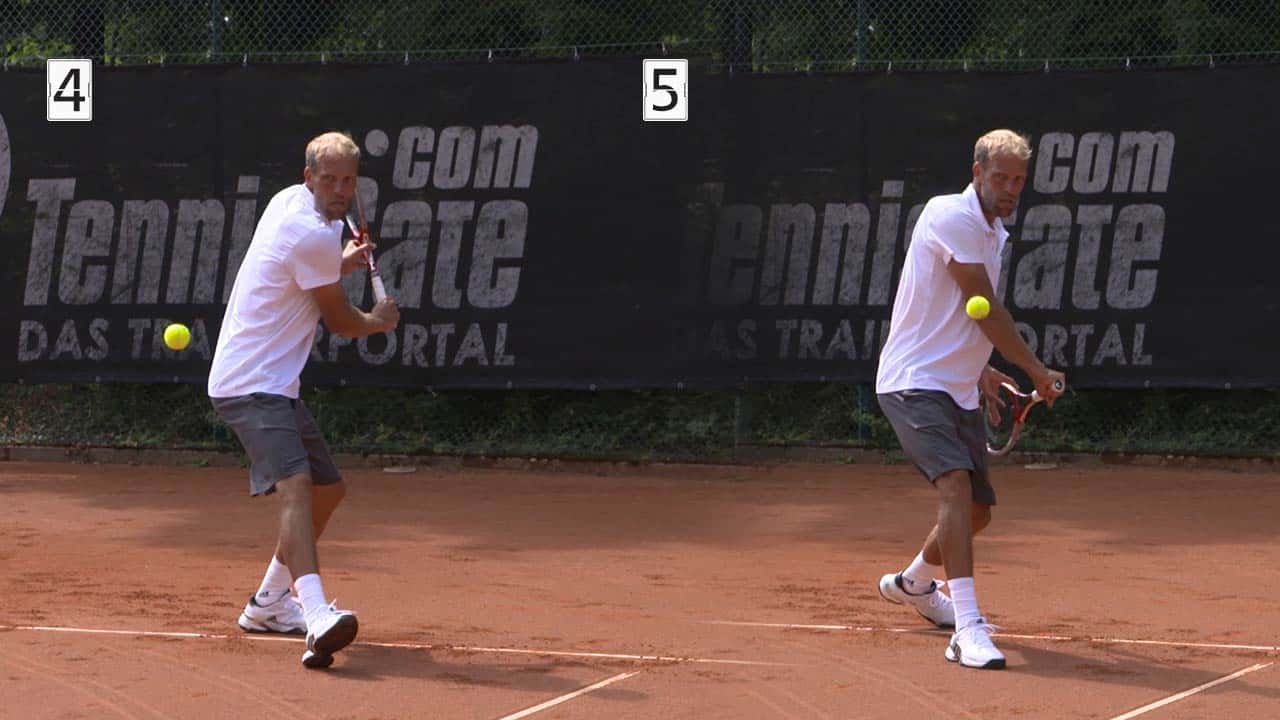
From the initial high shoulder turn you have to drop the racquet head under the ball at the end of the backswing enabling you to swing up and through the ball. As you can see from the picture below, the racquet head should point towards the ground before swinging forwards. The arm remains straight.
FORWARD SWING AND CONTACT POINT
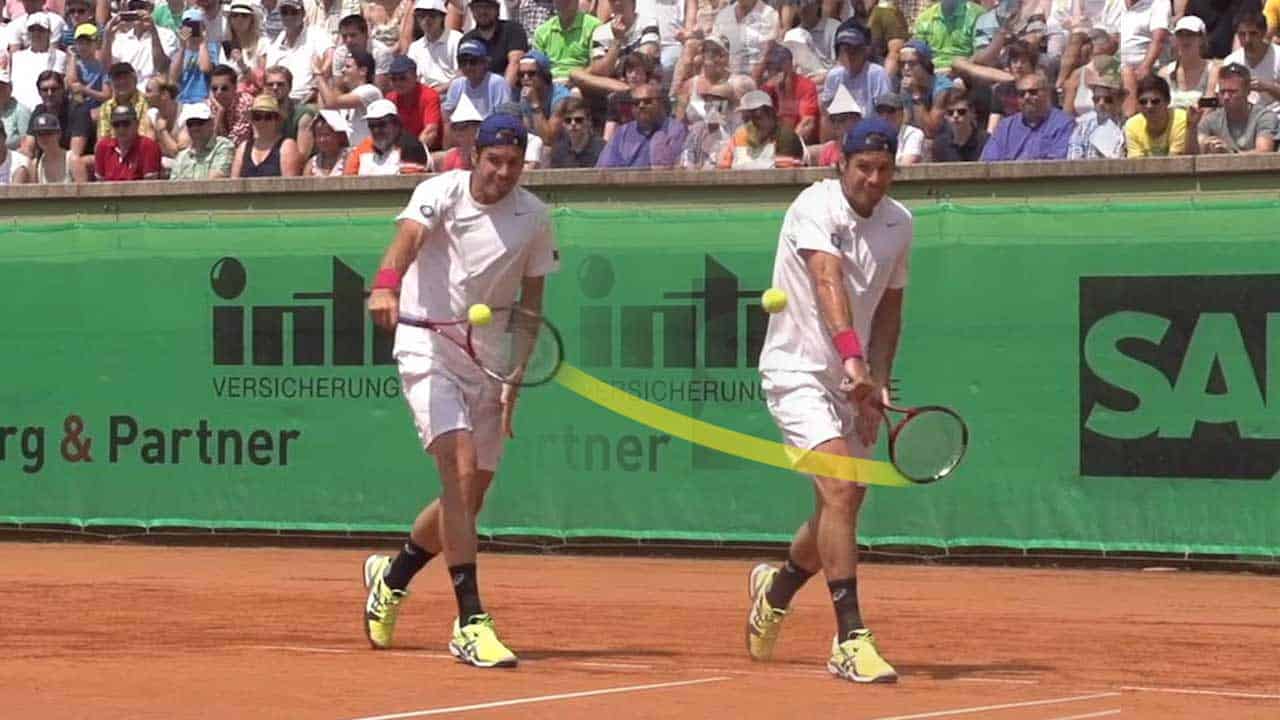
To hit topspin on your one handed backhand, the racquet has to swing upward from from low to high. The contact point is in front of the front foot but with the shoulders still sideways. The racquet head at contact should be parallel to the net when making contact with the ball. The following video will clarify the contact point for you.
THE FOLLOW THROUGH
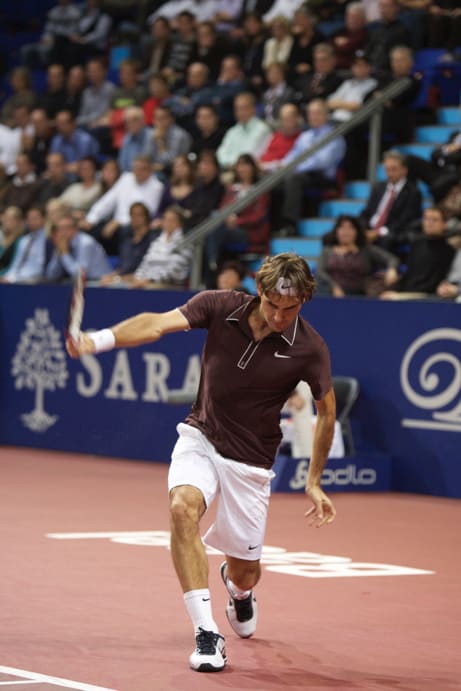
After contact your racquet head will remain stable and continue moving up and forwards as if pushing the ball. The racquet head will continue moving up and around as the body finishes rotation. The arm stays straight. The racquet will finish on the opposite side of the body, with the racquet head pointing up. Roger Federer hits a one handed backhand. The follow through for the one handed topspin backhand.
PRO TIPS TO IMPROVE YOUR ONE HANDED BACKHAND
If you already have the basics down for the one handed backhand, focusing on the tips below will help you improve your backhand further.
HOW TO USE YOUR OFF-ARM TO STABILIZE THE BACKHAND
Also very important on a one-handed backhand is the role of the non-dominant arm during the swing because it helps to stabilize the stroke. In general, the non-dominant arm will help take the racquet back and will move opposite to the swinging arm during the stroke as explained in the video.
HOW TO INCREASE TOPSPIN ON YOUR ONE HANDED BACKHAND
At this point it is also helpful to talk about the role of the forearm during the swing. As I mentioned earlier, the hitting arm is mostly straight during the swing, however it will also rotate as it approaches the ball. This helps accelerate the racquet head and increases the amount of spin. Take a look at the video to better understand the path of the racquet head as it swings forward.
Now that you have a clearer picture of the key components of a solid one-handed topspin backhand, let’s take a look at some common mistakes.
COMMON MISTAKES ON THE TOPSPIN ONE HANDED BACKHAND
The following section will help you understand and correct some of the most common one-handed topspin backhand problems.
BENDING THE ARM
As mentioned above, the player should maintain a fairly straight arm through the shot, starting with the preparation. Bending the arm somewhere on the backswing, as a way to adjust to the contact or in the follow through will lead to inconsistencies. The following video will explain why keeping your elbow straight is so important.
ROTATING TOO EARLY
This is arguably the most common mistake on the one-handed topspin backhand. In contrast to the forehand where the player rotates to hit the ball and is basically facing the net at contact, the contact point on the one-handed topspin backhand occurs while the player is still sideways. What makes this error so common is that the stroke does start by turning the body into the shot. However, the upper body slows down to let the arm swing through.
Let’s take a look at how to avoid this common mistake. Now that you are more familiar with the whole structure of the one-handed topspin backhand, it’s time to go practice. One great way you can look for areas to improve your one handed backhand is to take a video of yourself hitting the stroke. Then compare your technique with our slider at the top of this page to make sure you’re getting in the right positions for your one handed backhand.
Power In The One-Handed Backhand Part 1
Glen Hill
For all that one-handed backhands are often admired for their beauty and grace on the tennis court, they have persisted at the peak of the game for one simple reason: they work. One handed backhands are capable of higher peak levels of spin and velocity than two-handed backhands. That is not to say they are superior in every regard but this one aspect is, at this juncture, beyond debate.
Modern groundstrokes are rotational, and the amount of energy available to put into the ball is limited by the speed of the racquet at contact. When we refer to “power” in a groundstroke, we’re often really referring to racquet head speed. There are many common misunderstandings about power as it relates to modern groundstrokes. At least one of these misconceptions is very apparent in the one-handed backhand. The idea that power comes from the ‘back’ leg in groundstrokes is widespread.
The “load and explode” doctrine of teaching proliferated in the tennis world amongst coaches and students, and lingers in various forms to this day. The problem is that it isn’t a particularly effective source of power. It’s not what the top professional players in the world actually do when they play. We can see this by examining the two most powerful backhands in the game today: Dominic Thiem, and Stanislas Wawrinka.
By looking at the motor patterns of their legs and hips during the backhand we will see that the back leg isn’t the source of power driving the hips into rotation. To begin with we will look at the backhand of Wawrinka. Stanislas has long been renowned for having the biggest backhand in the game. His ability to hit toe-to-toe with Rafael Nadal’s forehand with his one-handed backhand has made him both a legend, and a three-time slam champion. So what does Stan do on his backhand?
Wawrinka
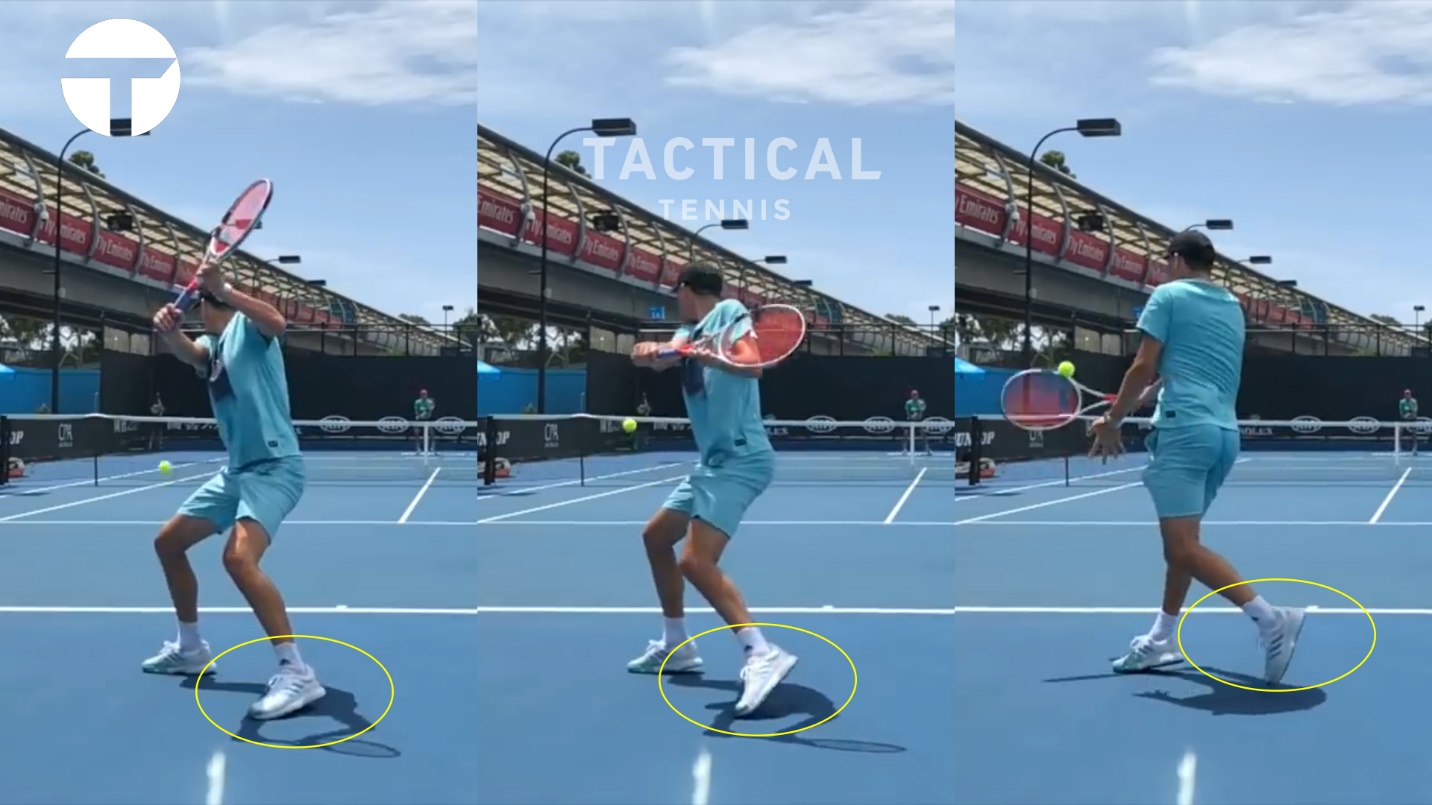
Let’s start by taking a look at the back leg of Wawrinka during the explosive phases of his stroke. Remember we are beginning with the idea that players drive off their back leg in order to generate power. There are two key pieces to examine in the image above, both circled in different colors. In the left side of the image we see Stanislas as he is about to begin to truly accelerate his racquet.
In the fractions of a second that follow, his racquet will drop, and then explode forward to the point of contact. As we look at the position of his left leg, we see that he is not well set up to exert force or power from it. His left leg is almost straight, and he only has a portion of his left foot in contact with the ground. As he transitions to the position on the right of the image, his leg has straightened ever-so-slightly.
Wawrinka’s left foot is even less in contact with the ground now, with the outside edge clearly lifted up. Nothing about these positions suggest Wawrinka is using his left leg as a source of power. He is not driving off his left leg to accelerate the hips or the racquet. Rather, we see that his weight has shifted almost entirely onto his lead (right) leg before beginning the true acceleration of the racquet.
If the intent was to drive off the rear leg for power, Wawrinka would need to have a significant portion of his weight on that rear leg - instead it is on the front leg. As Wawrinka completes his acceleration through the ball his left leg continues to tell us a lot. His hips structure is rotating and his left hip is coming forward, but his left leg is now swinging backwards behind him - in the opposite direction of his left hip.
If Wawrinka were using the left leg to drive the left hip up, the opposite would be true. Stan’s left leg would move up and through together with the hip, not move in the opposite direction. If you doubt this for a second, stand up and push your left hip forward with your left leg. Then try to do it while sending your left leg backwards. It just doesn’t work properly.
Thiem Time
Let’s shift over to examine Dominic Thiem’s mechanics. Examining Thiem’s rear leg in his backhand, we see again a pattern of movement that shows he is not driving off his back foot to accelerate his rear hip into the shot. Look at the progression of his foot position in these three images. This is not the position of someone using their foot for power.
Additionally we can see in the imagery above that while Thiem’s rear (left) hip rotates around to the left, his rear (left) foot rotates in the opposite direction, to the right. This confirms again that he is not driving the left hip forward with the left leg. If he were, the left foot would travel in the same direction as the left hip.
Why Not?
Now that we’ve seen that the most powerful one-handed backhands in the world aren’t pushing off their rear leg for power, we should ask (if we haven’t already) “why not?” After all, it isn’t good practice to just copy professional players without understanding - even the best players have inefficiencies or problematic movements patterns. In this case, the lack of rear-leg drive isn’t a peculiarity limited to one player - it’s something we see across the best backhands in the world.
The simple answer, and in this case the correct one, is that pushing off the rear leg to provide power for rotation simply doesn’t work well. It’s a poor way to initiate rapid rotation of the hip structure because, compared to other methods, it’s slow - and slow hips mean a slow racquet.
Now What?
If the rotation in these backhands is not being driven by pushing off the rear leg, what is driving it? There’s better ways to rotate the hip structure more quickly, and that’s what we’ll look at next time, in Part 2 *Images thanks to video from Slow Motion Tennis and Pro Tennis Photos