Thinking Revolution
For more than a century, school sports have taught us to see the body as a machine: bones as levers, muscles as motors, joints as hinges. That model is simple, easy to visualize, and it explains why we break bones when we fall. But it doesn't explain something much smaller: why Roger Federer can hit a forehand 145 km/h with his arms almost completely relaxed. Machines don't do that. And the human body is not a machine either.
In fact, the body is a system of Tensegrity (tension-integrity structure) — a portmanteau of "tension" and "integrity" (integrity). Architect Buckminster Fuller coined the concept in 1955, and physiologist Stephen Levin introduced it to biology in 1981 under the name biotensegrity. In a tensegrity structure, the compression members — the bones — never touch each other directly. They are suspended within a network under constant tension, composed of fascia muscles, tendons and ligaments. The force does not pass through a single point; it is evenly distributed throughout the system. Whenever one part is affected, the entire system reacts at the same time. Think of a spider web: touch one strand, and the whole web vibrates.
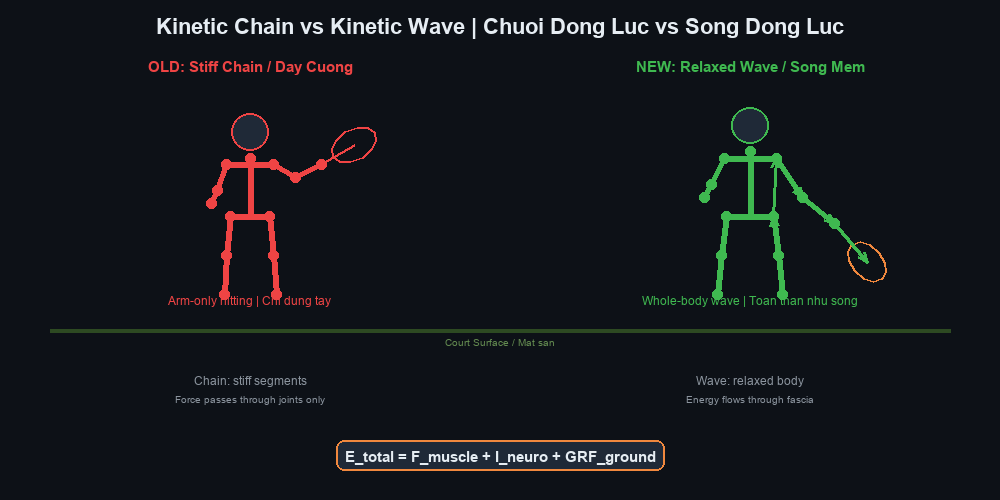
It is from this intuition that the Future of Tennis Research Institute proposes a groundbreaking theoretical framework called the Wave Transmission Model (WTM). According to that model, the body is not a mechanical machine consisting of dry and rigid links, but a continuous non-linear elastic waveguide field. The entire mass of muscles, tendons, bones and especially the fascia network form a sophisticated mechanical vibration transmission medium, where energy is not transferred step by step but is accumulated, modulated and synchronized throughout the entire fascia fascia system. The traditional kinetic chain model is still useful on a rough level, but when applied to the 160 km/h swings of Carlos Alcaraz or Jannik Sinner, it reveals three paradoxes that cannot be ignored. First, the spirit conduction time: each individual muscle group takes 30–50 milliseconds to fully contract, so if the force has to pass through 5–6 sequential links, the total time will be 150–250 milliseconds, while the entire stroke takes only 80–120 milliseconds. Second, energy loss at joints: each joint is a point of consumption due to friction, so transmitting force through dozens of joints will lose more than 60% of the original energy from the ground. Third, joint overload injuries: anyone who tries to stiffen each joint to create force will put all the shear stress on the shoulder cartilage and elbow ligaments, leading to rotator cuff tears and premature degeneration. The wave model solves all three paradoxes with a single mechanism — transmitting vibrations instead of transmitting forces.
And here is the key to this book: fascia (fascia) is the body's super conductor of wave transmission. Until the 2000s, anatomy textbooks still treated fascia as useless packaging. Now, thanks to the work of Robert Schleip and Helene Langevin, we know fascia is the body's largest sensory organ and is a continuous, nonlinear elastic force transmission network in the form of a liquid crystal collagen matrix. Microscopically, it consists of super-strong collagen fibers that can withstand tensile loads of up to 120 MPa, elastic elastin fibers, hyaluronic acid (a lubricant that holds up to 6 liters of water per gram), and fibromuscular cells that contract actively without nerve spirit signals. The elastic properties of fascia do not obey the usual Hooke's law but are nonlinear: at slow speeds it is soft, slides gently and absorbs deformation without resistance; At fast recoil impulses it instantly locks into a super spring, transmitting energy intact without deforming the joint; and unlike muscles that must consume ATP molecules to stretch, fascia stores and releases kinetic energy completely passively according to the natural elastic cycle. When hyaluronic acid is at its ideal viscosity, the fascia layers slide smoothly; When it aggregates due to stress, cold or lack of exercise, the traveling waves will carry noise.
Fascia is also a type of mechanical memory. It not only transmits force but also stores physical information. Practicing a correct technique long enough, fascia restructures itself in a direction that is optimal for that technique — which is why top athletes have a deeper "body memory" than amateurs, and also why after injury, fascia takes six months to two years to fully recover. Continuous wrong practice will "program" it in a bad direction.
Tung State — lessons from Tai Chi
In Tai Chi, the word Tung (松) is the highest principle. It does not mean loose or weak. Tung is a state of intentional relaxation: there is no useless muscle contraction, but the body is still slightly expanded in all directions like a tight balloon, maintaining an internal pressure sufficient for the waves to propagate without causing interference, and ready to react immediately. A simple test: stand up straight, drop your shoulders, breathe deeply and feel the space between your vertebrae open up — that's when the tensegrity network works best.
The biggest obstacle preventing the propagation of elastic waves is the phenomenon of antagonistic contraction: when anxious, afraid of damaging or intentionally using hand force, the brain simultaneously activates both agonist and antagonist muscles, the two groups restrain each other, creating internal tension, locking the joints and blocking the path of mechanical waves. The energy generated from the ground is absorbed and then dissipated into heat right in the body, causing tennis players to tire quickly and maximize the risk of tennis elbow tendonitis. In order for the waves to transmit smoothly, the body must reach a state of Lung Tung (Sung) - a flexible relaxation, joints wide open, ligaments slightly taut like guitar strings, but not limp or weak. Only then will the body become a perfect waveguide, allowing mechanical energy to circulate with almost absolute efficiency. Why does Tung create speed? When the muscle tenses, the fascia fibers are compressed, the hyaluronic acid is squeezed out, waves bounce back at the stiff spots, and energy is wasted in resisting its own contraction. In the Tung state, fascia relaxes, hyaluronic acid activates, waves propagate freely and energy is fully transferred into the balloon. Tension is loss of strength; Letting go is powerful.
The four fascia rails and their roles
Researcher Thomas Myers has mapped twelve "train tracks" fascia in the human body (Anatomy Trains — Body Rail Map, 2001). In tennis, the four most important lines are: Superficial Front Line, which runs from the toes to the chest and head, maintaining a standing position during the preparation phase; Superficial Back Line from the sole of the foot through the Achilles tendon to the spine, passing ground reaction force up from the leg; Spiral Line diagonally from right shoulder to left hip and down to right leg, creating twist and X-Factor; and Arm Lines guide waves from the body through the shoulders and arms to the head of the racket.
Why do players often get injured?
More than 80% of tennis injuries — tennis elbow, shoulder pain, back strains — come from one common cause: ground reaction force is not metabolized through the tensegrity system but goes straight to the bones and joints. The chain usually goes like this: stiffening the arm when hitting causes fascia to compress, waves from the ball bounce back into the joint instead of being absorbed, the elbow tendon is subjected to constant load, then micro-tearing of the collagen fibers leads to tendonitis and chronic tennis elbow. The solution is not painkillers, but rather returning the body to the Tung state so that fascia does its job of absorbing the load and protecting the tendons.
Change the training language
The most important condition for a coach is to change the way he uses words. Instead of giving mechanical commands — "bend your elbows!", "rotate your hips hard!" — lead with the wave: "let your arms fall naturally, don't hold tight", "let your hips lead, shoulders follow like a tail". Gong means to block the wave; Letting go means letting the wave pass. The difference between an amateur and a master lies entirely in this transmission mechanism: mechanical wave pulses pass through the whole body in just 20–30 milliseconds, compared to 150–200 milliseconds for sequential mechanical sequences. The whole body maintains a loose but cohesive elastic state — tensegrity — and energy is released automatically through the elastic recovery mechanism of the fascia fascia, turning the blow into a weightless but devastating whip. This entire book will return to that idea, chapter by chapter, on each part of the swing.

Earth Battery – Ground Reaction Force
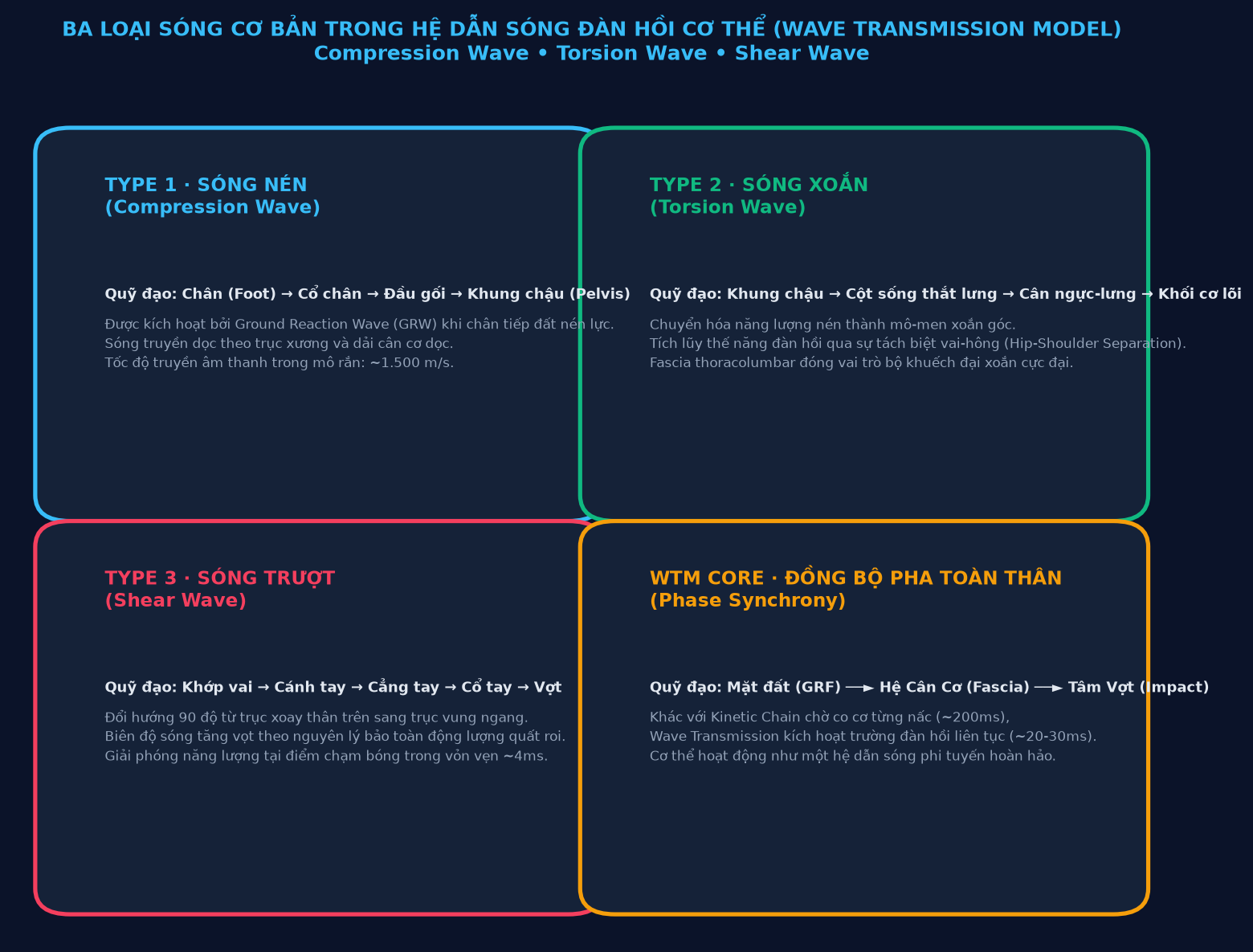
All force in tennis starts from the ground, not from the hands. When you step into the shot, your foot goes down and the ground pushes back — that's Ground Reaction Force (GRF). It is the atomic battery of the shot: a source of primary energy that no single muscle in the body can produce. Good athletes don't "hit harder"; they just know how to release this battery more effectively. According to the Wave Propagation Model, the moment the foot presses down is not simply the starting point of a lever, but an event that generates a ground reaction force (Ground Reaction Wave — GRW): that energy immediately begins its journey through the body in three basic wave forms.
The first wave is a compression wave. It arises as soon as the foot hits the ground, compressing the body's weight onto the hard court surface. Ground reaction force creates a pressure wave that travels along the leg, thigh, and spine. Because bone tissue and periosteum have a high molecular density, compression waves propagate at extremely fast speeds, about 1,500 m/s, acting as a signal to activate the entire system before any muscles can contract. The second wave is a torsion wave. When the compression wave reaches the pelvis, the foot angle and the phase difference between the two leg axes convert it into a rotational torque, twisting the lumbar spine and stretching the entire thoracolumbar fascia (TLF). This is where the body absorbs enormous elastic energy, like twisting a highly loaded rubber band. The third wave is a shear wave. When the torsional wave reaches the shoulder joint and pectoral girdle, it turns 90 degrees to transform into a sliding wave that runs along the arm to the racket head. At that time, the shoulder does not play a role in generating force but is a "wave deflector": the completely relaxed arm acts like a rope, the amplitude of oscillation gradually increases with length and reaches its maximum right at the center of the racket face.
GRF is not a straight stream. Its shape depends on how you land. In an open stance (open stance, 45–90 degrees from the base line), the GRF transitions straight into horizontal rotation — ideal for high-speed forehands. In the semi-open position (30–45 degrees) it balances rotation and propulsion, being most flexible. In the closed (perpendicular) position, the GRF turns into a strong forward push — good for slice backhands. And in a scissor kick, you don't hit the ground when you hit, so GRF is generated from the previous momentum, giving you a longer reaction time. Choose the landing point, i.e. place "wave node" first, deciding the direction of the energy discharge battery into the shot.
Fascia turns the GRF into a longitudinal wave
Feet touching the ground is just the beginning. The magic lies in the fact that fascia receives the compression wave and turns it into a longitudinal wave running up the spine. The process takes place in a very narrow time window: from 0 to 30 ms, the foot is down, the muscle and fascia prepare to receive the load; From 30 to 80 ms, GRF peaks, fascia contracts and stores elastic potential energy; From 80 to 130 milliseconds, fascia unfolds, the potential energy turns into an upward longitudinal wave. If you stretch too early — before your foot is stable — you lose GRF, weaken the wave, and lose control. If extension is too late — after the hip has rotated — the transmission chain is broken, the force "breaks" at the hip. That's why quiet, silent footsteps are proof that fascia is working perfectly.
Triple joint extension — the switch
Real strength comes from the synchronization of three joints: ankle, knee and hip, expanding and contracting in rhythm to shoot vertical waves up. This is the "switch" that top athletes unconsciously turn on. But the wave only continues if the path is clear: the ankle is naturally slightly flexed as the first shock absorber; The pillow is slightly bent about 20 degrees to absorb GRF from below; neutral spine, physiological curvature, so that the waves do not break; Neutral hips when standing, flexed when hitting, is the transition point from vertical waves to horizontal waves. Locking the knees completely straight, arching the back, or flexing the ankles all cause the wave to "leak" or "lock", and the energy is lost.
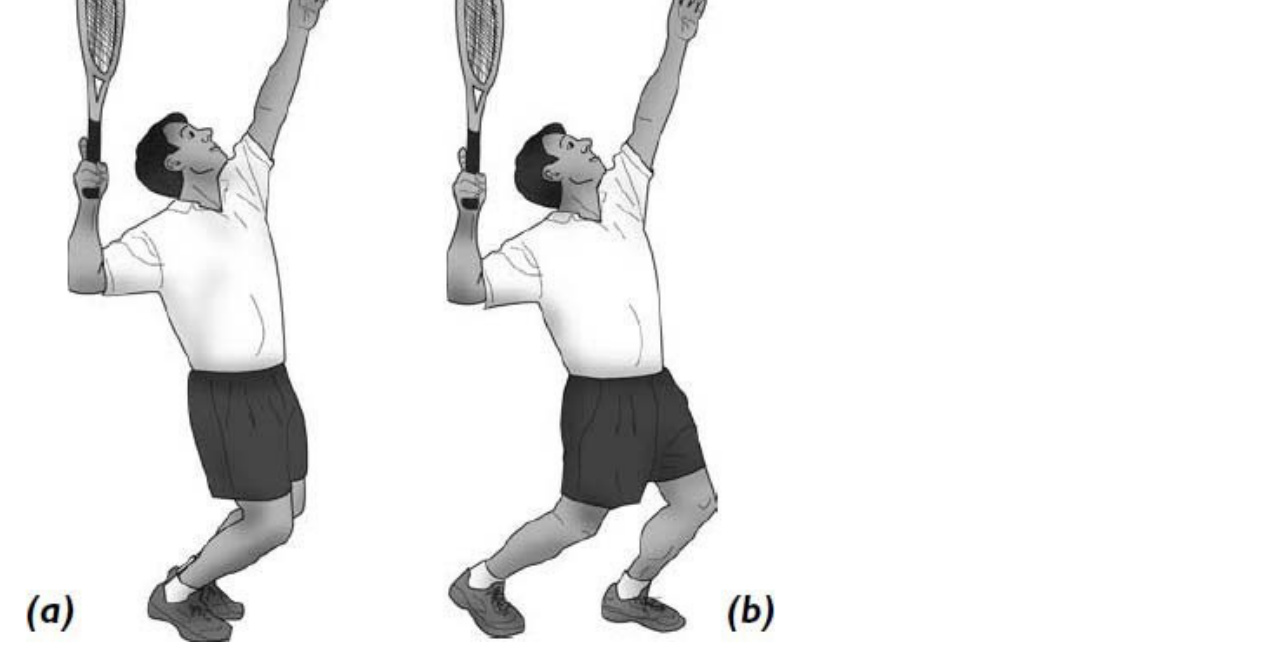
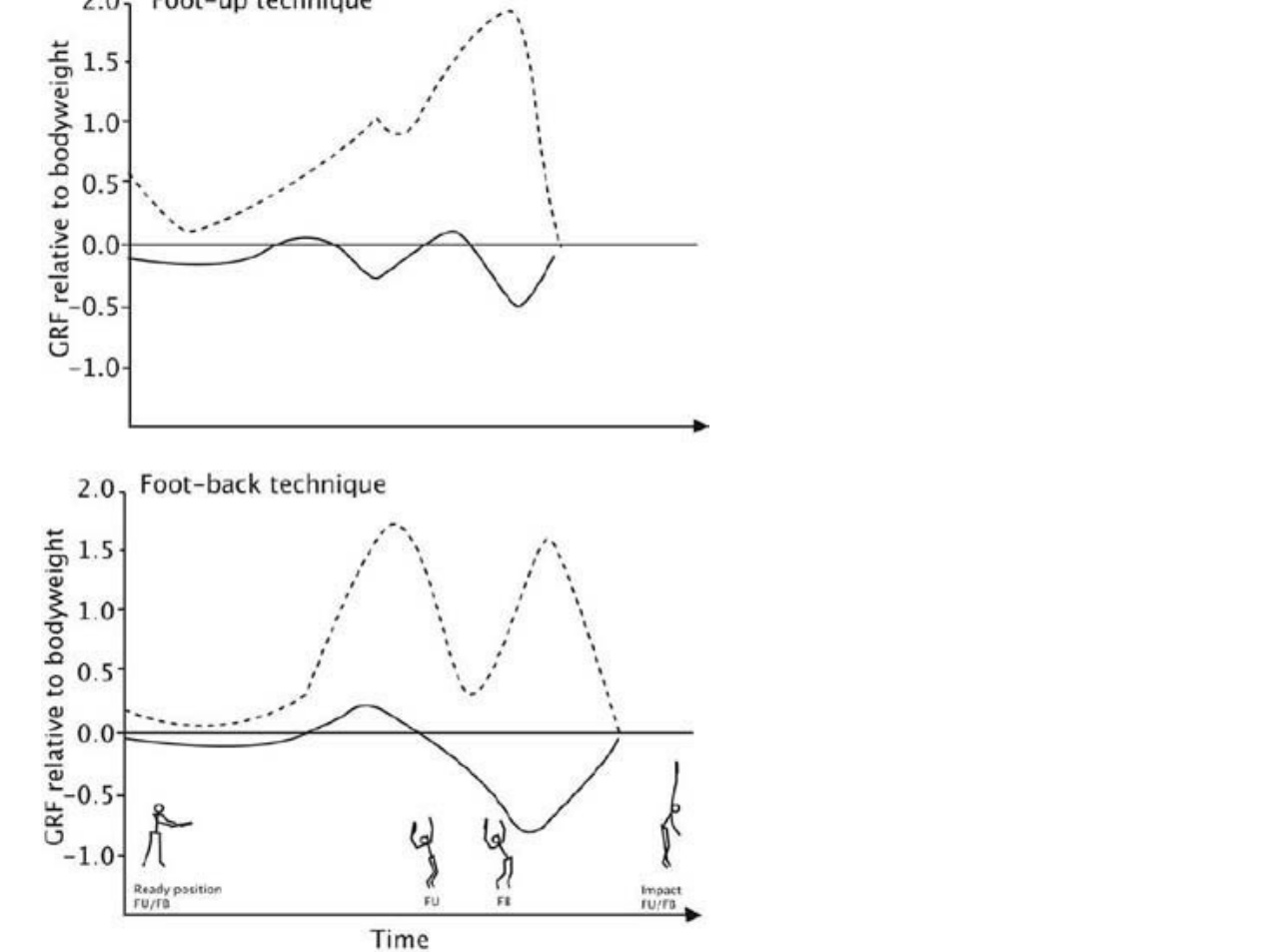
In short, the start of every stroke is a wave event, not a muscular push. The ground reaction force creates a compression wave, the compression wave turns into a twisting wave at the pelvis, the twisting wave turns into a sliding wave at the shoulders, and the sliding wave explodes at the racket head. Fascia is the converter, the triple joint extension is the switch, and the silence of the footsteps is the measure of effectiveness. Footwork is not about running fast, but about placing wave node correctly to direct the wave into the shot.
Wave Node – Biological Transformer Station
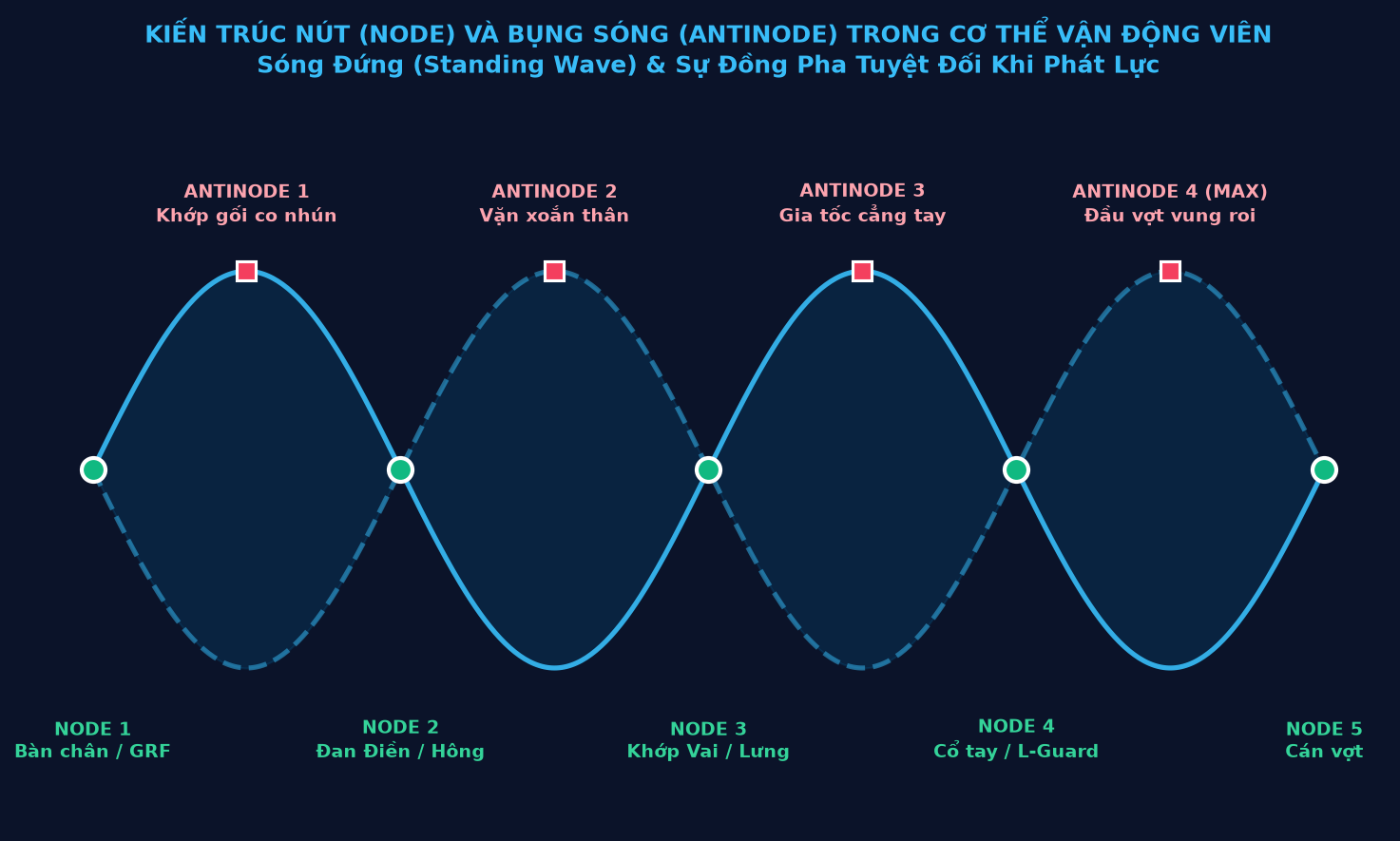
In the machine model, the joint is a hinge — a rigid point of change of direction. In the wave model, the joint is wave node (wave node): a biological transformer station where momentum is received, redirected, and transmitted without leakage. Place a joint in the right position, and the reaction force from the ball cancels itself out; Place it wrong, and the wave bounces back at you in the form of injury. When the incident wave running up from the ground meets the reflected wave bouncing from the racket head, they interfere and form a standing wave system. In that system, wave node are locations with zero vibration amplitude but subject to maximum mechanical pressure and potential energy density. In a standard swing, the natural nodes are at the foot contacting the ground, at the central axis of rotation of the pelvis (Dan Dien), at the shoulder glenoid joint and at the point of the racket handle in the palm of the hand. Maintaining these key points — not allowing the body's axis to tilt — is the art of an elite athlete.
Position wave node at each joint
Each joint has a "golden position" for waves to pass through freely. The wrist is slightly bent naturally, about 15 degrees, without straining, so that the waves from the racket do not transmit back to the forearm. The elbow is slightly bent about 150 degrees, the shoulders are relaxed, effectively preventing tennis elbow. The shoulder is the most important wave node of the arm: the ligaments, without strain, allow the ISR torsion wave to pass freely. The spine is neutral, keeping the physiological curvature, so that the GRF transmits straight without breaking. The hips are neutral when standing, flexed when hitting, and are the transition point from vertical waves to horizontal waves. Knees are slightly bent at 20 degrees, not locked, absorbing GRF from below. And the ankle has a slight natural dorsiflexion, acting as the first shock absorber in the chain. If one node misses — losing balance with the base leg or turning the hips out of control — the entire standing wave system collapses and the swing energy is instantly dissipated.
Racket handle interacts with wave node
Each grip puts the hand in a different position relative to the wave node of the forearm, so it is suitable for a different shot. Continental keeps his hands on bevel 2, closest to the nodal point — high control, used for serves, volleys and slices. Eastern Forehand at bevel 3, slightly away from the nodal point — medium speed forehand, flat and light topspin. Semi-Western at bevel 4 — strong topspin forehand, most popular in modern times. Western is at bevel 5, farthest from the node — extremely strong topspin but requires more precise timing. Choosing a grip is not a preference, but choosing how your hand communicates with wave node.
Wave node spirit sutra
The body has more than just wave node joints. The spirit meridian system is the same. The basal ganglia filters unnecessary motor signals, allowing only optimal commands to pass through — it is the "automatic filter" of the top athlete. The cerebellum regulates timing and coordination, so every shot has perfect rhythm without the need for thought. The spinal cord processes basic reflexes locally, without waiting for the brain, shortening reaction time to 50–80 milliseconds. The spinal stretch reflex even helps the body automatically react to the speed of the opponent's ball up to 80 milliseconds faster than the cerebral cortex's processing. When these three stations work in harmony, the spirit meridian wave travels cleanly from intention to movement.
When does wave node fail?
Most of the pain comes from locked wave node. Wrist pain after playing is often because you grip the racket too tightly — loosen your grip by 20%, letting your wrist drift naturally. Elbow pain when hitting the backhand is often due to shoulder stiffness - slightly bend the elbow, relax the shoulders, let the arm hang naturally. If the shoulder hurts a lot after serve, it means the ball of the head is straining — remember the right shoulder is wave node, relax it so the ISR rotates on its own. Back pain when playing overhead is often because the spine is not neutral — keep it naturally straight, don't arch too much. All errors have the same root: gong means stiffness, stiffness means the wave bounces.
Wave Antinode & Fajin Release
If wave node is a stationary point, then wave antinode (antinode) is the exact opposite point: where the oscillation amplitude reaches its maximum. In a tennis shot, the ultimate goal is that at the moment the racket touches the ball, the racket head must be in wave antinode state - where the explosive energy is strongest. To understand this double button–wave antinode pair is to understand why the same input force produces completely different shots. Wave antinode is typically located at the knee when flexing and loading, at the oblique muscle when twisting, and especially at the top of the racket head when it is released in a fan-shaped trajectory. An elite athlete is one who maintains the nodal points while allowing the wave antinodes to oscillate freely at extreme speeds.
Standing wave in stroke
Standing waves appear when two waves in opposite directions, with the same frequency, meet and resonate (resonance). During the stroke, there are two such waves. Longitudinal waves originate from ground reaction force, running along the spine. Transverse waves are generated from the rotation of the hips and shoulders. When these two waves meet with precise timing in the shoulder and arm areas, they create a standing wave. At wave antinode — the head of the racket — the resonance amplitude is much larger than the sum of the two amplitudes combined. That's why Federer's 130 km/h forehand with his arms seems so effortless: he doesn't hit with his hands, he lets two waves resonate at the tip of the racket.
Mechanism Fajin Release
Fajin is a concept in Chinese martial arts that describes the release of extremely fast and powerful energy. The physics behind it is simple: if the longitudinal wave has amplitude A1 and the transverse wave has amplitude A2, at perfect resonance the total amplitude is A1 + A2; but in nonlinear systems of the body, reality often reaches greater than that. Analysis using accelerometers and electromyography (EMG) shows that the sequences of a top Tai Chi master and an elite tennis player (like Roger Federer with his smooth forehand) have amazing similarities, including four stages. The first is the accumulation phase: lowering the center of gravity, bringing the body into a deep state, the entire external muscle mass relaxes so that gravity stretches the internal fascia fascia bands like a bow. Next is the wave genesis phase: the hind foot suddenly kicks the ground without flexing the thigh, ground reaction force creates a compression wave that propagates vertically up the pelvis. The third stage is torsional modulation: the pelvis rotates open, transmitting the impulse into the thoracolumbar fascia intersection, the energy is accelerated by the shoulder-hip separation angle. Finally, there is release & wave termination: the shear wave spreads along the relaxed arm and explodes at the contact surface. The entire energy release cycle occurs in less than 25–30 milliseconds — faster than any consciousness can keep up.
Passive whip effect
This is one of the most difficult to accept but most important ideas of modern tennis: the arms do not create force. The arm is just a whip. When you swing the whip, the hand holding the whip moves slowly but the tip of the whip reaches supersonic speed. During the stroke, the torso creates the wave, and the arms passively let the wave "whip" the racket head. A locked wrist at impact (classical forehand) blocks this effect; Relax your wrist and whip naturally at the point of contact (modern style), to release the power. That's the difference between a shot reaching 80–90 km/h and a shot exceeding 130 km/h with the same effort.
The event ends the wave at the point of contact with the ball
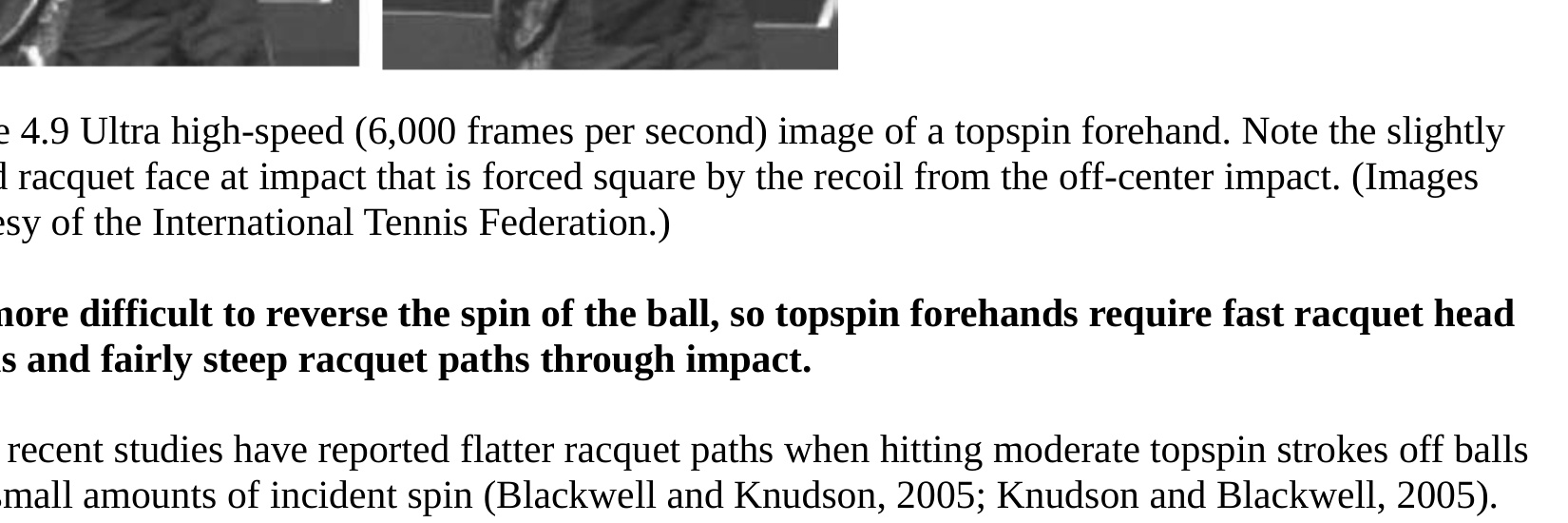
The time it takes for the ball to hit the racket net only lasts 3.5 to 4.5 milliseconds — an extremely short amount of time that no spirit command from the brain can intervene. The strike is purely a wave termination event. At the moment of contact, the peak of the mechanical sliding wave must reach the center of the racket face (sweet spot), coinciding with the moment the ball reaches maximum compression on the strings. When this phase synchronization occurs, the momentum transfer efficiency is at its maximum: nearly 90% of the accumulated momentum is transformed into the velocity and spin rate (rpm — RPM) of the ball; The backlash against the body is eliminated, the athlete feels that the racket surface is "as smooth as gliding through butter", without any twitching in the wrist or elbow; and excess energy is smoothly dissipated along the spiral curve of the 8th loop, absolutely protecting the rotator cuff joint capsule.
Three masters under the lens of wave mechanics
If viewed through the lens of wave transmission, the three best players of this generation appear as different wave shapes. Roger Federer is a master of standing waves, keeping the head and neck axis absolutely motionless at the point of contact, using a straight arm mechanism with long wave amplitude and extreme wrist relaxation to create a feeling of weightlessness. Carlos Alcaraz possesses a super-fast explosive compression wave, accumulating extremely deep ground force from an extended leg position, taking full advantage of ground reaction force and the elasticity of the front diagonal band to rise from deep defensive positions on the field. Jannik Sinner is the ultimate in controlled phase slippage: the slim body acts as a narrow low-impedance waveguide, the energy flows through the arms like a soft whip, bringing the average ball speed to the highest level in the world. Same physics, three waves, and in all of them, wave antinode explodes at the tip of the racket in that exact 4 millisecond window.
X-Factor & Potential Energy Window 40–80ms
The X-Factor is the angle difference between the hips and shoulders at the moment of the stroke — or, in the language of wave mechanics, the hip-shoulder separation angle. Think of it as a bow: the hips and shoulders rotate in opposite directions, and the tension between them accumulates elastic potential energy in the fascia oblique muscle (Anterior Oblique Sling, AOS). Good athletes do not rotate their hips and shoulders at the same time; they "charge" energy into the fascia network, then relax so it shoots out.
Yellow window 40–80 msec
X-Factor's strength lies in timing. After the foot hits the ground, the right shoulder "lags" behind the hip exactly the same distance — and the golden window to keep that delay is 40 to 80 milliseconds. During that interval, the AOS is stretched to its maximum, accumulating potential energy. If the shoulders rotate at the same time as the hips, the X-Factor disappears, all potential energy evaporates. If the shoulders lag too long, the chain breaks, and the force of the fracture is at the hips. The 40–80ms window is when the bow is most stretched before the arrow flies.
Wave collapse and controlled phase slip
The more sophisticated mechanism behind X-Factor is wave collapse and controlled phase delay. Instead of all parts moving at the same time, each body segment lags the previous segment by about 15–25 milliseconds, creating an exponential resonance effect. Pelvic anterior rotation (phase 0 msec); The chest and thoracolumbar fascia begin to rotate 20 ms later; the upper arm and elbow are pulled more than 40 milliseconds late; forearm and wrist tilt backward (loading phase) delayed by more than 60 milliseconds; and the soaring racket head makes contact with the ball 80–85 milliseconds later. When the larger segment (hip, torso) suddenly slows down the rotation speed, all the momentum does not disappear but is compressed and transmitted instantly to the smaller, lighter segment (arm, forearm, racket). This is the secret that helps players with slim bodies like Jannik Sinner create tremendous ball speed without needing protective muscles.
Nonlinear elastic force
The interesting thing about fascia is its nonlinearity: the more properly stretched, the more the rebound force exceeds expectations. Top athletes use AOS like a spring — they put energy into fascia the muscle, not contract it. When the spring releases, it gives back more than what was tied to it. That's why in the same movement, this person's ball runs 90 km/h, the other person 130 km/h: it's not that one side is stronger, but the other side accumulates and releases elastic potential energy better.
"At the same time" error and how to fix it
The most common mistake in movers is to rotate the hips and shoulders at the same time — a seemingly "powerful" reflex that completely suppresses the X-Factor and eliminates controlled phase slip. Fix it by slowing down: step on your feet, let your hips go first, feel the other shoulder behind you, then release. In the right forehand, the sequence goes like this — the left foot kicks the ground pushing the GRF up to the left; left hip pushes forward, stretching AOS from left hip to right shoulder; right hip rotates, further stretching the AOS from right hip to left shoulder; right shoulder is fired by elastic AOS, activating ISR; and the waves propagate out to the racket head. X-Factor is the bow, 40–80ms is the golden window, wave collapse is the 15–25ms delay between segments, elite loads into fascia rather than muscle contraction, and rotating at the same time is self-destructing.
Sling Systems
If the X-Factor is a stretched spring, then the sling systems — long diagonal bands of muscle-fascia are the highways that guide waves throughout the body. X-Factor stores energy, but it is these circuits that are the path through which that energy flows, from the ground to the head of the racket. There are four main circuits, and to understand them is to understand why a blow can be "light yet heavy".
Four main circuit systems
The Anterior Oblique Sling (AOS) connects one hip to the other shoulder through the core of the torso. It is most important for every swing, because it stores elastic potential energy when the hips and shoulders are out of phase. The Posterior Oblique Sling (POS) consists of the latissimus dorsi and the opposite gluteal muscles, which are responsible for stabilizing the shot and protecting the spine in the finishing phase. The Deep Longitudinal Sling (DLS) runs along the spine, transmitting ground reaction force to the non-dominant arm. And the Lumbo-Pelvic Sling (LS) system keeps the hip foundation solid so the wave has a fulcrum to explode.
How they activate in one shot
Watch the sequence: on the backstroke, POS stores energy through back twist. Entering the transition phase, the AOS is stretched through the core, creating huge elastic potential energy. When swinging the racket, DLS transmits ground reaction force to the non-dominant arm, while LS keeps the hips stable as a foundation for the explosive wave. In the following phase, AOS and POS combine, returning energy and protecting the spine. The four systems do not work independently; they are an orchestra, and the stroke is the symphony.
Dan Dien — central transformer station
Between the circulatory systems is Dan Dien, the area deep below the navel, where the body's core compresses the waves before releasing Fajin. It cannot be ignored: all longitudinal waves from the feet up pass through here, are condensed and then shot out. Doing the wrong thing — only working the superficial muscles, contracting individual blocks — will bypass the Dan Dien, and the wave will lose strength right at the core. Tennis is a three-dimensional movement, not on a flat surface, so training must reflect that multi-dimensionality.
Five core things: the four circuit systems are wave-guided highways; AOS is most important for rotation; POS protects the spine; Dan Dien is an indispensable transformer station; and because tennis is 3D, training must be multi-plane.
ISR – Hidden Engine
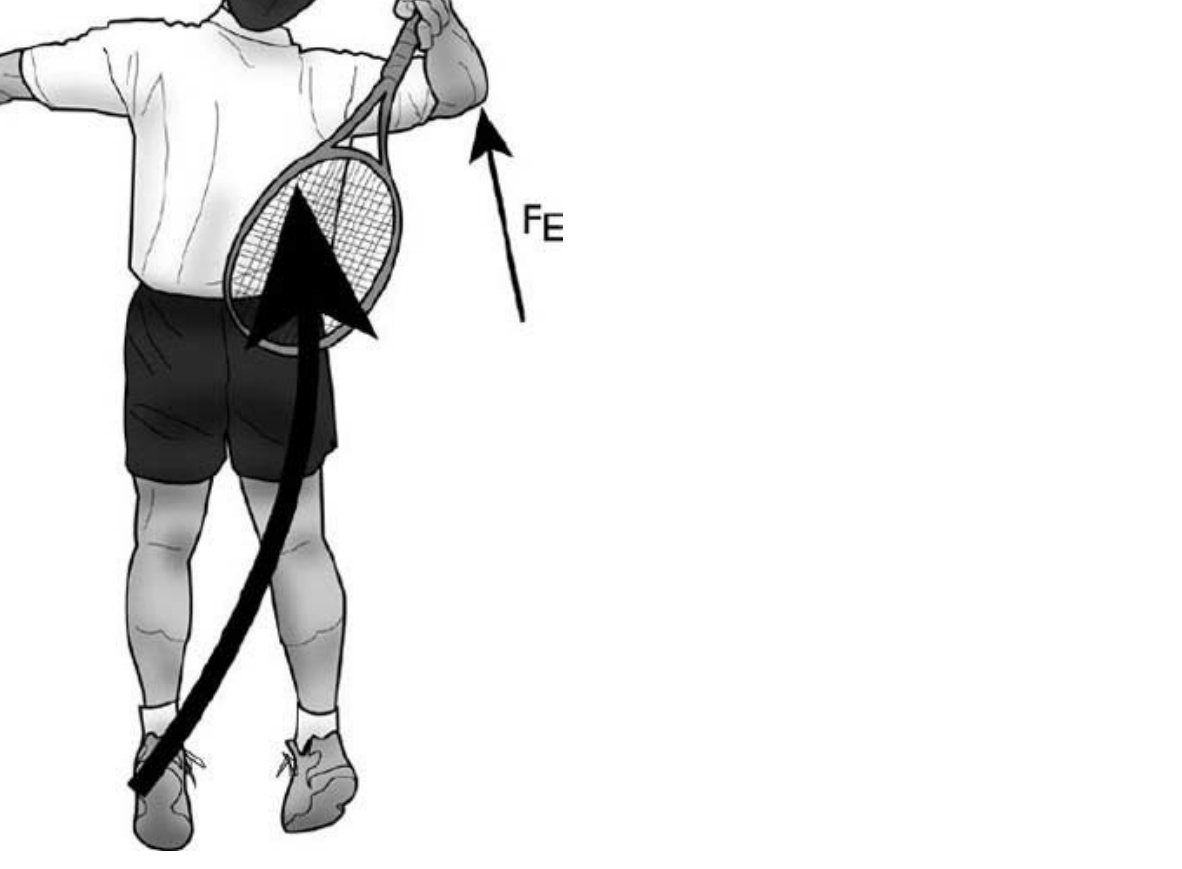
Internal Shoulder Rotation (ISR) is the strongest "hidden engine" of the wave propagation chain. It contributes up to 40% of the power of serve and 30% of the forehand, although most players don't even know it exists. At serve, top athletes reach ISR angular velocities of 2500–3000 degrees/second; in forehand, 1800–2500 degrees/sec. In just 80–120 ms, ISR alone generates 15–25 m/s (54–90 km/h) of racket head speed.
Torsional waves from ISR
The magic of ISR is that it transfers energy in a spiral path, not a straight line. From the shoulder, the torsional wave runs through the upper arm, down the forearm, and out the head of the racket. When ISR is active, the racket head draws a circular arc from bottom to top — the true nature of wave antinode. But ISR is incredibly fast, faster than any human consciousness can keep up with. It should be an automatic reflex, not a conscious command.
ISR is blocked by arm brace
Because ISR is so fast, just a little bit of stiffness is enough to stop it. Right shoulder is wave node — relax the trochanter to allow the ISR to rotate freely; to be stiff is to close the door. The right arm is relaxed: the racket grip is tight, the forearm muscles contract, and the torsional wave bounces back into the shoulder instead of out the racket head. That's why many people who serve the ball have shoulder pain — it's not that they're weak, it's that they tense up and lose hidden engine. Let go, let the shoulders do wave node, and the ISR naturally does its job.
Three things to remember: ISR contributes 40% of serve power; it is faster than human perception so it must be a reflex; and it is blocked as soon as you tense your arms or shoulders.
Quiet Eye & Spirit Classics
Waves don't just run through the body; it runs in my head. Quiet Eye (QE) is the skill of keeping the eyes fixed on a target point for a specified period of time, before taking action. It is not an innate talent, but a technique that can be practiced. A quiet eye leads to a quiet brain, and a quiet brain creates a wave node spirit meridian for the entire system.
The enemy's name is VOR
The destructive mechanism is called the vestibulo-ocular reflex (VOR). When your head moves while swinging the racket, the VOR activates for 5–10 milliseconds, the brain immediately orders the shoulder and neck muscles to "decelerate" to stabilize the head, the shoulder muscles tense slightly, and you lose 10–20% of force. The solution is surprisingly simple: keep your head still. The head does not move, the VOR does not activate, the ISR is free, and the force is maximal. That's why top athletes appear to "stand still" at the neck even when their whole body explodes.
Focus outside, not inside
Research consistently shows that external focus is better than internal focus. Don't think about your wrists, don't think about elbow flexion, don't think about controlling every muscle — let "feel" guide the movement, and focus completely on the ball. Specifically: seeing the line of the ball until it touches the racket; When losing control under pressure, find a spot on the ball and don't look away; If you hit your wrist too early, you look where the ball will bounce, not the racket; and before the critical point, look at the seam of the ball — that is the mental anchor.
Center of mass and Dan Dien spirit meridians
In terms of spirit meridians, true stability originates from the center of mass (COM): an imaginary point deep in the pelvis, right in the Dan Dien region. When the COM is kept still while your head is also still, the vestibular system has no reason to activate the VOR, and the spirit meridian wave travels cleanly from intention to movement. The Meni Gate — the mid-lumbar point — acts as a pressure hinge: keeping it neutral keeps the entire fascia fascia lattice under optimal tension. That's why an elite athlete appears to "stay in the middle" even when the legs and shoulders are explosive.
The basal ganglia is what automates this process: with enough practice, it "takes over" from consciousness, freeing you from having to think. Five key points: QE is a trainable skill; static eyes generate static waves spirit; VOR is the enemy; external focus wins internal; and static COM is the foundation of it all.
Differential Learning & Fitness System Fascia
If the previous chapters were about structure, this one is about time. Fascia muscle does not change through repetition alone; it restructures through variation. That is the principle of Differential Learning (DL): continuously changing conditions gives better results than repeating the same movement thousands of times.
Slingshot effect and four principles
Fascia works like a slingshot — it shoots stronger waves when properly stretched beforehand. The four principles of the fascia (Fascial Fitness) system are: pre-stretch, elastic storage, hydration, and slow + dynamic combination. Dynamic fascia warm-up — foam rolling, oscillation, pendulum swing — wakes up the system before exercise. Plyometric elastic movements, such as pogo jumps, train fascia rebounding. Slow stretching for 90–120 seconds per area helps restructure collagen. And power swings—medicine balls, cable chops—activate AOS and POS.
Stretch-Shortening Cycle
The rebound motor of fascia is associated with a Stretch-Shortening Cycle (SSC): a muscle or band of fascia is rapidly stretched (elastic phase), then shortened shortly thereafter (explosive phase), taking advantage of the stored elastic energy. That's the mechanism that makes you jump higher when you have a small step back, and makes the racket swing stronger when your knees and hips have time to "bounce" before shooting up the wave. SSC absolutely preserves the joint: instead of using muscle strength to brake and then push, you let fascia absorb and then bounce back — the joint does not bear the impact. A good serve is a perfect contraction-extension cycle from the toes to the tip of the racket.
Refactoring time
This is the most patient part. Muscles restructure in 2–6 weeks; tendons take 3–6 months; but fascia takes six months to two years. Articular cartilage measured in years. Many people give up because they measure progress in muscle, while waves live in fascia. The standard is really simple: moving silently around the field is proof that fascia is performing well.
Ten exercises to feel the waves
To "hear" the waves instead of just hitting hard, practice ten combat exercises: (1) smooth step — strike without making a sound with your heels; (2) shoulder drop — hang the arm like a pendulum before swinging; (3) lunge without straining — lower the knee 20 degrees and then shoot up without tightening; (4) core twist — hip-anterior shoulder rotation, hold 40–80ms; (5) passive whip — swing the forearm loosely, letting the racket head swing on its own; (6) sweet spot — touching the ball to the center of the racket face, no wrists; (7) Dan Dien pushing — feeling the pressure below the navel when kicking the ground; (8) static eyes — keep gaze fixed 400–500ms in front of the ball; (9) lag segment — let the hips go first, the shoulders follow one beat; (10) recovery — after the stroke, relax completely, without straining.
Five-week lesson plan
An actual lesson plan lasts five weeks: weeks 1–2 are just getting acquainted — recognizing GRF, Tung and Dan Dien states, no pressure; weeks 3–3 focus on X-Factor and ISR through core twisting exercises; Week 4 introduces SSC and fascia system fitness (plyometric, foam roll, cable tightness); Week 5 integrates Quiet Eye and differential learning — each time changing the angle, speed and contact point so that fascia learns through variation, not through mechanical repetition.
Three things to remember: variation wins repetition; fascia is a spring sling that shoots more powerfully when loaded correctly; and six months to two years is realistic for fascia — patience is key.
Essence – Qi – Spirit
Over the past ten chapters, we have gone from a mechanical view to a wave view. The tension-integrated network shows that the body is a network, not a machine. Ground reaction force is the battery. Wave node and wave antinode are the substation and boom point. X-Factor, circuitry and ISR are transmission lines. Quiet Eye and differential learning are how we train that system. The final chapter brings it all together under a three-layer framework of ancient martial arts: Jing, Qi, Spirit — body, energy, and mind.
Body, energy, mind in one beat
Jing is the body — network fascia, joints wave node, and Tung relaxation. Chi is energy — waves run from the ground to the racket, Fajin explodes, breath and internal pressure keep the net taut. Spirit is the mind — Quiet Eye, basal ganglia automatism, and the Flow state where you are no longer thinking. The three layers are inseparable: a tense body (damaged Tinh) will leak energy (weak Qi), and a hasty mind (Spirit chaos) will activate the VOR, eroding the force. On the contrary, when all three are smooth, the stroke becomes gentle but powerful, the ball goes fast and spins without you having to exert any effort.
A reasonable route
This journey has no destination, only practice. The first month, you get acquainted with the tension-integrated network, the Tung state, and the basic ground reaction force sensation — now just awareness. From the fourth to ninth month, you develop X-Factor, ISR and vascular system through fascia system fitness, the body begins to "load" and "release" naturally. From October to eighteen, differential learning and Quiet Eye are integrated, and fascia is quietly refactoring. From nineteen to twenty-four, you fine-tune Spirit — Flow status and pressure management. And after two years, the system organizes itself: athletes no longer "hit" the ball, they become a working wave field.
This book is not a process you do once. Every day on the field is an opportunity to listen to the wave in the body, fine-tune it, and allow it to explode a little more freely. There is no destination on this journey — only constant practice, endless curiosity, and the joy of feeling the energy flow through you. Don't strain. Let go, and let the waves do the rest.